Nike SWOT Analysis (2026): Strengths, Weaknesses, Opportunities & Threats
A Nike SWOT analysis for 2026 shows a $46.4 billion brand with growing wholesale and North America sales, but falling digital, Converse…
Practical marketing guides on careers, skills and tools

A SWOT analysis lists a company’s strengths, weaknesses, opportunities and threats in a simple 2×2 grid. Below you will find the definition, a free template, the steps to run one and SWOT analysis examples of top brands, built from their annual reports.
A SWOT analysis is a strategic planning technique that lists a company's internal strengths and weaknesses and the external opportunities and threats it faces, in a 2x2 grid. Managers use it to see where they stand before choosing a strategy. For example, a brand with strong pricing power (a strength) can use it to enter a growing market (an opportunity).
The framework is older than most people think. Research by Puyt, Lie and Wilderom (2023) traces it to Robert F. Stewart's "SOFT" approach, published in 1965, which was relabeled Strengths, Weaknesses, Opportunities and Threats in 1967.
The template below is free to use. Copy the four questions in each box into your own document, slide or whiteboard, then fill in each box with evidence.
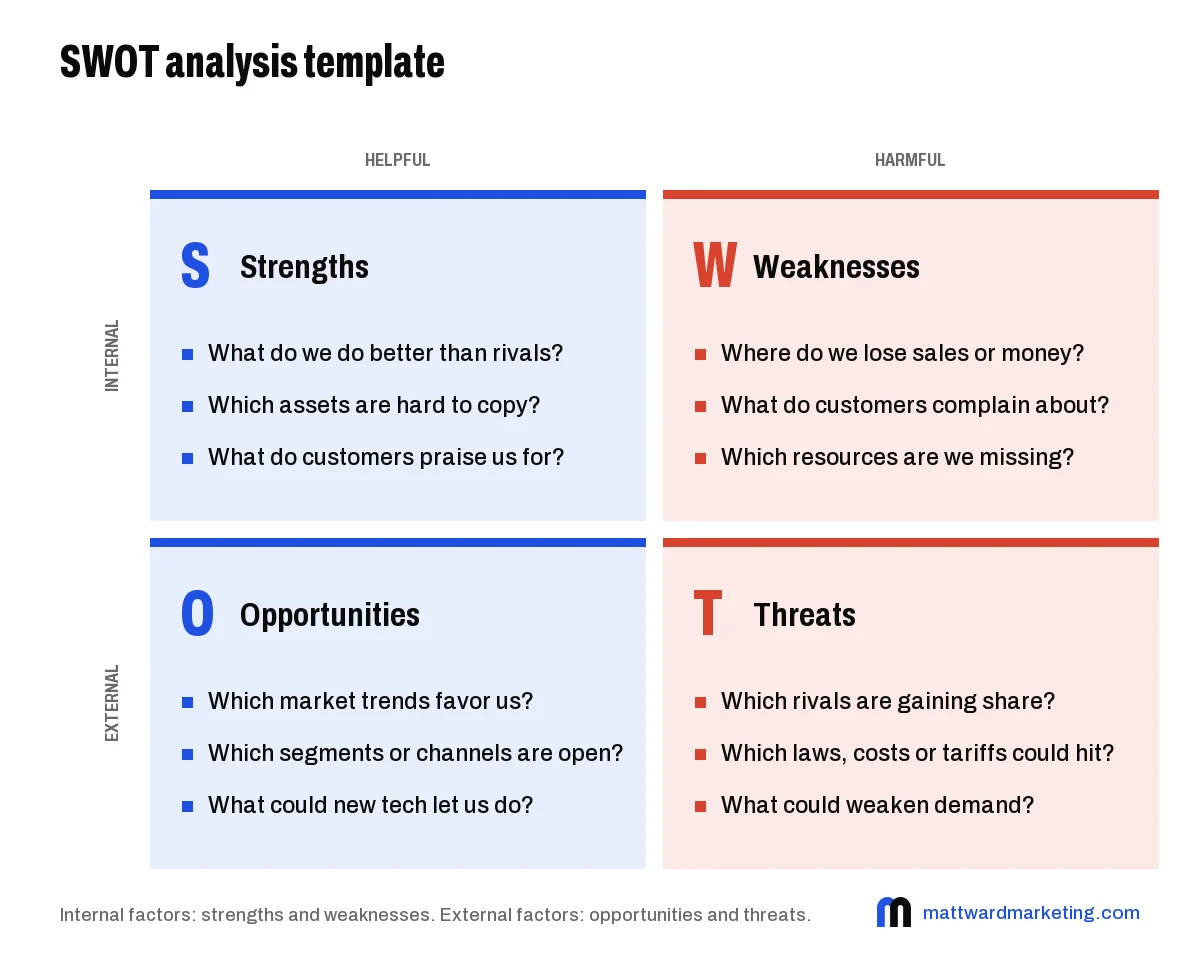
| Component | Internal or external | Question to ask | Example: Nike, fiscal 2026 |
|---|---|---|---|
| Strengths | Internal, helpful | What do we do better than our rivals? | $46.4 billion in revenue |
| Weaknesses | Internal, harmful | Where are we losing sales or money? | Greater China revenue down 11% |
| Opportunities | External, helpful | Which trends or channels could we use? | Wholesale revenue up 6% |
| Threats | External, harmful | What could hurt us that we do not control? | Revenue expected to fall in fiscal 2027 |
You can create a SWOT analysis alone in an hour, but it works best as a short session with people who see the business from different perspectives.
Write down the decision the SWOT should support, such as entering a new market or launching a product. A SWOT without a clear objective turns into a list of generic ideas.
Pull recent numbers first: sales, margins, customer reviews, market share and competitor moves. Then invite participants from sales, product, finance and customer service, so the brainstorming covers more than one point of view.
List strengths and weaknesses that the company controls, such as its brand, costs, team, technology or distribution. Keep only points you can back with a fact.
List opportunities and threats in the market, such as customer trends, new regulation, tariffs, technology shifts and competitors. A useful test: if the factor would exist even if your company disappeared, it is external.
Rank the points in each box by impact, then match them. The TOWS matrix (Weihrich, 1982) pairs strengths with opportunities, weaknesses with threats and so on, to produce concrete strategies.
The main benefit of SWOT is speed: it gives a team a shared picture of the business with no special data or software. Its limit is that it does not rank or weigh anything on its own, so it works best next to tools like a PESTLE analysis for the external picture or a competitive analysis for rivals.
Each example below applies the same framework to a real company, with figures taken from its annual report and quarterly results. Start with the Nike SWOT analysis, which shows a $46.4 billion brand with growing wholesale sales but falling revenue in Greater China.
A Nike SWOT analysis for 2026 shows a $46.4 billion brand with growing wholesale and North America sales, but falling digital, Converse…
A SWOT analysis is a planning tool that lists a company's strengths, weaknesses, opportunities and threats in a 2x2 grid. Strengths and weaknesses are internal; opportunities and threats are external.
Define the decision you need to make, gather recent data, list the internal factors (strengths and weaknesses) and the external factors (opportunities and threats), then rank them and turn the most important ones into actions.
A good example uses real figures. In our Nike SWOT analysis, a strength is $46.4 billion in fiscal 2026 revenue, a weakness is an 11% drop in Greater China, an opportunity is 6% wholesale growth and a threat is an expected revenue decline in fiscal 2027.
PESTLE only looks outside the company, at political, economic, social, technological, legal and environmental factors. SWOT covers both sides: internal strengths and weaknesses, and external opportunities and threats. Many teams run a PESTLE first and use it to fill the opportunities and threats boxes.