
It seems we can’t find what you’re looking for. Perhaps searching can help.
Key takeaways
- A competitive analysis compares your company with its rivals on the same criteria, so you can see where you win and where you lose.
- Look at two kinds of rivals: direct competitors that sell the same product and indirect competitors that meet the same need another way.
- A comparison table with weighted scores turns opinions into a ranking.
- The most reliable competitor data is public: annual reports, the "Competition" section of a 10-K and the rivals' own pricing pages.
What is a competitive analysis?
A competitive analysis is a structured comparison of a company with its main competitors, covering customers, products, pricing, channels, positioning, strengths and weaknesses. It shows where the focal firm has an advantage and where rivals can attack. For example, a coffee chain can compare its prices and store count with those of two rivals before raising prices.
The idea that competition goes beyond your closest rival comes from Michael E. Porter. In "How Competitive Forces Shape Strategy" (Harvard Business Review, March-April 1979), he showed that competition depends on more than direct rivals. His book "Competitive Strategy: Techniques for Analyzing Industries and Competitors" (Free Press, 1980) turned that view into a method. In a 2008 update in the same journal, he names the other four forces: customers, suppliers, potential entrants and substitute products.
Competitive analysis template: the comparison grid
Put your company in the first column, then add two direct rivals and one indirect rival. Fill each cell with a fact and a score from 1 to 5.
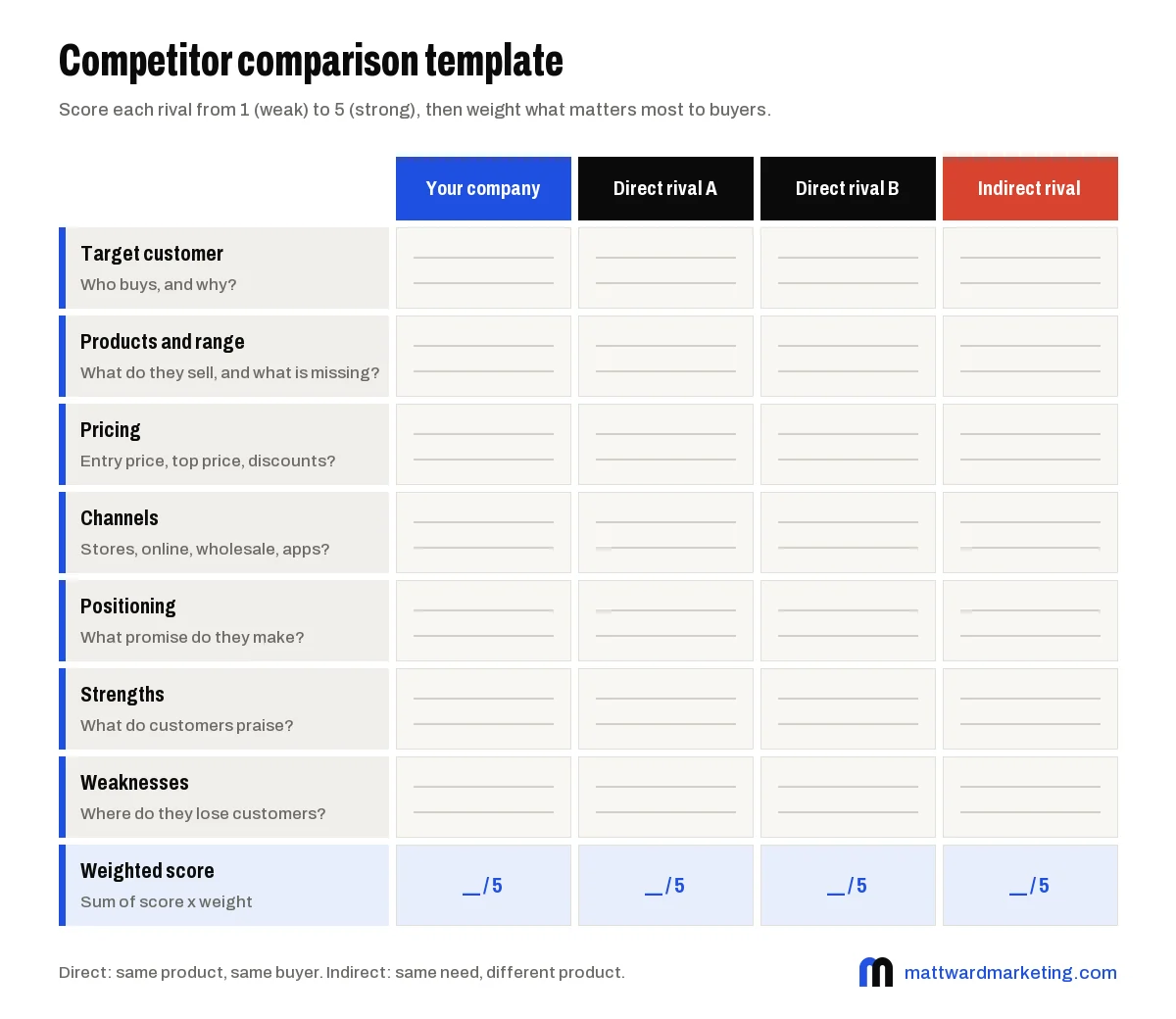
| Criterion | Question to ask | Where to find the answer |
|---|---|---|
| Target customer | Who buys, and why? | Annual report, investor presentations, reviews |
| Products and range | What do they sell, and what is missing? | Official site, catalog, 10-K business section |
| Pricing | What are the entry and top prices? | The competitor's own pricing page or online store |
| Channels | Where do customers buy? | Annual report, store locator, app listings |
| Positioning | What promise do they make? | Homepage, ads, mission statement |
| Strengths and weaknesses | Why do customers choose or leave them? | Reviews, results, market share data |
When you add a weight to each criterion and multiply it by the score, the grid becomes a competitive profile matrix (CPM). The weights reflect what matters most to buyers and add up to 1.
How to do a competitive analysis, step by step
1. Define the market and the decision
Write down the market and the decision the analysis should support, such as a price change or a launch.
2. List direct and indirect competitors
A direct competitor sells the same kind of product to the same buyer. An indirect competitor meets the same need with a different product. Group rivals with similar strategies into a strategic group, and pick the three to five that matter most.
3. Collect data from reliable sources
Start with each rival's annual report or 10-K. The SEC's guide to reading a 10-K says the Business section may describe the competition a company faces. Then check pricing pages and reviews, and date every figure.
4. Score and weight each criterion
Score every competitor on each row, then apply the weights. Benchmarking against the leader shows which gaps are worth closing.
5. Predict reactions and decide
Note each rival's objectives and its likely reaction if you move first, such as a price cut. Turn the biggest gaps into two or three actions for your marketing strategy.
Common mistakes in a competitive analysis
- Ignoring substitutes and indirect competitors.
- Using undated figures or numbers with no source.
- Scoring criteria that customers do not care about.
- Running the analysis once and never updating it.
Competitive analysis vs. SWOT and PESTEL
A competitive analysis looks at rivals. A SWOT analysis sums up your own strengths and weaknesses plus external opportunities and threats, and a PESTEL analysis covers the wider environment.
Competitive analysis examples from top brands
The brand examples listed below apply this method to real companies, using their own filings. Coming soon: Nike, Starbucks, Chipotle, Home Depot and Caterpillar. Start with the company's own list: Nike's 10-K for fiscal 2026, filed July 15, 2026, names 11 competitors in its Competition section, including adidas, Puma, On and lululemon.
Competitive analysis FAQ
What is competitive analysis?
Competitive analysis is the process of comparing your company with its direct and indirect competitors on the criteria buyers care about, such as price, products, channels and positioning. The goal is to find where you can win and where rivals are stronger.
How do you do a competitive analysis?
Define the decision, list direct and indirect competitors, collect dated data from annual reports and official sites, score each rival in a comparison table, then predict their reactions and choose your actions.
What is a good example of competitive analysis?
A good example starts from official sources. Nike's 10-K for fiscal 2026 names 11 rivals, including adidas, Puma, On and lululemon. A competitive analysis of Nike would compare it with those companies using figures from their own annual reports.
Sources
- Porter, M. E. (1979). "How Competitive Forces Shape Strategy." Harvard Business Review, March-April 1979 (HBR).
- Porter, M. E. (1980). Competitive Strategy: Techniques for Analyzing Industries and Competitors. New York: Free Press (CiNii library record).
- Porter, M. E. (2008). "The Five Competitive Forces That Shape Strategy." Harvard Business Review, January 2008 (HBR).
- U.S. Securities and Exchange Commission. "How to Read a 10-K," modified July 1, 2011 (SEC).
- NIKE, Inc. Form 10-K for fiscal 2026, filed July 15, 2026, used in the Nike example (SEC EDGAR).