
It seems we can’t find what you’re looking for. Perhaps searching can help.
Key takeaways
- A marketing strategy explains who you sell to, why they should choose you and how you will reach them.
- Strategy sets the direction, a marketing plan schedules the work, and tactics are the single actions, such as an email or a video.
- Every effective marketing strategy covers six components: target market, positioning, marketing mix, channels, budget and KPIs.
- Good strategies are measurable: each goal has a number, a deadline and a tool to track it.
- The marketing strategy examples on this page come from each company's own annual report and official announcements.
What is a marketing strategy?
A marketing strategy is a company's long-term plan for reaching its target audience and turning it into customers. It defines the market, the unique value proposition (UVP) and the channels. A marketing plan then turns it into a calendar, and tactics like paid advertising, SEO or email carry it out.
Two classic frameworks still shape most strategies. Igor Ansoff's growth matrix comes from "Strategies for Diversification," published in the Harvard Business Review in 1957. It outlines four ways to grow: market penetration, market development, product development and diversification.
The second is segmentation, targeting and positioning (STP). In Philip Kotler's textbook "Marketing Management," the part titled "Developing a Winning Marketing Strategy" covers exactly these steps: identifying market segments and target customers, then crafting a value proposition and positioning.
Marketing strategy template: the six components
Use the canvas below as a free one-page template. Fill in each box with evidence from market research, not guesses. For the offer, price and place, see our marketing mix guide.
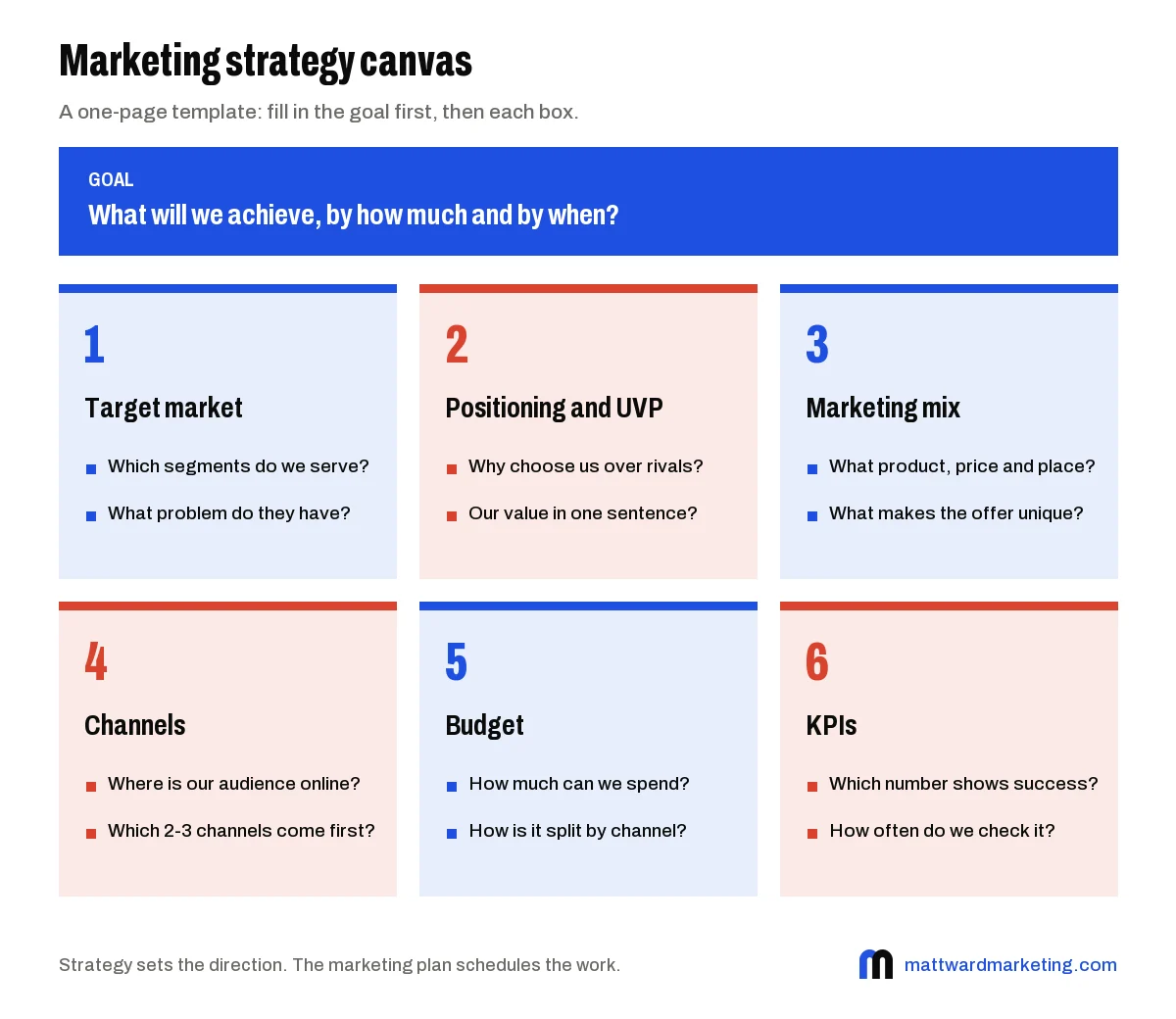
| Component | Question to answer | Example: Google, 2025 |
|---|---|---|
| Target market | Who are we selling to? | Consumers, advertisers, businesses that buy Google Cloud, and creators |
| Positioning and UVP | Why should they choose us? | Helpfulness: "an even more helpful Google for everyone" |
| Marketing mix | What do we offer, at what price and where? | Free products like Search, paid for by advertisers |
| Channels | Where will the audience hear from us? | Its own products, Super Bowl ads, its blog and events |
| Budget | How much will we spend, and where? | $28.7 billion on sales and marketing, 7% of revenue |
| KPIs | How will we measure success? | Paid clicks, reported every quarter |
How to build a marketing strategy, step by step
A first version fits on one page. Add the detail later, in the marketing plan.
1. Set a measurable goal
Start with one business goal, such as "grow online sales 20% in 12 months." Ansoff's matrix helps you choose the route: sell more to current customers, enter new markets or launch new products.
2. Research the market and the audience
Use surveys, focus groups, customer interviews and your analytics tools. Map the marketing landscape: what competitors offer, charge and say.
3. Choose your target and positioning
Split the market into segments, pick the ones you can serve best, and write your unique value in one sentence.
4. Pick channels and allocate resources
Choose the few channels where your audience already spends time, such as search, social media marketing, email or videos. Allocate resources to them in proportion to the expected return.
5. Measure and adjust
Assign one KPI to each goal and review it monthly. Drop the tactics that do not move the number and move their budget to the ones that do.
Common mistakes in a marketing strategy
- Confusing tactics with strategy, such as "post daily" with no goal behind it.
- Targeting "everyone," which makes the message too generic to persuade anyone.
- Setting goals you cannot measure, like "raise awareness."
- Spreading a small budget across too many channels.
- Writing the strategy once and never reviewing it.
Types of marketing strategies
Most strategies mix a few types: content marketing and SEO, paid advertising, social media marketing, email marketing, brand marketing and partnerships. A brand marketing strategy focuses on how people perceive the company. Performance strategies focus on direct sales you can track.
Marketing strategy examples from top brands
Each guide listed below applies the same six components to one company, using figures from its annual report and its own announcements. Breakdowns of Amazon, Google, Coca-Cola, Nike and Starbucks are on the way. To check a brand's position before you plan, start with a SWOT analysis and a competitive analysis.
Marketing strategy FAQ
What is marketing strategy?
Marketing strategy is the long-term plan a company uses to reach its target audience, stand out from competitors and win customers. It covers six components: target market, positioning, marketing mix, channels, budget and KPIs.
How do you do a marketing strategy?
Set a measurable goal, research your market and audience, choose a target segment and a clear unique value proposition, pick the channels where that audience spends time, then measure the results every month and move budget to what works.
What is a good example of marketing strategy?
Google is a strong example. Its free products, such as Search and YouTube, work as its main channel, and its brand promise is helpfulness. Alphabet spent $28.7 billion on sales and marketing in 2025, just 7% of its $402.8 billion revenue.
What is the difference between a marketing strategy and a marketing plan?
The strategy decides who you target, what you promise and which channels you use. The marketing plan turns those choices into tasks, owners, dates and budgets for a set period, usually a year or a quarter.
Sources
- Ansoff, H. I. (1957). "Strategies for Diversification." Harvard Business Review, 35(5), 113-124, as cited in Zupic, I., Čater, T., Caputo, A. and Uršič, D. (2025). "Mapping the Influence of Ansoff's Corporate Strategy." Strategic Change (Goldsmiths, University of London).
- Kotler, P., Keller, K. L. and Chernev, A. (2022). Marketing Management, 16th edition. Pearson (Pearson).
- Alphabet Inc. Form 10-K for the fiscal year ended December 31, 2025, filed February 5, 2026, used in the Google example (SEC EDGAR).
- Alphabet Announces Third Quarter 2026 Results, Exhibit 99.1 to Form 8-K, October 28, 2026 (SEC EDGAR).