
It seems we can’t find what you’re looking for. Perhaps searching can help.
Key takeaways
- A PESTEL analysis scans the macro environment of a business through six factors: political, economic, social, technological, environmental and legal.
- PESTEL, PESTLE and PEST are the same family. PESTLE only changes the letter order, and PEST is the older four-factor version without environmental and legal.
- Every factor is external: the company cannot control it, only prepare for it.
- A useful PESTEL names a fact, a date or a source for each point and ends with a short list of priorities.
- Many teams run a PESTEL first and use it to fill the opportunities and threats of a SWOT analysis.
What is a PESTEL analysis?
A PESTEL analysis is a framework that lists the political, economic, social, technological, environmental and legal factors in a company's external environment. Managers use it before entering a market or setting a strategy. For example, a retailer planning to open in a new country would check its elections, inflation, age distribution, internet use, climate rules and labor law.
The idea of scanning the outside world is older than the acronym. Harvard Business School professor Francis J. Aguilar studied how companies gather information about external events and trends for strategic planning in his book Scanning the Business Environment (Macmillan, 1967). Later researchers widely used his classification of environmental factors.
PESTEL analysis template: the six factors
Copy the questions in each box into a document, slide or whiteboard, then answer each one with evidence for the market you are studying.
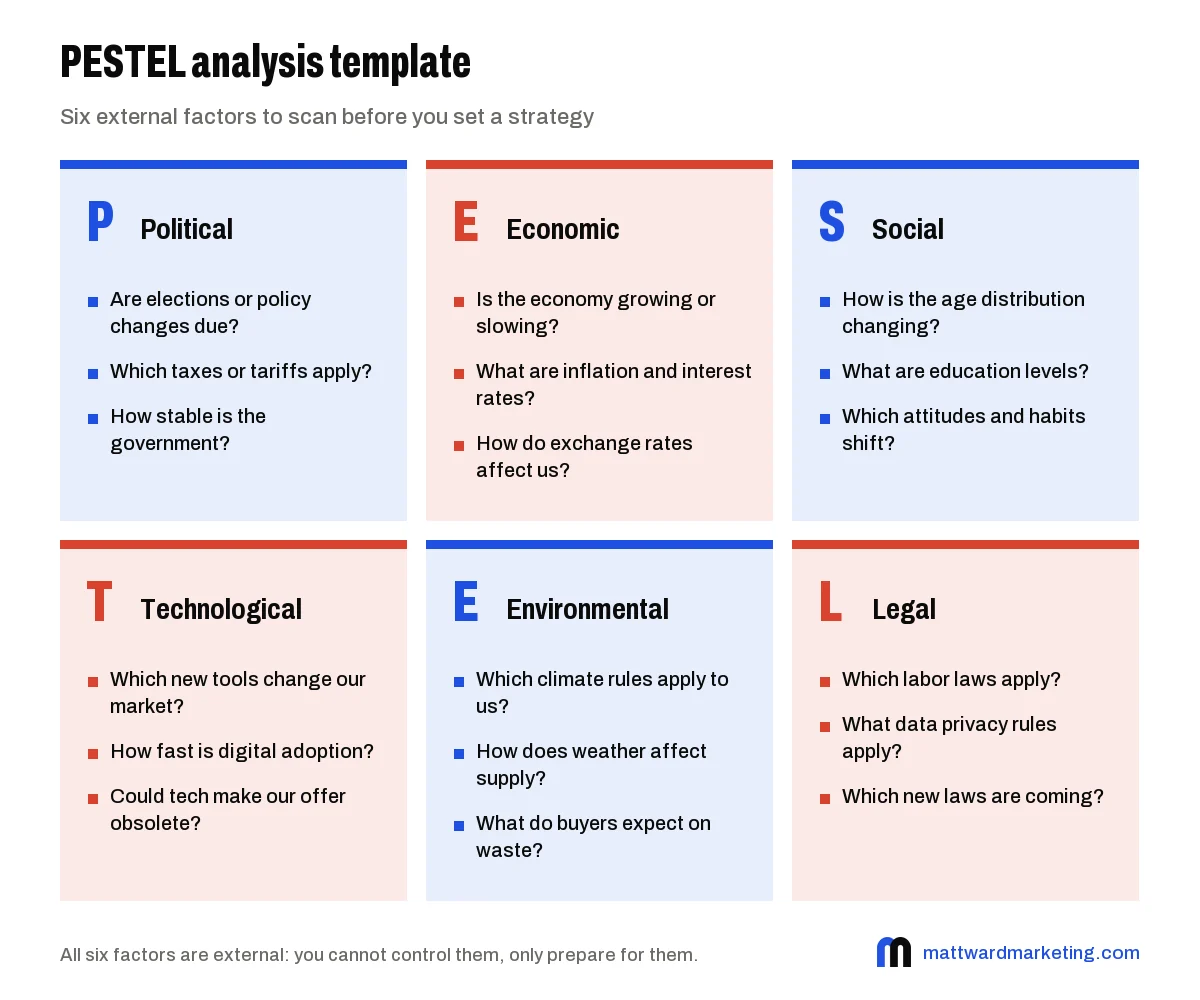
| Factor | What it covers | Question to ask |
|---|---|---|
| Political | Government stability, elections, trade policy, tariffs, taxes | How could government decisions change our costs or access? |
| Economic | Growth, inflation, interest rates, exchange rates, unemployment | Will customers have more or less money to spend? |
| Social | Age distribution, education level, attitudes, lifestyles, culture | How are our customers and their habits changing? |
| Technological | Automation, AI, digital adoption, research and development | Which technology could make our offer cheaper or obsolete? |
| Environmental | Climate, weather, emissions targets, waste, resource use | Which climate or sustainability pressures affect us? |
| Legal | Employment law, consumer protection, data privacy, health and safety | Which current or coming laws apply to us? |
How to do a PESTEL analysis, step by step
A first draft takes a few hours. The research is what makes it useful, so plan time for it.
1. Set the scope
Name the company, the country or region and the time frame, such as "our US business over the next three years." A PESTEL of "the world" is too broad to act on.
2. Collect evidence for each factor
Use official statistics, central bank reports, government sites, industry studies and reliable news. Write down the source and date next to every point.
3. Fill in the six boxes
Add three to five factors per letter. If a point could fit two boxes, such as a new emissions law, put it where its effect is strongest and stay consistent.
4. Rate impact and likelihood
Score each factor from 1 to 5 for how much it would affect you and how likely it is. Highlight the factors with high scores on both.
5. Turn the findings into actions
Mark each top factor as an opportunity or a threat, decide who owns the response and set a date to review the analysis.
Common mistakes in a PESTEL analysis
- Listing internal issues, such as weak sales staff, which belong in a SWOT.
- Writing generic points like "the economy is uncertain" with no number or source.
- Covering every factor equally instead of ranking what matters most.
- Mixing countries or markets in one analysis.
- Never updating it after an election, a new law or a price shock.
PESTEL vs SWOT: which one do you need?
PESTEL looks only outside the company. A SWOT analysis covers internal strengths and weaknesses plus external opportunities and threats. Use both: the PESTEL feeds the external half of the SWOT.
PESTEL analysis examples from top brands
The articles below apply the same template to real countries and companies, with dated sources. Coming soon: PESTLE analyses of the USA, China, India and Canada, and a Nestlé PESTEL analysis.
PESTEL analysis FAQ
What is a PESTEL analysis?
A PESTEL analysis is a tool for studying the external environment of a business. It groups outside factors into six areas: political, economic, social, technological, environmental and legal.
How do you do a PESTEL analysis?
Set the market and time frame, collect dated evidence for each of the six factors, rate each one by impact and likelihood, then turn the highest-rated factors into opportunities, threats and actions.
What is a good example of a PESTEL analysis?
A good example studies one market and backs every point with a source. For a country, that means figures such as inflation, population by age and internet use, plus the laws and policies that affect companies there.
What is the difference between PEST, PESTLE and PESTEL?
They are variations of the same framework. PEST covers political, economic, social and technological factors. PESTLE and PESTEL add environmental and legal factors and differ only in letter order. Longer variations, such as STEEPLE and STEEPLED, add more letters, for example an ethical factor.
Sources
- Aguilar, F. J. (1967). Scanning the Business Environment. New York: Macmillan, Studies of the Modern Corporation (Open Library record).
- Harvard Business School (2013). "HBS Professor Frank Aguilar Dies at 80" (hbs.edu).
- Kourteli, L. (2005). "Scanning the business external environment for information: evidence from Greece." Information Research, 11(1), paper 242 (informationr.net).