
It seems we can’t find what you’re looking for. Perhaps searching can help.
Key takeaways
- By definition, the marketing mix is the set of decisions a business makes to sell a product: what to offer, what to charge, where to sell it and how to promote it.
- The best-known version is the 4 Ps of marketing: product, price, place and promotion.
- Service businesses often use the extended 7 Ps, which add people, process and physical evidence.
- The four elements only work when they fit together and fit the same target customer.
What is a marketing mix?
The marketing mix is the combination of choices a company makes about its product, price, place and promotion to reach a target market. Marketers use it to turn a strategy into concrete decisions. For example, a premium brand pairs a high price with selective stores and image-led advertising.
Harvard Business School professor Neil H. Borden popularized the term in his article "The Concept of the Marketing Mix," published in the Journal of Advertising Research in 1964. His list had a dozen elements, including product planning, pricing, branding, personal selling and packaging.
E. Jerome McCarthy reduced the idea to four elements, the 4 Ps, in his 1960 textbook Basic Marketing: A Managerial Approach. In 1981, Bernard Booms and Mary Jo Bitner proposed three more Ps for service firms.
Marketing mix template: the 4 Ps and the 7 Ps
The template below is free to use. Answer each guiding question for one product and one target customer.
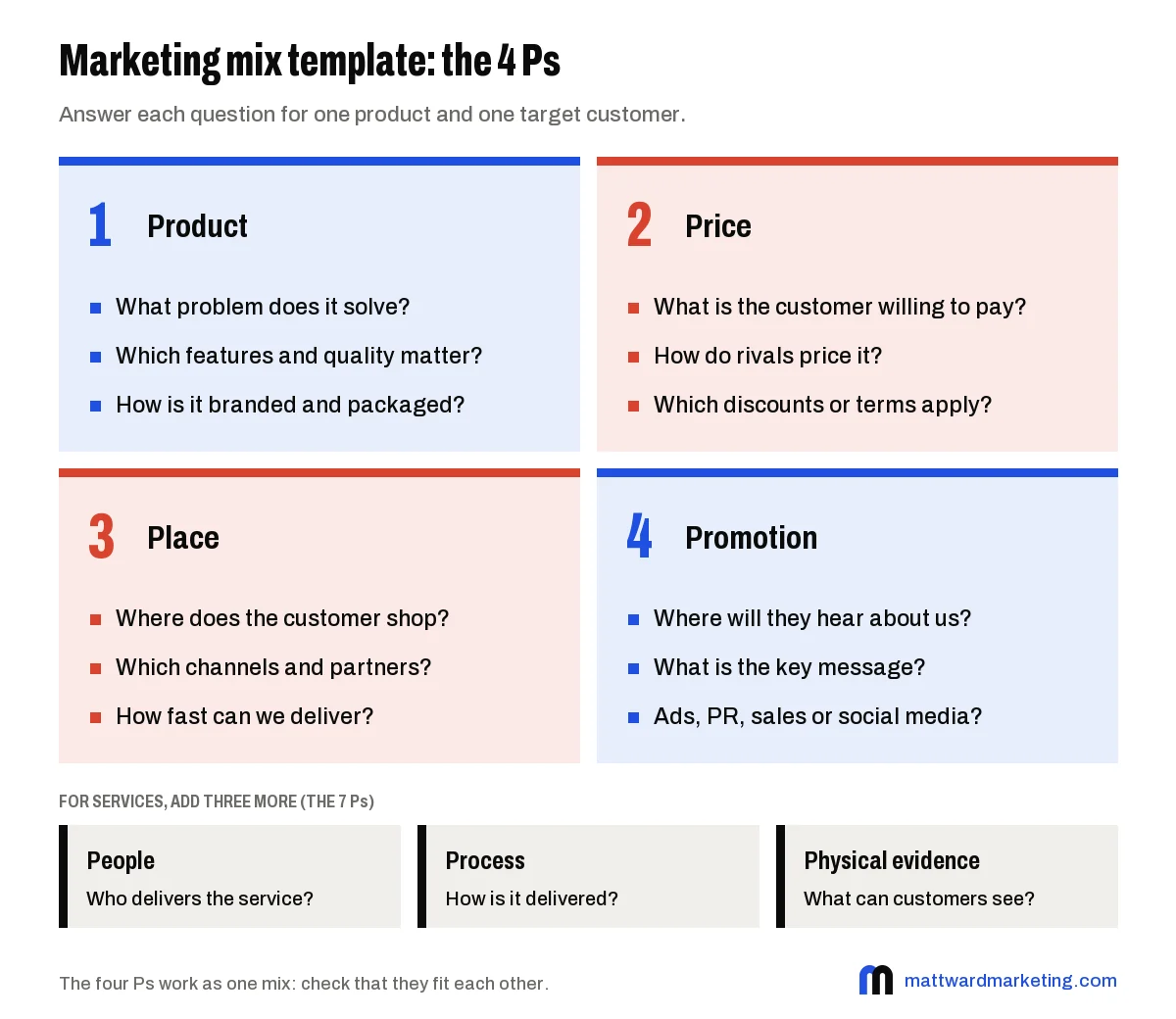
| Element | Question to ask | Typical decisions |
|---|---|---|
| Product | What problem does our product offering solve? | Features, quality, design, branding, packaging, product mix |
| Price | What is the right price for this customer? | List price, discounts, payment terms, bundles |
| Place | Where does the customer expect to buy? | Own stores, retailers, online, distribution, inventory |
| Promotion | How will the customer hear about us? | Advertising, personal selling, sales promotion, PR, social media |
| People (7 Ps) | Who delivers the service? | Hiring, training, customer service |
| Process (7 Ps) | How is the service delivered? | Booking, waiting times, delivery steps |
| Physical evidence (7 Ps) | What can the customer see or touch? | Store design, website, receipts, reviews |
How to create a marketing mix, step by step
Formulate your first mix for one product and one customer, not the whole company.
1. Define the target customer
Write down who buys, what they need and what they compare you with.
2. Describe the product or service
List the features, benefits and quality level that matter to that customer. Note what makes your product service different from the alternatives.
3. Set the price
Check costs, competitor prices and perceived value. Product pricing should match the position you want: a low price signals value, a high price signals premium.
4. Choose the place
Decide which channels will put the product in the right place at the right time: your own website, retailers, marketplaces or a sales team.
5. Plan the promotion and check the fit
Pick the messages and channels that reach your customer. Then read the four Ps together as one mix. A premium price sold through discount channels sends mixed signals, so fix the weakest element first.
Common mistakes in a marketing mix
- Treating each P on its own instead of as one connected plan.
- Setting the price from costs only, without checking what customers will pay.
- Writing one mix for every customer segment.
- Ignoring people, process and physical evidence when you sell a service.
Benefits and limits of the 4 Ps
The 4 Ps are easy to remember and give a team a shared checklist for any launch. Their limit is that they look at the business from the seller's side, so pair them with a SWOT analysis or a competitive analysis before you decide.
Marketing mix examples from top brands
The brand examples listed below apply this template to real companies, element by element. Nike, Apple and PlayStation are coming next, each built from the company's own reports.
Marketing mix FAQ
What is marketing mix?
Marketing mix is the set of decisions a business makes about product, price, place and promotion to sell to a target market. Service firms often add people, process and physical evidence, for a total of seven Ps.
How do you do a marketing mix?
Define your target customer, then describe the product, set the price, choose the sales channels and plan the promotion. Finish by checking that all four elements send the same message to the same customer.
What is a good example of marketing mix?
A good example shows how the four Ps support each other. A premium sportswear brand, for instance, combines innovative products, high prices, its own stores and website, and athlete-led advertising. Our brand examples below break this down for real companies.
What are the 4 Ps and the 7 Ps of marketing?
The 4 Ps are product, price, place and promotion (McCarthy, 1960). The 7 Ps add people, process and physical evidence for services (Booms and Bitner, 1981).
Sources
- Borden, N. H. (1964). "The Concept of the Marketing Mix." Journal of Advertising Research, pp. 2-7. Reprinted in Classics II, supplement to Journal of Advertising Research, 24(4), 1984, pp. 7-12 (EBSCO Research Starters).
- McCarthy, E. J. (1960). Basic Marketing: A Managerial Approach. Homewood, IL: Richard D. Irwin (Encyclopedia.com, Everyday Finance).
- Booms, B. H. and Bitner, M. J. (1981). "Marketing strategies and organization structures for service firms." In Donnelly, J. H. and George, W. R. (eds.), Marketing of Services. Chicago: American Marketing Association, pp. 47-51 (Deakin University Library record).