Walmart SWOT Analysis (2026): Strengths, Weaknesses, Opportunities & Threats
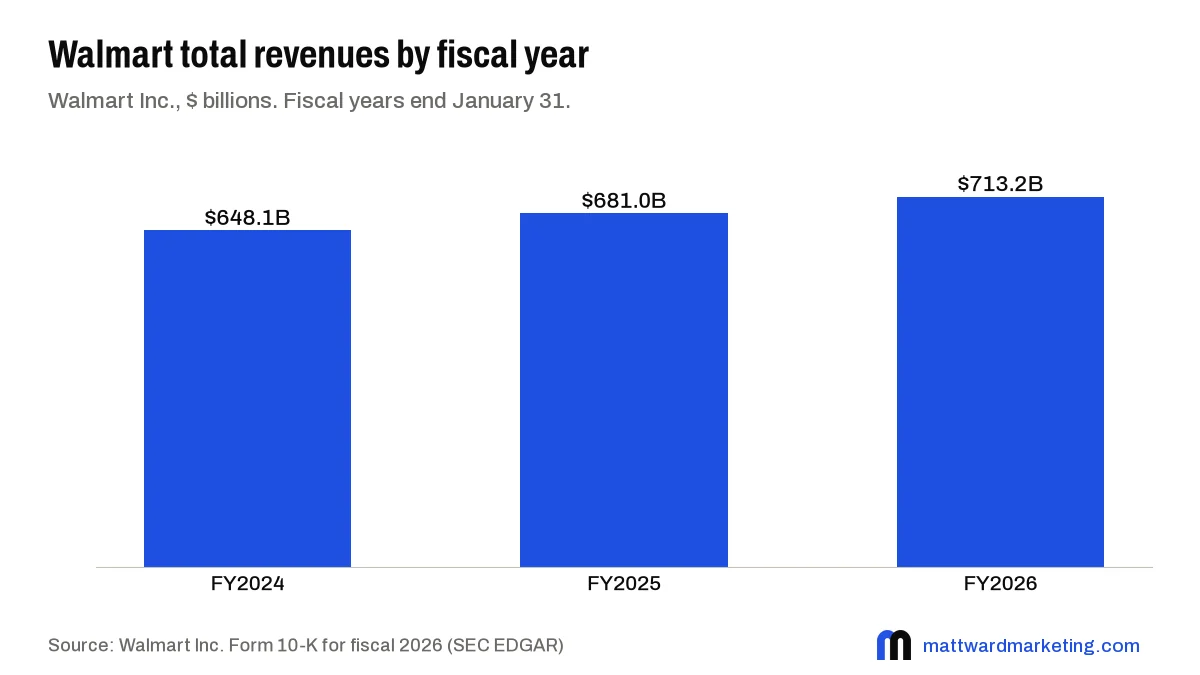
A Walmart SWOT analysis for 2026 shows a $713.2 billion retailer that keeps growing through low prices, grocery and a fast-rising eCommerce and advertising business, but earns only about 4 cents of operating income per dollar of sales. This guide sets out Walmart’s strengths, weaknesses, opportunities and threats, with every figure taken from its fiscal 2026 annual report and its latest quarterly results.
Key takeaways
- Walmart’s biggest strength is scale: total revenues reached $713.2 billion in fiscal 2026, the year ended January 31, 2026, from 10,955 stores and clubs.
- Its main weakness is a thin margin: operating income was $29.8 billion, or about 4.2% of net sales, and it grew only 1.6% in fiscal 2026.
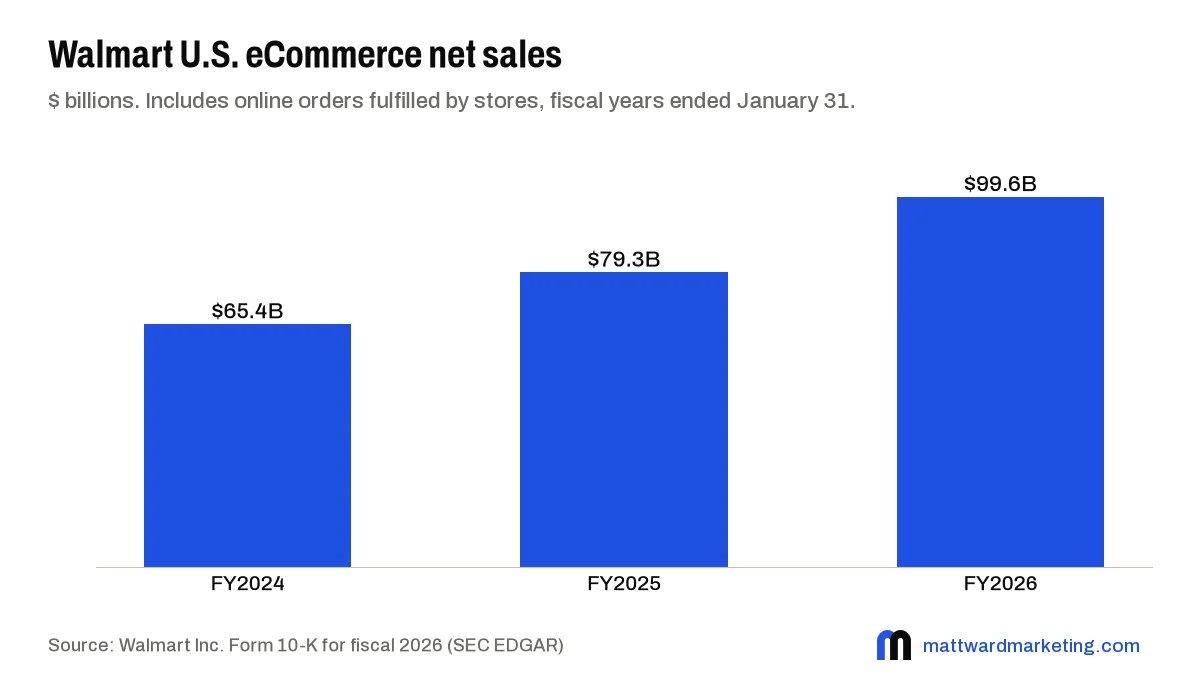
- eCommerce is now a core strength: Walmart U.S. eCommerce sales were about $99.6 billion in fiscal 2026, up from $65.4 billion two years earlier.
- The clearest opportunity is advertising, which grew 46% to nearly $6.4 billion in fiscal 2026, plus marketplace, fulfillment services and Walmart+ memberships.
- The biggest threats are tariffs and trade policy, drug price regulation, open litigation and competition from eCommerce, social commerce and AI shopping tools.
What is a SWOT analysis of Walmart?
A Walmart SWOT analysis lists the company’s internal strengths and weaknesses and the external opportunities and threats it faces. For fiscal 2026, that means a $713.2 billion omnichannel retailer with strong grocery, eCommerce and advertising growth, but a low operating margin. For example, revenue grew 4.7% while operating income grew 1.6%.
Walmart Inc. is based in Bentonville, Arkansas, and runs three segments: Walmart U.S., Walmart International and Sam’s Club U.S. It had about 2.1 million associates on January 31, 2026. John Furner became President and CEO on February 1, 2026, succeeding Doug McMillon.
| Walmart at a glance | Fiscal 2026 (year ended January 31, 2026) |
|---|---|
| Total revenues | $713.2B (up 4.7%) |
| Operating income | $29.8B (up 1.6%) |
| Net income attributable to Walmart | $21.9B (up 12.6%) |
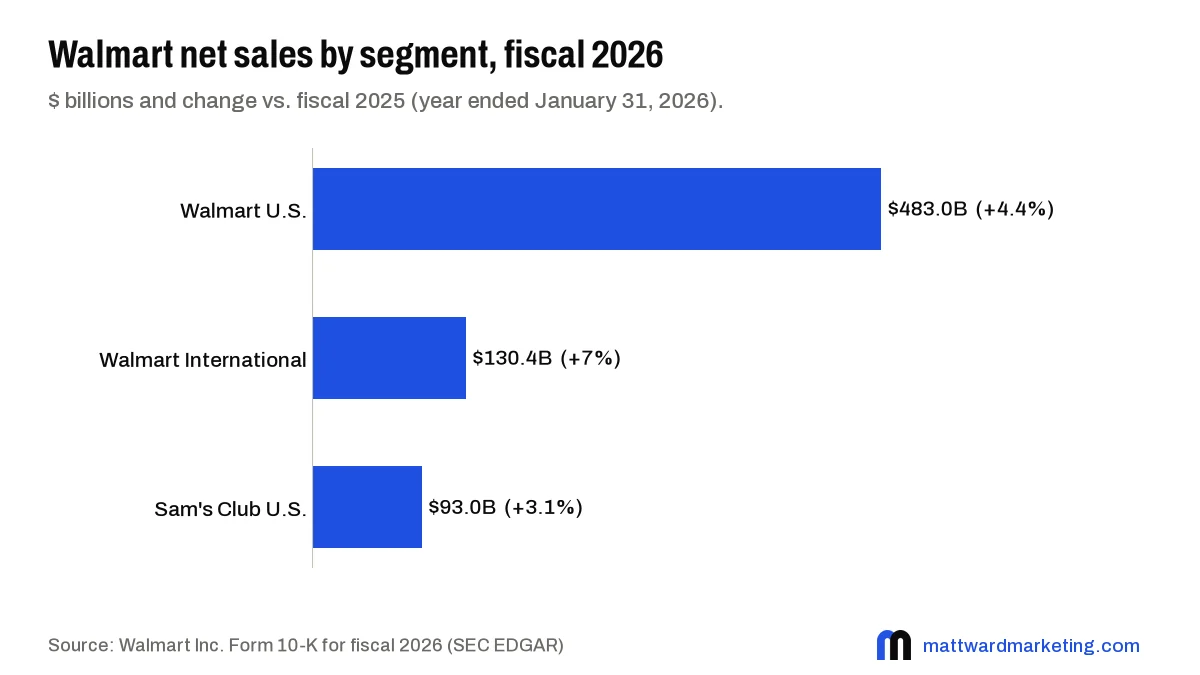
| Walmart U.S. / International / Sam’s Club U.S. net sales | $483.0B / $130.4B / $93.0B |
| Stores and clubs | 10,955 in 19 countries |
| Associates | About 2.1 million |
What are Walmart’s biggest strengths?
Walmart’s biggest strengths are scale, price leadership and an omnichannel network built on its stores. Total revenues reached $713.2 billion in fiscal 2026, and the company runs 10,955 stores and clubs. Its stores double as fulfillment hubs: customers can use pickup or delivery at over 8,400 locations worldwide.
1. Cost leadership and everyday low prices
Walmart’s leadership strategy rests on EDLP (everyday low price) and EDLC (everyday low cost). Its 10-K calls price leadership a commitment that “has been and will remain a cornerstone of our business.” Cost control funds the low prices, and the low prices bring traffic.
2. Grocery brings shoppers back every week
Grocery is Walmart’s largest category. Walmart U.S. sold $285.5 billion of grocery in fiscal 2026, about 59% of the segment’s $483.0 billion in net sales. Private brands such as Great Value, Equate, bettergoods and onn. add choice at lower price points.
3. Stores that work as an eCommerce network
Substantially all Walmart U.S. stores offer same-day pickup and delivery. Walmart U.S. eCommerce sales were about $99.6 billion in fiscal 2026, up from $79.3 billion in fiscal 2025. In the quarter ended July 31, 2026, global eCommerce sales grew another 23%.
4. Cash to keep investing
Walmart generated $41.6 billion of operating cash flow in fiscal 2026 and spent $26.6 billion on property and equipment. It also paid $7.5 billion in dividends and bought back $8.1 billion of its own shares.
What is Walmart’s main weakness?
Walmart’s main weakness is a thin profit margin. In fiscal 2026, operating income was $29.8 billion on $706.4 billion of net sales, about 4.2%. Operating income grew only 1.6%, far slower than revenue, as costs such as liability claims and a PhonePe compensation charge rose.
1. Rising costs eat into profit
Operating expenses rose to 20.9% of net sales in fiscal 2026. Walmart blamed about $0.9 billion of higher self-insured general liability claims in the U.S., a $0.7 billion PhonePe share-based compensation charge and higher depreciation.
2. Heavy dependence on the U.S. market
Walmart U.S. and Sam’s Club U.S. generated about 82% of consolidated net sales in fiscal 2026. Walmart U.S. alone made 68%. A slowdown in American spending hits the whole company.
3. International profit fell
Walmart International grew net sales 7.0% to $130.4 billion in fiscal 2026, but its operating income fell 7.2% to $5.1 billion. The PhonePe charge was booked in this segment.
4. Long-running legal exposure
Walmart still faces opioid lawsuits. As of August 21, 2026, about 118 cases against the company were pending in the federal multidistrict litigation, plus 15 other opioid-related cases in U.S. and Canadian courts.
What opportunities does Walmart have?
Walmart’s opportunities sit in higher-margin businesses built on its traffic: advertising, marketplace, fulfillment services and memberships. Its global advertising business grew 46% to nearly $6.4 billion in fiscal 2026, including VIZIO. In the quarter ended July 31, 2026, advertising grew 38% and membership fee revenue grew 17%.
1. Retail media with Walmart Connect
Walmart Connect, its U.S. ad business, grew 43% in the second quarter of fiscal 2027, excluding VIZIO. Advertising helped lift the gross profit rate, according to the company’s 10-Q.
2. Marketplace and fulfillment services
Walmart sells supply chain and fulfillment services to online marketplace sellers, plus data insights for suppliers. Marketplace was one of the main drivers of the 23% global eCommerce growth in the second quarter of fiscal 2027.
3. Walmart+ and Sam’s Club memberships
Walmart+ offers free shipping, unlimited delivery from stores and fuel discounts. Walmart says Walmart+ net member additions hit a record for a second quarter in the period ended July 31, 2026. Sam’s Club membership fee revenue grew 6% in the same quarter.
4. Faster growth abroad and AI tools
Net sales in China rose from $20.0 billion in fiscal 2025 to $24.6 billion in fiscal 2026, about 23%. Walmart also says its strategies increasingly use AI-powered tools to support customer experiences, associate productivity and operational efficiency.
What threats does Walmart face in 2026?
Walmart’s main threats are trade policy, regulation, litigation and new forms of competition. Less than one third of what it sells in the U.S. is imported, mostly from China, Vietnam, Mexico, India and Canada, so tariffs still matter. New drug price rules and shifting consumer confidence add pressure.
1. Tariffs and trade policy
Walmart received about $2.9 billion in refunds of tariffs paid under the International Emergency Economic Powers Act in the quarter ended July 31, 2026. It put much of that money into lower prices. Its 10-Q still lists tariffs and trade restrictions as a source of uncertainty.
2. Drug price regulation
New maximum fair price rules for certain prescription drugs took effect in January 2026. Walmart says pharmacy deflation from these rules cut about 125 basis points from Walmart U.S. comp sales in the second quarter of fiscal 2027.
3. New competitors and AI shopping agents
Walmart’s 10-K names social commerce platforms and “emerging agentic shopping tools and platforms” as competitors, alongside physical and eCommerce retailers. Online rivals are the clearest example; see our Amazon SWOT analysis for the other side of that fight.
4. Legal and regulatory risk in India
In India, the Competition Commission is reviewing alleged competition law violations by Flipkart subsidiaries, and the Directorate of Enforcement has issued a foreign investment notice to Flipkart. Walmart cannot estimate the possible loss from either matter.
Walmart SWOT matrix
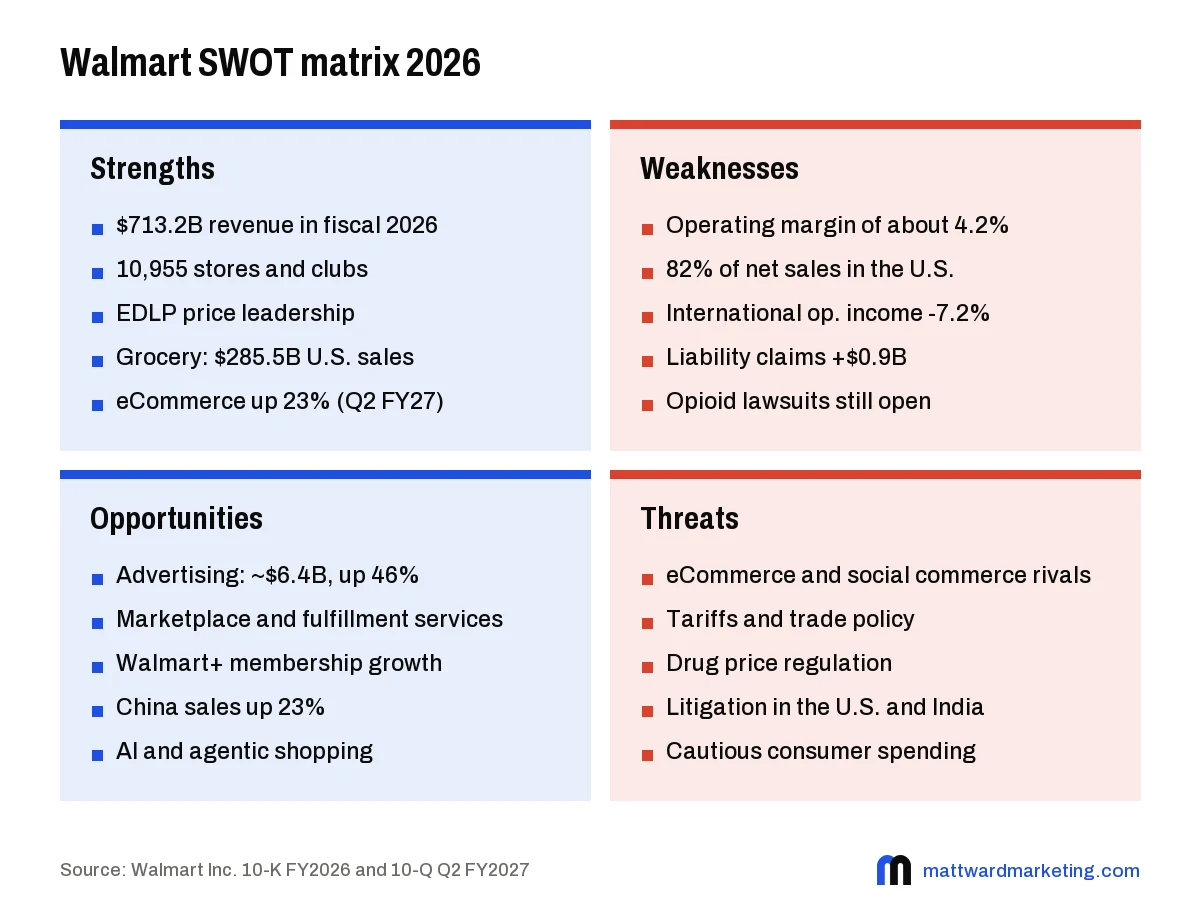
| Strengths | Weaknesses |
|---|---|
| $713.2B revenue in fiscal 2026; 10,955 stores and clubs; EDLP price leadership; $285.5B of U.S. grocery sales; eCommerce up 23% in Q2 FY2027; $41.6B operating cash flow | Operating margin of about 4.2%; operating income up only 1.6%; 82% of net sales in the U.S.; International operating income down 7.2%; $0.9B more in liability claims; open opioid lawsuits |
| Opportunities | Threats |
| Advertising near $6.4B, up 46%; Walmart Connect up 43% in Q2 FY2027; marketplace and fulfillment services; Walmart+ membership growth; China sales up 23%; AI tools | Tariffs and trade policy; maximum fair price drug rules; eCommerce, social commerce and AI shopping rivals; litigation in the U.S. and India; cautious consumer spending |
What does Walmart’s SWOT mean for marketers?
Walmart’s SWOT shows how a low-price brand can build high-margin businesses on top of its traffic. Shoppers come for groceries and low prices, and Walmart sells advertising, memberships and seller services around those visits. In fiscal 2026, advertising grew 46% while total revenue grew 4.7%.
For a small business, the lesson is to find the second product your customers’ attention can support. For brands that sell through Walmart, it means retail media and marketplace listings now sit next to shelf space in the marketing plan. You can compare more brands in our SWOT analysis library.
FAQ
What are Walmart’s biggest strengths?
Scale, low prices and stores that double as an eCommerce network. Walmart reported $713.2 billion in total revenues in fiscal 2026, runs 10,955 stores and clubs, and grew Walmart U.S. eCommerce sales to about $99.6 billion.
What is Walmart’s main weakness?
A thin profit margin. Operating income was about 4.2% of net sales in fiscal 2026 and grew only 1.6%, held back by higher liability claims, a PhonePe charge and rising depreciation.
What threats does Walmart face in 2026?
Tariffs and trade policy, new drug price rules that cut pharmacy sales, opioid and India-related litigation, and competition from eCommerce, social commerce and AI shopping tools.
Sources
- Walmart Inc. Form 10-K for the fiscal year ended January 31, 2026, filed March 13, 2026 (SEC EDGAR).
- Walmart Inc. Form 10-Q for the quarter ended July 31, 2026, filed August 28, 2026 (SEC EDGAR).
- Walmart Inc. fourth quarter and fiscal 2026 earnings release, Form 8-K Exhibit 99.1, February 19, 2026 (SEC EDGAR).
- Walmart Inc. second quarter fiscal 2027 earnings release, Form 8-K Exhibit 99.1, August 20, 2026 (SEC EDGAR).
- Walmart Inc. Form 8-K on executive appointments, January 16, 2026 (SEC EDGAR).