Amazon SWOT Analysis (2026): Strengths, Weaknesses, Opportunities & Threats
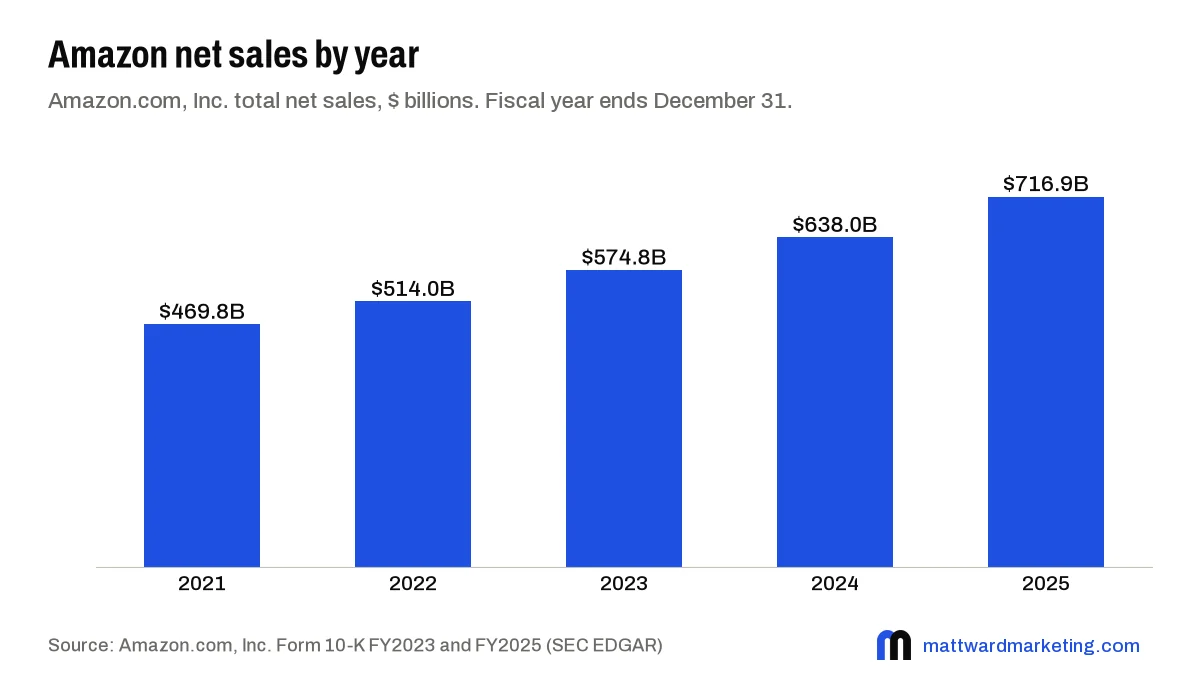
An Amazon SWOT analysis for 2026 shows a $716.9 billion company whose cloud and advertising businesses earn most of its profit, while its AI spending has pushed free cash flow below zero. This guide sets out Amazon’s strengths, weaknesses, opportunities and threats, with every figure taken from its fiscal 2025 10-K and its third-quarter 2026 filings.
Key takeaways
- Amazon’s biggest strength is scale: net sales reached $716.9 billion in 2025, up 12%, and $797.5 billion in the twelve months to September 30, 2026.
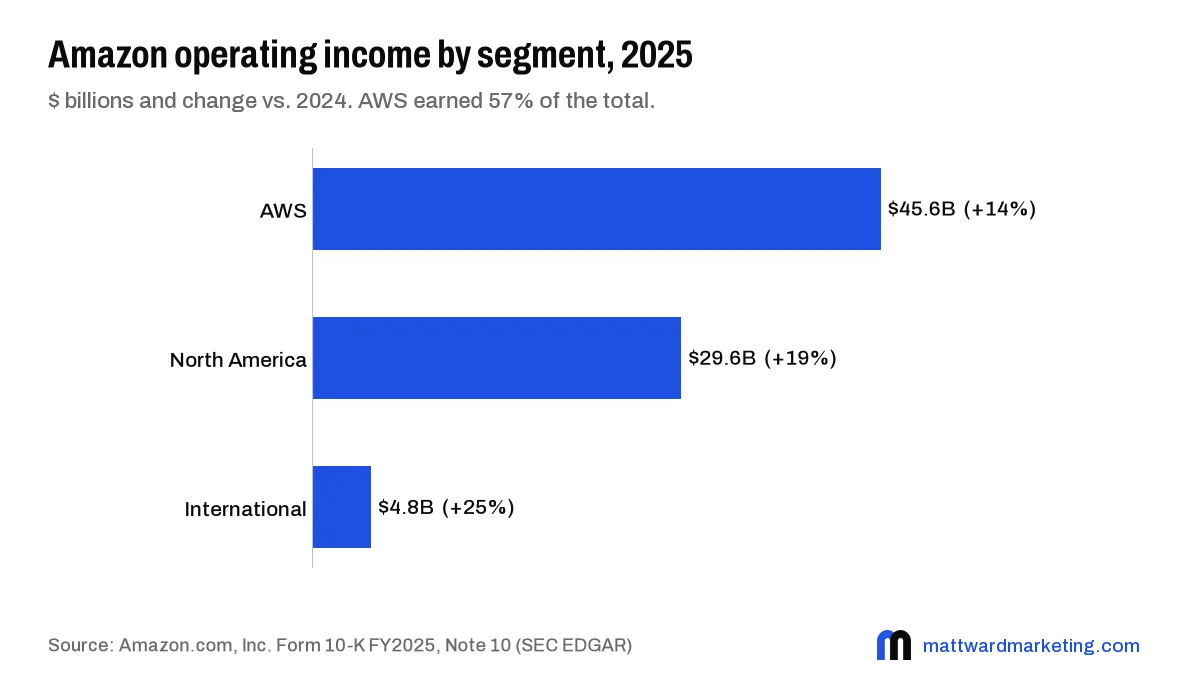
- AWS is the profit engine: it earned $45.6 billion of Amazon’s $80.0 billion operating income in 2025, and its sales grew 39% in the third quarter of 2026.
- Amazon’s main weakness is cash: AI and data center spending turned trailing twelve-month free cash flow into a $42.4 billion outflow by September 30, 2026.
- The clearest opportunities are AI services, advertising ($68.6 billion in 2025, up 22%), groceries, pharmacy and new bets like Amazon Leo and Zoox.
- The biggest threats are legal: antitrust cases in three countries, European fines, and an FTC complaint filed in August 2026 over sponsored ad auctions.
What is a SWOT analysis of Amazon?
An Amazon SWOT analysis lists the company’s internal strengths and weaknesses and the external opportunities and threats it faces. For 2026, that means a retail, cloud and advertising giant with record margins but heavy capital spending. For example, operating margin hit 13.9% in the third quarter of 2026, while free cash flow turned negative.
Amazon.com, Inc. is based in Seattle and reports three segments: North America, International and Amazon Web Services (AWS). It sells through its online stores, its marketplace for independent sellers, and physical stores, including Whole Foods Market, which it bought in 2017. It also makes consumer electronics like Kindle, Echo, Fire TV and Ring, and runs Prime, Prime Video and a large advertising business.
| Amazon at a glance | Figure |
|---|---|
| Net sales, 2025 | $716.9B (up 12%) |
| Operating income, 2025 | $80.0B |
| Net income, 2025 | $77.7B |
| Net sales, Q3 2026 | $201.9B (up 12%) |
| Operating margin, Q3 2026 | 13.9%, its highest ever |
| Employees, September 30, 2026 | About 1,638,000 |
What are Amazon’s biggest strengths?
Amazon’s biggest strengths are scale, a profitable cloud business and a fast fulfillment network. Net sales reached $716.9 billion in 2025, AWS earned $45.6 billion in operating income, and Amazon delivered more than 1.5 billion items same-day or overnight to Prime members in the third quarter of 2026.
1. AWS, the profit engine
AWS made 18% of Amazon’s net sales in 2025 but 57% of its operating income. In the third quarter of 2026, AWS sales rose 39% to $46.0 billion, with a 38.7% operating margin. CEO Andy Jassy put its annualized revenue run rate at $184 billion.
2. A marketplace that sellers rely on
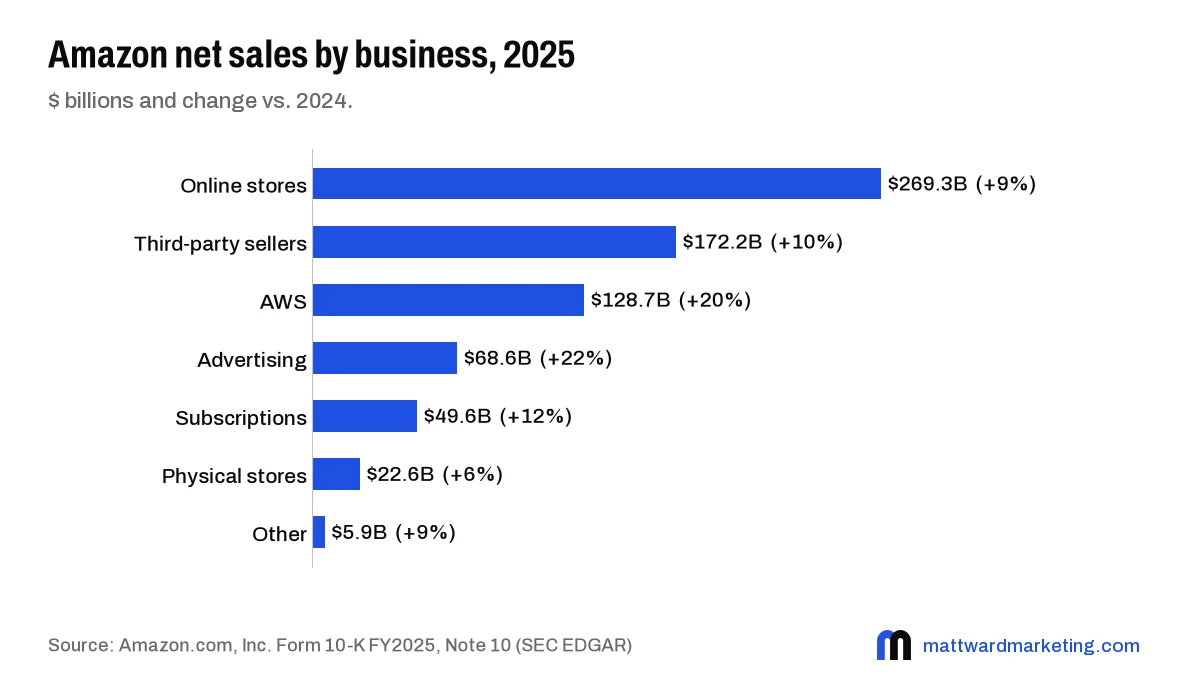
Third-party seller services brought in $172.2 billion in 2025, up 10%. Independent sellers accounted for 61% of the units sold in the third quarter of 2026. That gives Amazon broad selection without owning all the inventory.
3. A fast-growing advertising business
Advertising sales grew 22% to $68.6 billion in 2025. Ads make money from shoppers who are already on Amazon. The company expects ad revenue growth in the high teens in the fourth quarter of 2026.
4. Prime and the fulfillment network
Subscription services, led by Amazon Prime, earned $49.6 billion in 2025. Amazon’s 10-K says it views Prime and shipping offers “as effective worldwide marketing tools.” Its own fulfillment network, plus more than one million robots in its fulfillment centers, lets it promise very fast delivery.
5. Cash generation
Operating cash flow rose 29% to $168.3 billion in the twelve months to September 30, 2026. That cash funds new bets without slowing the core business.
What is Amazon’s main weakness?
Amazon’s main weakness is that its retail business earns thin margins while its AI spending absorbs all of its cash. Purchases of property and equipment reached $210.7 billion, net, in the twelve months to September 30, 2026. As a result, free cash flow was an outflow of $42.4 billion.
1. Thin retail margins
In the third quarter of 2026, the North America segment earned a 7.7% operating margin and International just 3.7%. AWS earned 38.7%. Without AWS, Amazon would be a much less profitable company.
2. Rising debt and capital spending
Long-term debt rose from $65.6 billion on December 31, 2025, to $173.1 billion on September 30, 2026. Amazon expects about $220 billion in cash capital expenditures in 2026, primarily for AI.
3. Profits that swing with AI investments
Amazon holds large stakes in Anthropic and OpenAI. In the first nine months of 2026, it recorded $62.8 billion of upward adjustments on its Anthropic stock. Net income still fell in the third quarter of 2026, to $20.7 billion, because the prior year included $9.5 billion of Anthropic gains.
4. Dependence on China-based sellers and suppliers
Amazon’s 10-K says China-based sellers make up significant portions of its seller services and advertising revenue. China-based suppliers also provide many of its components and finished goods, so trade disputes hit Amazon directly.
5. A growing carbon footprint
Amazon’s carbon footprint rose 16% in 2025, to 80.85 million metric tons of CO2e, as its operations grew. Supply chain emissions made up 76% of that footprint.
What opportunities does Amazon have?
Amazon’s opportunities sit in AI, advertising, groceries, healthcare and new businesses. AWS offers AI models through Bedrock and sells its own Trainium chips. In retail, fresh groceries and everyday essentials made up about half of all units sold in the third quarter of 2026. E-commerce was still only 17.1% of U.S. retail sales in the second quarter of 2026, according to the Census Bureau.
- AI services. Fortune 500 companies spent nearly 7x more on Bedrock year over year in the third quarter of 2026.
- Agentic shopping. Alexa for Shopping, Amazon’s AI shopping assistant, was used by more than 400 million customers in the twelve months to Q3 2026.
- Advertising. Full-Funnel Campaigns in the new Amazon Ads Agent put sponsored ads, display, video and streaming TV into one AI-run campaign.
- Grocery. Whole Foods Market had over 550 stores at the time of Amazon’s April 2026 shareholder letter, with 100 more planned in the next few years.
- Healthcare. Amazon Pharmacy customers rose more than 60% year over year in Q3 2026.
- New businesses. Amazon Leo, its low Earth orbit satellite service, signed AT&T as its first major U.S. telecom partner. Zoox robotaxis began paid rides in Las Vegas.
- International growth. International sales grew 13% in 2025, faster than North America’s 10%.
What threats does Amazon face in 2026?
Amazon’s main threats are regulators, competition and supply limits. In August 2026, the FTC and 22 state attorneys general sued Amazon over reserve prices in its sponsored ad auctions. Antitrust class actions are also pending in the U.S., Canada and the U.K. Tariffs, chip shortages and tight labor markets add pressure.
1. Antitrust and consumer protection cases
Since March 2020, private plaintiffs, state attorneys general and the FTC have filed cases alleging price fixing and monopolization. They target Amazon’s pricing policies, the Featured Offer, seller data, advertising and the structure of Prime. Amazon recorded a $2.5 billion charge in the third quarter of 2025 to settle another FTC lawsuit. It disputes all the pending allegations.
2. European fines
Luxembourg’s data protection authority fined Amazon €746 million under the GDPR in 2021, and Amazon’s appeal is ongoing. In Italy, a court cut a competition fine from €1.13 billion to €752 million in September 2025, and Amazon has appealed again.
3. Intense competition
Amazon’s 10-K lists ten groups of competitors. They range from physical and online retailers to search engines, social networks, AI assistants, cloud providers, grocers and healthcare companies. Rivals like Walmart in retail and Microsoft and Google in cloud compete on price, speed and AI.
4. Tariffs, chips and labor
Amazon warns that tariff and trade policy changes can raise prices and cut demand. It relies on a limited group of suppliers for AI chips, and its Q4 2026 guidance flags supply volatility for memory chips. It also faces union organizing efforts and constrained labor markets.
Amazon SWOT matrix
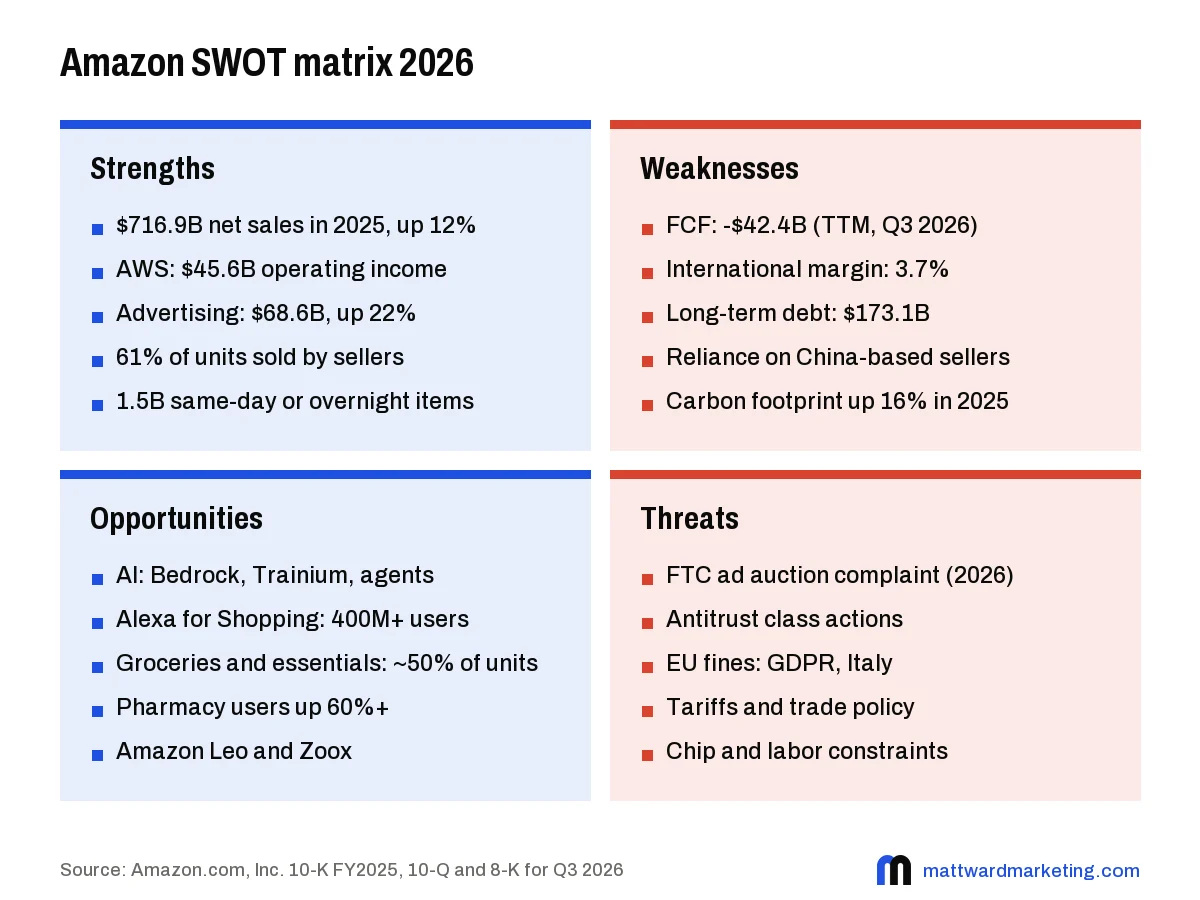
| Strengths | Weaknesses |
|---|---|
| $716.9B net sales in 2025; AWS operating income $45.6B; advertising $68.6B, up 22%; 61% of units sold by independent sellers; 1.5B items delivered same-day or overnight in Q3 2026 | Free cash flow of -$42.4B (TTM to Q3 2026); International margin of 3.7%; long-term debt of $173.1B; reliance on China-based sellers and suppliers; carbon footprint up 16% in 2025 |
| Opportunities | Threats |
| AI services (Bedrock, Trainium, agents); Alexa for Shopping with 400M+ users; groceries and essentials at about half of units; Pharmacy customers up 60%+; Amazon Leo and Zoox | FTC complaint over ad auctions (August 2026); antitrust class actions; GDPR and Italian competition fines; tariffs; AI chip and labor constraints |
What does Amazon’s SWOT mean for marketers?
Amazon’s SWOT shows that a company can win by turning one customer promise into many businesses. Fast, cheap delivery built the traffic. That traffic now powers a $68.6 billion ad business that grew 22% in 2025. For marketers, Amazon is both a sales channel and a media channel.
If you sell on Amazon, plan for both roles. Your listing competes for organic rank, and your sponsored ads compete in an auction that regulators are now examining. Track your ad costs closely, and do not let one marketplace become your only channel.
The company’s own playbook also holds a lesson. Amazon treats Prime as a marketing tool, not only as a product. Free shipping and video keep members coming back, which lowers the cost of every future sale.
For a side-by-side example, see the Apple SWOT analysis and the Nike SWOT analysis, or browse every SWOT analysis on this site.
FAQ
What are Amazon’s biggest strengths?
Scale, AWS and logistics. Amazon’s net sales reached $716.9 billion in 2025, AWS earned $45.6 billion of its $80.0 billion operating income, and its network delivered more than 1.5 billion items same-day or overnight to Prime members in the third quarter of 2026.
What is Amazon’s main weakness?
Thin retail margins and heavy spending. International earned a 3.7% operating margin in the third quarter of 2026, and AI and data center investment turned trailing twelve-month free cash flow into a $42.4 billion outflow.
What threats does Amazon face in 2026?
Antitrust and consumer protection cases, including an FTC complaint over ad auctions filed in August 2026, European fines, intense competition in retail and cloud, tariffs, and limited supplies of AI chips and labor.
Sources
- Amazon.com, Inc. Form 10-K for the fiscal year ended December 31, 2025, filed February 6, 2026 (SEC EDGAR).
- Amazon.com, Inc. Form 10-Q for the quarter ended September 30, 2026, filed October 30, 2026 (SEC EDGAR).
- Amazon.com, Inc. third quarter 2026 results, Form 8-K, Exhibit 99.1, October 29, 2026 (SEC EDGAR).
- Amazon.com, Inc. Form 10-K for fiscal 2023, filed February 2, 2024, for 2021 and 2022 net sales (SEC EDGAR).
- Andy Jassy, 2025 Letter to Shareholders, Form 8-K, Exhibit 99.1, April 9, 2026 (SEC EDGAR).
- Amazon 2025 Sustainability Report (sustainability.aboutamazon.com).
- U.S. Census Bureau, Quarterly Retail E-Commerce Sales, 2nd Quarter 2026, August 18, 2026 (census.gov).