Starbucks SWOT Analysis (2026): Strengths, Weaknesses, Opportunities & Threats
A Starbucks SWOT analysis for 2026 shows a $37.9 billion coffee brand whose “Back to Starbucks” plan returned it to sales growth, but with thinner margins than two years ago and heavy reliance on North America. This guide sets out Starbucks’s strengths, weaknesses, opportunities and threats, with every figure taken from its fiscal 2026 results and latest SEC filings.
Key takeaways
- Starbucks’s biggest strength is scale: it ended fiscal 2026 with 41,607 coffeehouses and $37.9 billion in revenue.
- Its comeback is real: global comparable coffeehouse sales rose 6.2% in fiscal 2026 and U.S. comps rose 7.7% in the fourth quarter.
- Its main weakness is profitability: the GAAP operating margin was 9.7% in fiscal 2026, against 15.0% in fiscal 2024.
- The clearest opportunity is new stores, with about 1,200 net new coffeehouses planned for fiscal 2027, led by International.
- The biggest threats are volatile arabica coffee prices, trade policy, rising labor costs and crowded competition from quick-service chains.
What is a SWOT analysis of Starbucks?
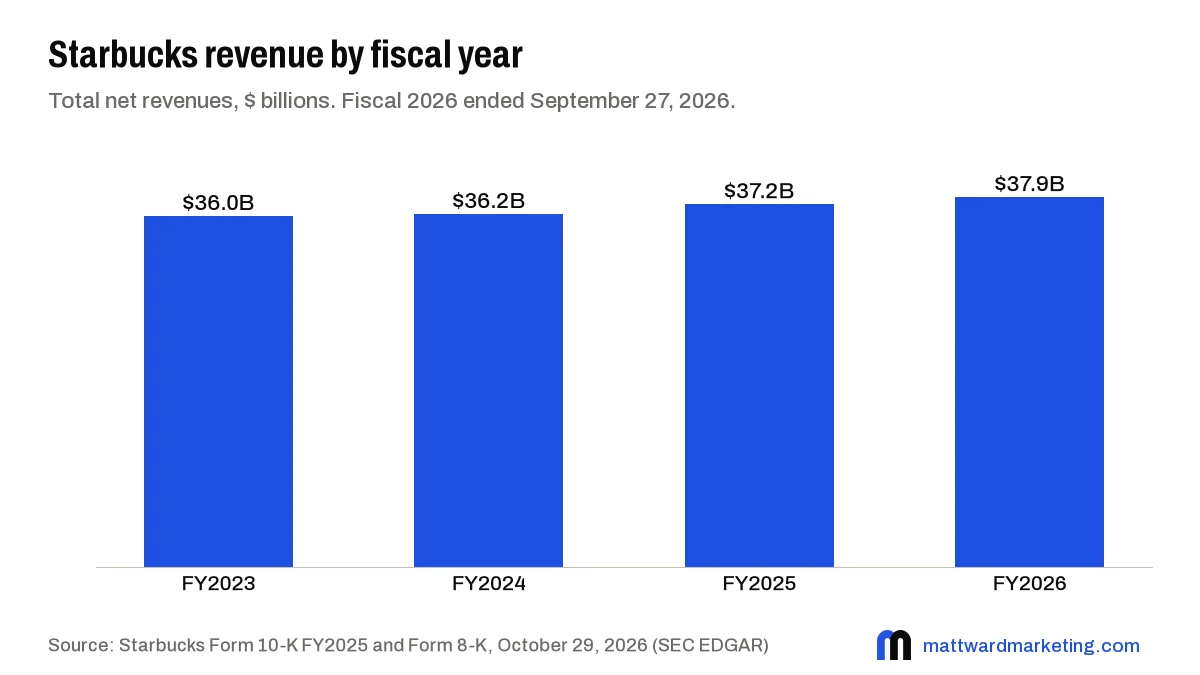
A Starbucks SWOT analysis lists the company’s internal strengths and weaknesses and the external opportunities and threats it faces. For fiscal 2026, that means a growing, global coffee brand still paying for a turnaround. For example, revenue rose 2% to $37.9 billion while restructuring charges reached $689 million.
Starbucks Corporation is based in Seattle and has sold coffee since 1971. It roasts high-quality arabica beans and sells coffee, tea, food and packaged products through company-operated and licensed coffeehouses. Its fiscal year 2026 ended on September 27, 2026.
| Starbucks at a glance | Fiscal 2026 (year ended September 27, 2026) |
|---|---|
| Revenue | $37.9B (up 2%) |
| Net earnings | $2.5B (up 36%) |
| GAAP operating margin | 9.7% (up 180 basis points) |
| Global comparable coffeehouse sales | Up 6.2% |
| Coffeehouses | 41,607 (32% company-operated, 68% licensed) |
| Employees | About 381,000 (September 28, 2025) |
What are Starbucks’s biggest strengths?
Starbucks’s biggest strengths are its global footprint, a recovering U.S. business and a brand experience that is hard to copy. It ended fiscal 2026 with 41,607 coffeehouses, and global comparable sales grew 6.2%. In the fourth quarter alone, U.S. comparable sales rose 7.7%, with transactions up 2.4%.
1. Scale and a global brand
Starbucks runs 41,607 coffeehouses, and 16,781 of them are in the U.S. Beyond the flagship brand, it sells under Teavana, Ethos and Starbucks Reserve. Few coffee chains can match that reach.
2. A turnaround that is working
Starbucks announced its “Back to Starbucks” strategy in the fourth quarter of fiscal 2024. By fiscal 2026, North America comparable sales were up 6.6%, driven by 3.6% more transactions. “Back to Starbucks started as our turnaround plan. Now, it’s our growth plan,” Niccol said on October 29, 2026.
3. Control of coffee quality
Starbucks controls nearly all of its coffee buying, roasting and packaging. It owns most of its roasting plants and runs ten farmer support centers, staffed by agronomists who work with coffee growers. This control over beans and brew is a source of differentiation that rivals struggle to imitate.
4. A light, licensed model abroad
68% of Starbucks coffeehouses are licensed. Licensees pay royalties and buy product, so Starbucks grows with less capital. The International segment’s operating margin rose to 19.7% in the fourth quarter of fiscal 2026, from 10.8% a year earlier.
5. Loyalty and packaged coffee
Starbucks Rewards members earn Stars on purchases, and the app supports Mobile Order and Pay. Channel Development, which sells packaged coffee through the Global Coffee Alliance with Nestlé, earned $1.0 billion in operating income on $2.2 billion of revenue in fiscal 2026.
What is Starbucks’s main weakness?
Starbucks’s main weakness is profitability. Its GAAP operating margin was 9.7% in fiscal 2026, well below 15.0% in fiscal 2024, because of labor investments and restructuring. For example, operating income was $3.7 billion in fiscal 2026, compared with $5.4 billion two years earlier.
1. Margins have not recovered
Restructuring and impairment charges totaled $689 million in fiscal 2026. In September 2026, Starbucks closed about 250 North America coffeehouses that did not meet its standards, a plan with about $300 million in charges.
2. Heavy dependence on North America
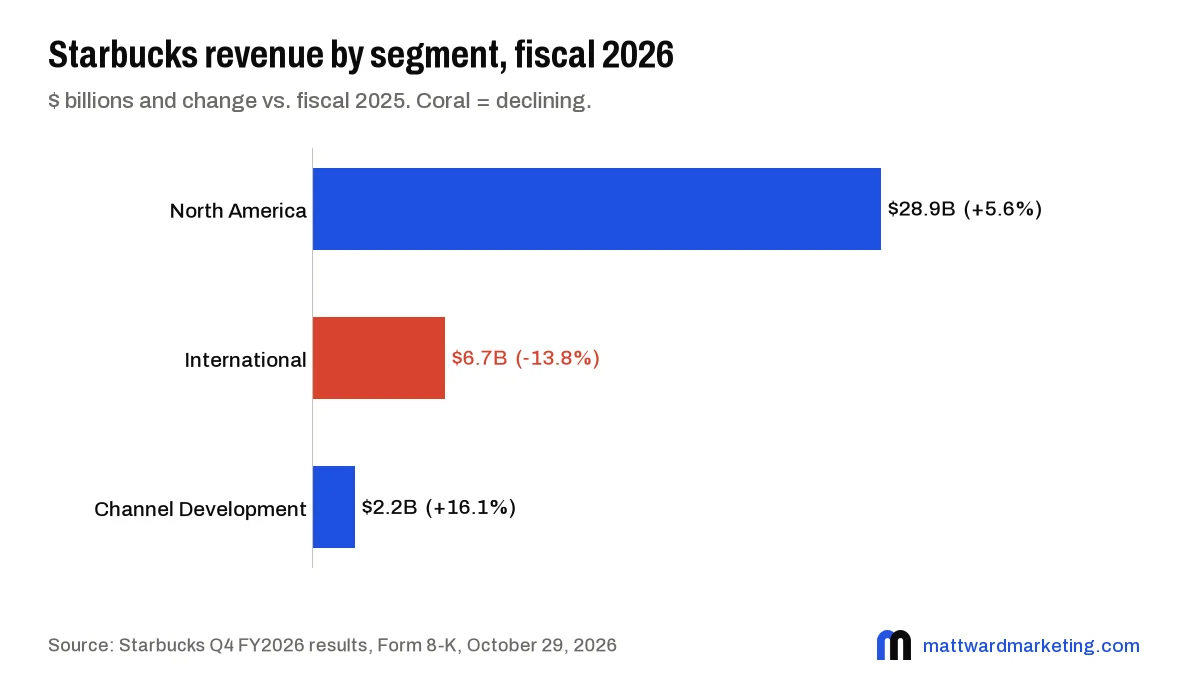
North America brought in $28.9 billion, or about 76% of fiscal 2026 revenue. The 10-K lists this “heavy reliance” on one segment as a risk. A slowdown in U.S. spending would hit Starbucks harder than a more diversified chain.
3. Weak traffic outside North America
International comparable sales grew only 0.9% in the fourth quarter of fiscal 2026, and comparable transactions fell 2.8%. Growth there came from higher average tickets, not more visits.
4. Labor relations
Unions have won representation rights at around 6% of Starbucks’s more than 10,000 U.S. company-operated stores, according to its fiscal 2025 10-K. The company is still negotiating first contracts, which adds cost and uncertainty for baristas and managers alike.
What opportunities does Starbucks have?
Starbucks’s opportunities sit in store growth, its new China partnership and menu innovation. It plans about 1,200 net new coffeehouses in fiscal 2027, led by International, and expects North America comparable sales growth of about 4%. In the fourth quarter of fiscal 2026, food attach and product mix helped lift U.S. tickets 5.2%.
- Open about 1,200 net new coffeehouses in fiscal 2027, mostly through licensed partners abroad.
- Grow China through the joint venture with Boyu Capital, which bought 60% of Starbucks’s China retail operations in the third quarter of fiscal 2026. Starbucks kept 40% and still owns and licenses the brand.
- Sell more food with each drink: management credits “customer food attach” for part of its ticket growth.
- Use the redesigned Starbucks Rewards program and consumer marketing to bring customers back more often.
- Deliver its $2 billion cost savings program, which includes simpler Reserve and Roastery locations.
What threats does Starbucks face in 2026?
Starbucks’s main threats are coffee costs, trade policy, labor costs and competition. Arabica prices swing with weather, crop disease and futures trading, and tariffs added cost in fiscal 2026. Its 10-K also warns of direct competition from large quick-service chains and ready-to-drink coffee brands.
1. Coffee prices and supply
High-altitude arabica trades at a premium above the “C” commodity price. Starbucks says climate change may worsen the weather, water and crop disease risks behind that price. It hedges with futures and collars, and at June 28, 2026, it had $823 million in open green coffee purchase commitments.
2. Tariffs and trade policy
Starbucks imports were subject to reciprocal tariffs under IEEPA. After the U.S. Supreme Court ruled those tariffs unlawful on February 20, 2026, Starbucks received substantially all the refunds it requested. Its filings still list tariffs and trade restrictions as a risk.
3. Competition from every side
Starbucks competes with specialty coffee shops, quick-service restaurants and ready-to-drink coffee sold in grocery stores. The 10-K says rivals compete on quality, convenience, delivery, mobile ordering and price.
4. Labor costs and regulation
California’s Assembly Bill 1228 raised the minimum wage and set working standards for some Starbucks partners, and the company flags it as a labor cost risk. It also faces taxes on sugary drinks, privacy rules and new limits on plastic packaging.
Starbucks SWOT matrix
| Strengths | Weaknesses |
|---|---|
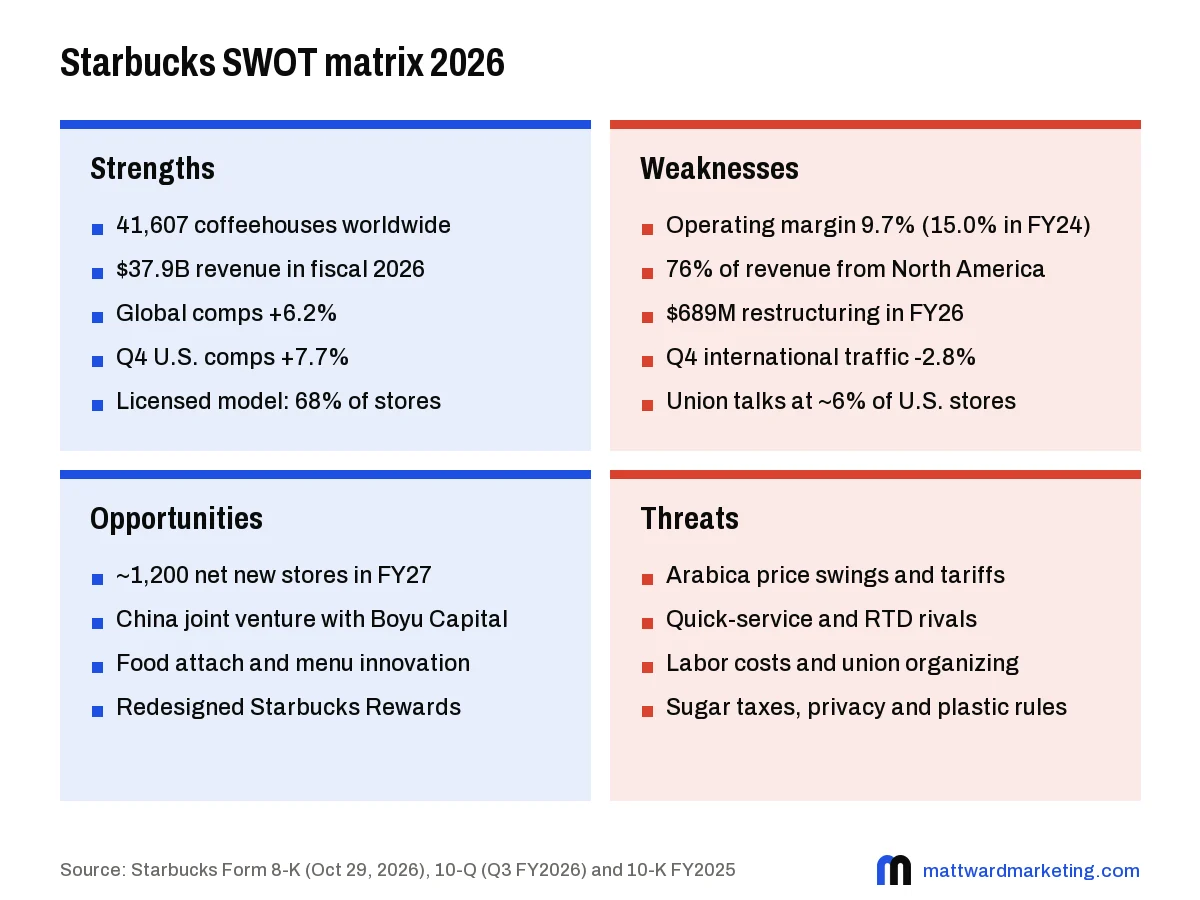
| 41,607 coffeehouses; $37.9B revenue; global comps up 6.2%; Q4 U.S. comps up 7.7%; 68% of stores licensed; control of coffee sourcing and roasting | 9.7% operating margin (15.0% in fiscal 2024); 76% of revenue from North America; $689M in restructuring charges; Q4 international transactions down 2.8%; unions at about 6% of U.S. stores |
| Opportunities | Threats |
| About 1,200 net new coffeehouses in fiscal 2027; China joint venture with Boyu Capital; food attach and menu innovation; redesigned Starbucks Rewards; $2B cost savings | Arabica price swings and climate risk; tariffs; quick-service and ready-to-drink rivals; labor costs and union organizing; sugar taxes, privacy and packaging rules |
What does Starbucks’s SWOT mean for marketers?
Starbucks’s SWOT shows that fixing the in-store experience can restart growth faster than discounts. Its comeback came from more visits and bigger tickets, not from new markets. In fiscal 2026, North America transactions rose 3.6% as the company invested in baristas, service and menu focus.
Three lessons stand out for marketers and small-business owners:
- Protect the core experience first. Starbucks closed coffeehouses that did not deliver “the coffeehouse experience” expected of the brand, even at a cost of about $300 million.
- Sell the add-on. Food attach helped lift average U.S. tickets 5.2% in the fourth quarter of fiscal 2026.
- Choose the right growth model per market. Starbucks moved China to a joint venture and expects its licensed model to bring lower revenue but a higher margin.
For more brand breakdowns built the same way, see the SWOT analysis hub, including the Nike SWOT analysis and the McDonald’s SWOT analysis.
FAQ
What are Starbucks’s biggest strengths?
Scale, a recovering U.S. business and control of its coffee. Starbucks ended fiscal 2026 with 41,607 coffeehouses and $37.9 billion in revenue, global comparable sales grew 6.2%, and it controls nearly all of its coffee buying and roasting.
What is Starbucks’s main weakness?
Profitability. Its GAAP operating margin was 9.7% in fiscal 2026, down from 15.0% in fiscal 2024, after $689 million in restructuring charges and heavy labor investment. It also depends on North America for about 76% of revenue.
What threats does Starbucks face in 2026?
Volatile arabica coffee prices, tariffs and trade policy, rising labor costs and union organizing, and competition from specialty coffee shops, quick-service chains and ready-to-drink coffee brands. Sugar taxes and privacy and packaging rules add regulatory pressure.
Sources
- Starbucks Corporation, Q4 and full fiscal year 2026 results, Exhibit 99.1 to Form 8-K, October 29, 2026 (SEC EDGAR).
- Starbucks Corporation, Form 10-Q for the quarter ended June 28, 2026, filed July 29, 2026 (SEC EDGAR).
- Starbucks Corporation, Form 10-K for the fiscal year ended September 28, 2025, filed November 14, 2025 (SEC EDGAR).
- Starbucks Corporation, Form 8-K on North America coffeehouse closures, filed September 24, 2026 (SEC EDGAR).
- Starbucks Corporation, Form 8-K on the support organization restructuring plan, filed May 15, 2026 (SEC EDGAR).