McDonald’s SWOT Analysis (2026): Strengths, Weaknesses, Opportunities & Threats
A McDonald’s SWOT analysis for 2026 shows a fast-food giant with 46,554 restaurants and $139.4 billion in Systemwide sales, but with flat U.S. sales and fewer U.S. guests. This guide sets out McDonald’s strengths, weaknesses, opportunities and threats, with every figure taken from its 2025 annual report and its third-quarter 2026 filings.
Key takeaways
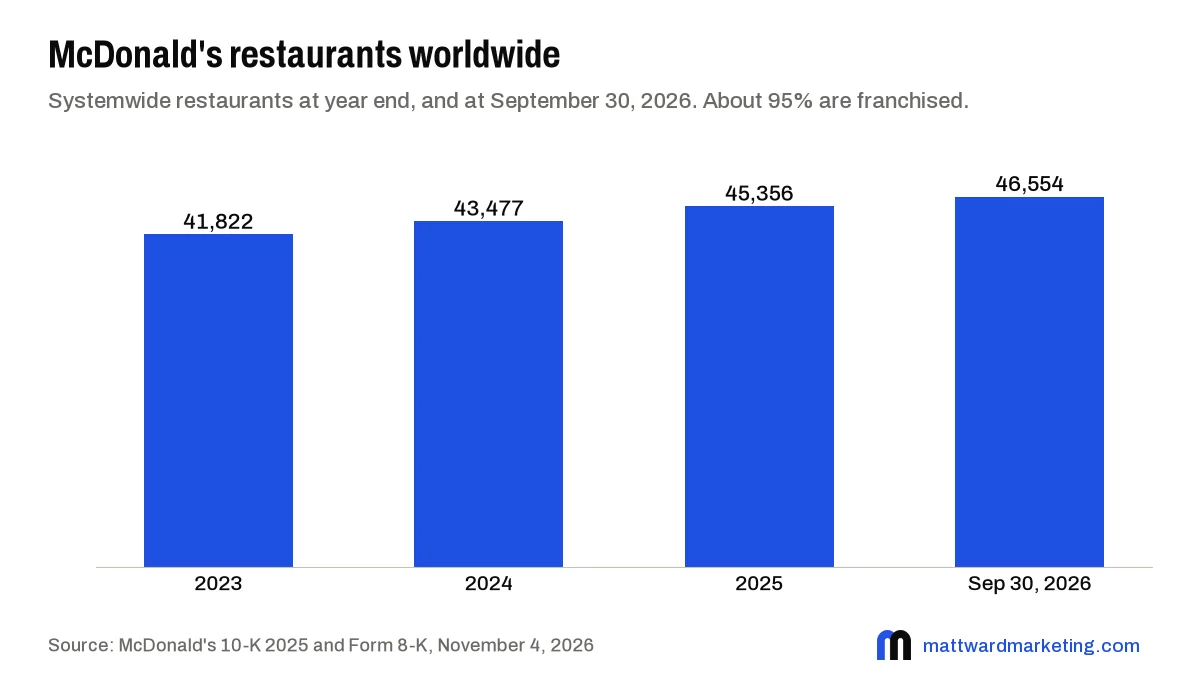
- McDonald’s biggest strength is scale: 46,554 restaurants in more than 100 countries at September 30, 2026, about 95% of them franchised.
- Its main weakness is the U.S. business, where comparable sales fell 0.2% in the third quarter of 2026 as guest counts declined.
- The franchise model makes McDonald’s very profitable: its operating margin was 46.1% in 2025.
- The clearest opportunities are loyalty, chicken and beverages, where McDonald’s targets 1.5 points of market share gains by 2030.
- The biggest threats are crowded competition for every meal, weight-loss drugs that change eating habits, and volatile beef and chicken costs.
What is a SWOT analysis of McDonald’s?
A McDonald’s SWOT analysis lists the company’s internal strengths and weaknesses and the external opportunities and threats it faces. For 2026, that means a fast-food leader with record restaurant growth and strong margins, but soft U.S. demand. For example, Systemwide sales grew 4% in the third quarter of 2026, while U.S. comparable sales fell 0.2%.
McDonald’s Corporation franchises and runs McDonald’s restaurants. It is based in Chicago, Illinois. Its menu is built around burgers, fries, chicken, breakfast and McCafé drinks. Franchisees, suppliers and employees form what the company calls its “three-legged stool.”
| McDonald’s at a glance | Figure |
|---|---|
| Restaurants (September 30, 2026) | 46,554, about 95% franchised |
| Systemwide sales (2025) | $139.4B (up 7%; up 5% in constant currencies) |
| Consolidated revenues (2025) | $26.9B (up 4%) |
| Operating income (2025) | $12.4B, a 46.1% operating margin |
| Global comparable sales (2025) | Up 3.1% |
| Company employees (year-end 2025) | Over 150,000, plus over 2 million in franchised restaurants |
What are McDonald’s biggest strengths?
McDonald’s biggest strengths are its size, its franchise model and its drive-thru network. It ran 46,554 restaurants at September 30, 2026. About 95% are franchised, so most revenue comes from rent and royalties. That model produced a 46.1% operating margin in 2025, on $26.9 billion of revenue.
1. Unmatched restaurant scale
McDonald’s restaurants generated $139.4 billion in Systemwide sales in 2025. In the third quarter of 2026 alone, they sold over $38 billion. The company opened 2,276 restaurants in 2025 and closed 396.
2. A franchise model that earns rent and royalties
Franchised restaurants paid McDonald’s $16.5 billion in 2025: $10.4 billion in rent and $6.0 billion in royalties. The company usually owns or leases the land and building, and franchisees pay for equipment, signs and décor. Franchise agreements generally run for 20 years.
3. Drive thru and delivery reach
McDonald’s says it has the most drive-thru locations in the world: nearly 29,000. More than 95% of its roughly 13,700 U.S. locations have one. Delivery is available from nearly 41,000 restaurants, about 90% of the system, at year-end 2025.
4. An iconic core menu
The 10-K counts 17 billion-dollar brands on the menu, including World Famous Fries, the Big Mac, the Quarter Pounder and Chicken McNuggets. Menu consistency is a selling point: the company runs regular sensory checks to keep core items the same everywhere.
5. Cash for shareholders
McDonald’s returned $7.1 billion to shareholders in 2025 through dividends and buybacks. In the third quarter of 2026, it raised its quarterly dividend by 4% to $1.93 per share.
What is McDonald’s main weakness?
McDonald’s main weakness is its U.S. business, its largest single market. U.S. comparable sales fell 0.2% in the third quarter of 2026. The company said negative guest counts were largely offset by higher average checks. In other words, fewer people came in, and those who did paid more.
1. Fewer U.S. guests
Over the first nine months of 2026, U.S. comparable sales rose 1.4%, driven by check growth while guest counts fell. CEO Chris Kempczinski said the U.S. improved “following our intervention on value.” A business that grows only through price is exposed when shoppers push back.
2. Weak spots abroad
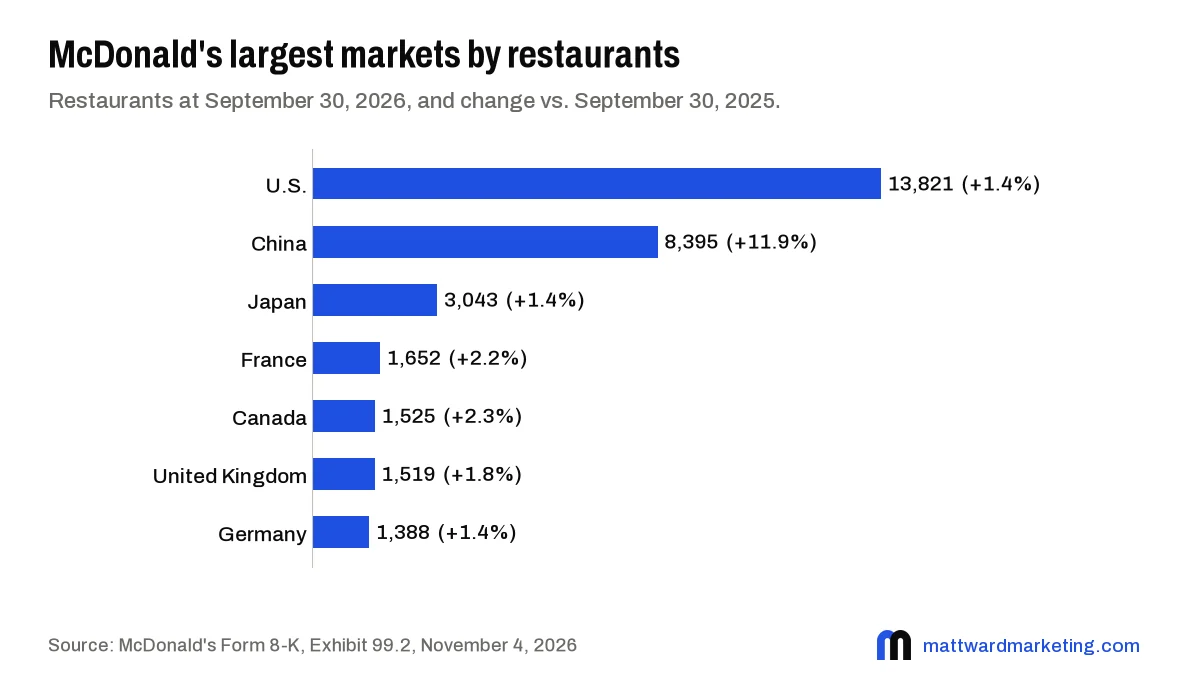
France had negative comparable sales in the first nine months of 2026, and so did China. Both are large markets: France had 1,652 restaurants and China 8,395 at September 30, 2026.
3. Pressure on company-run restaurants
U.S. Company-owned and operated restaurant margins fell 16% in the third quarter of 2026, to $75 million. Franchised margins in the U.S. still grew 2%.
4. Dependence on franchisees
With 95% of restaurants franchised, McDonald’s relies on owner-operators to fund remodels, adopt new technology and follow its value plans. Its 10-K warns that results suffer if franchisees are unwilling or unable to invest.
5. Restructuring costs and leadership change
McDonald’s booked $155 million of net pre-tax charges in the first nine months of 2026, mainly restructuring tied to its “Accelerating the Organization” program. On August 4, 2026, Skye Anderson replaced Joe Erlinger as President of McDonald’s USA.
What opportunities does McDonald’s have?
McDonald’s opportunities sit in loyalty, new restaurants and new menu categories. Its new McDonald’s > NEXT strategy, presented on September 23, 2026, targets 1.5 points of market share gains in both chicken and beverages by 2030. Loyalty members already spent $41 billion in the 12 months to September 30, 2026.
1. Loyalty and digital ordering
McDonald’s runs loyalty programs in 70 markets and reports nearly 220 million 90-day active members. It plans to grow loyalty sales to $45 billion a year by the end of 2027. Digital tools such as “Ready on Arrival” start a mobile order before the guest reaches the restaurant.
2. Chicken and beverages
Chicken is a fast-growing category, and McDonald’s has rolled out the McCrispy sandwich in nearly all major markets. Beverages are the second target. The company wants to keep its lead in beef while it gains share in both.
3. More restaurants, led by China
McDonald’s targets 50,000 restaurants worldwide by the end of 2028. China added 893 restaurants in the year to September 30, 2026, up 11.9%, the fastest growth of any large market.
4. AI and simpler restaurants
Through ArchIQ, a generative AI restaurant operating system, McDonald’s expects about 250 basis points of gross restaurant-level efficiency gains. It says that equals about $100,000 a year in cash flow for the average U.S. restaurant. It plans about $8.5 billion of support for franchisees through 2036.
What threats does McDonald’s face in 2026?
McDonald’s main threats are competition, changing eating habits and costs it cannot control. Its 10-K says it competes for every “informal eating out” occasion. That includes other burger chains, but also convenience stores, grocery stores and coffee shops. Weight-loss drugs and volatile beef prices add pressure.
1. Competition for every meal
The company competes on price, convenience, service, experience, menu variety and food quality. The 10-K points to “more discerning consumer spending” across the industry. That makes value meals and app deals the main battleground.
2. Weight-loss medications
McDonald’s third-quarter 2026 10-Q names GLP-1 weight-loss drugs as a risk that “could affect consumption patterns.” Its answer is more flexible portion sizes and more high-protein options.
3. Commodity and labor costs
The 10-K calls beef and chicken prices “particularly volatile.” The company can only partly hedge them. It also faces higher labor costs and more complex wage and hour laws in the U.S. and abroad.
4. Regulation and data rules
McDonald’s lists rules on packaging, nutrition and allergen labeling, and marketing among its legal risks. It also faces privacy laws such as the EU’s GDPR and the EU AI Act as it personalizes digital offers.
5. Food safety and brand perception
Food tampering, contamination or food-borne illness, real or perceived, could hurt the brand. The 10-K says food safety events have occurred within its system in the past. Its brand also depends on how people see its ingredients and workplace practices.
McDonald’s SWOT matrix
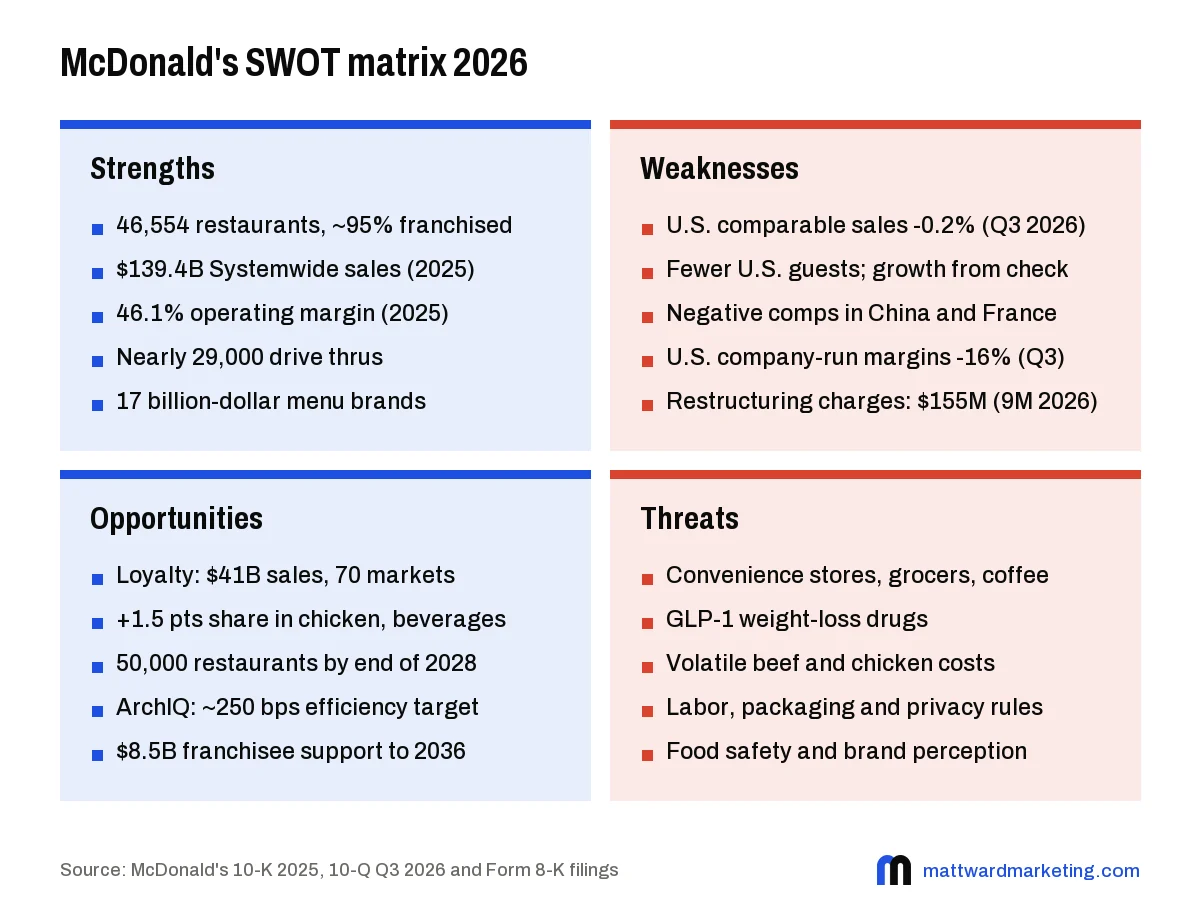
| Strengths | Weaknesses |
|---|---|
| 46,554 restaurants, about 95% franchised; $139.4B Systemwide sales in 2025; 46.1% operating margin; nearly 29,000 drive thrus; 17 billion-dollar menu brands | U.S. comparable sales down 0.2% in Q3 2026; fewer U.S. guests; negative comparable sales in China and France; U.S. company-run margins down 16%; $155M in restructuring charges |
| Opportunities | Threats |
| $41B in loyalty sales across 70 markets; 1.5-point share target in chicken and beverages; 50,000 restaurants by the end of 2028; ArchIQ efficiency gains; $8.5B franchisee support | Convenience stores, grocers and coffee shops; GLP-1 weight-loss drugs; volatile beef and chicken costs; labor, packaging and privacy rules; food safety risks |
What McDonald’s SWOT means for marketers
McDonald’s SWOT shows that price increases can hide a traffic problem for a while, but not forever. In 2025, U.S. comparable sales grew 2.1% thanks to higher average checks. By the third quarter of 2026, fewer guests pushed U.S. comparable sales below zero, and the company had to step in on value.
Three lessons apply to any brand:
- Track customer counts, not only revenue. Sales can grow while your customer base shrinks.
- Own the relationship. McDonald’s loyalty program gives it data on $41 billion of sales, so it can target offers instead of cutting prices for everyone.
- Defend your core and grow next to it. McDonald’s keeps its lead in burgers and fries while it chases chicken and drinks.
You can compare this with the Nike SWOT analysis, another global brand where channel choices shaped results, or browse every company in our SWOT analysis library.
FAQ
What are McDonald’s biggest strengths?
Scale, franchising and convenience. McDonald’s had 46,554 restaurants at September 30, 2026, about 95% franchised, and $139.4 billion in Systemwide sales in 2025. It also has nearly 29,000 drive thrus, and its franchise model delivered a 46.1% operating margin in 2025.
What is McDonald’s main weakness?
Soft U.S. demand. U.S. comparable sales fell 0.2% in the third quarter of 2026 because fewer guests visited, and growth earlier in the year came from higher checks rather than more customers. China and France also had negative comparable sales in 2026.
What threats does McDonald’s face in 2026?
Competition from quick-service chains, convenience stores, grocers and coffee shops; GLP-1 weight-loss drugs that may cut demand; volatile beef and chicken prices; rising labor costs; and stricter rules on packaging, nutrition labeling and data privacy.
Sources
- McDonald’s Corporation Form 10-K for the fiscal year ended December 31, 2025, filed February 24, 2026 (SEC EDGAR).
- McDonald’s Corporation Form 10-Q for the quarter ended September 30, 2026, filed November 6, 2026 (SEC EDGAR).
- McDonald’s reports third quarter 2026 results, Form 8-K, Exhibits 99.1 and 99.2, November 4, 2026 (press release, supplemental information).
- McDonald’s advances NEXT strategy, Form 8-K, Exhibit 99.1, September 23, 2026 (SEC EDGAR).
- McDonald’s appoints Skye Anderson as President of McDonald’s USA, Form 8-K, Exhibit 99.1, August 4, 2026 (SEC EDGAR).