Dunkin SWOT Analysis (2026): Strengths, Weaknesses, Opportunities & Threats
This Dunkin SWOT analysis for 2026 shows a coffee and donut brand with $14.5 billion in 2025 system sales and more than 14,200 restaurants, but a footprint still centered on the Northeast. Dunkin’ has been private since Inspire Brands bought it in December 2020, so this guide uses its 2026 franchise disclosure document, Inspire Brands releases and Dunkin’ Brands’ last annual report, and it says clearly what is no longer disclosed.
Key takeaways
- Dunkin’s biggest strength is scale: Inspire Brands reports $14.5 billion in 2025 system sales and more than 14,200 restaurants in 39 global markets.
- Its main weakness is geographic concentration: about 54% of its franchised single-brand U.S. restaurants are in nine Northeast states.
- The model is asset-light: 9,963 of its 9,999 U.S. restaurants were franchised at the end of 2025.
- The clearest opportunities are new markets and channels, including Canada, Puerto Rico and 150 Walmart stores.
- The biggest threats are Starbucks, a fast-growing Dutch Bros, McDonald’s breakfast and value-seeking guests.
What is a SWOT analysis of Dunkin’?
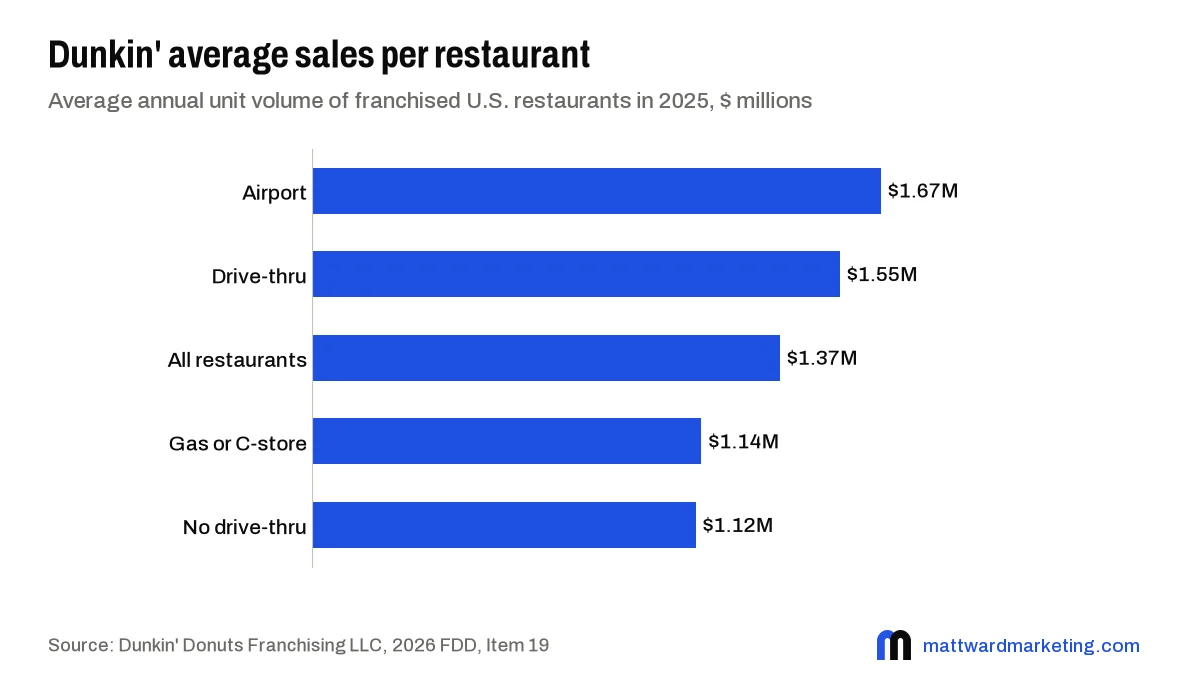
A Dunkin’ SWOT analysis lists the brand’s internal strengths and weaknesses and the external opportunities and threats it faces. For 2026, that means a beverage-led franchise system with 9,999 U.S. restaurants, strong drive-thru sales and a heavy Northeast base. For example, drive-thru restaurants averaged $1.55 million in 2025 sales, versus $1.12 million without one.
Dunkin’ began in Quincy, Massachusetts, in 1950, when founder Bill Rosenberg sold coffee for ten cents a cup. It dropped “Donuts” from its name in 2018. Inspire Brands, which also owns Arby’s, Baskin-Robbins, Buffalo Wild Wings, Jimmy John’s and SONIC, completed its purchase of Dunkin’ Brands on December 15, 2020, paying $106.50 per share in cash.
What Dunkin’ still discloses
Because Dunkin’ no longer files with the SEC, there are no quarterly results, no same-store sales and no segment data after 2020. Inspire Brands does not file with the SEC either, and its website publishes only headline figures such as system sales and restaurant counts. Two public documents fill part of the gap: Inspire’s 2026 fact sheet and the franchise disclosure document (FDD) that Dunkin’ files with state regulators, which includes audited financial statements.
| Dunkin’ at a glance | Latest public figure |
|---|---|
| Global system sales | $14.5B (2025, Inspire Brands) |
| Restaurants worldwide | 14,200+ in 39 global markets (2025) |
| U.S. restaurants | 9,999, of which 9,963 franchised (December 28, 2025) |
| International restaurants | 4,242 single-brand franchised (December 28, 2025) |
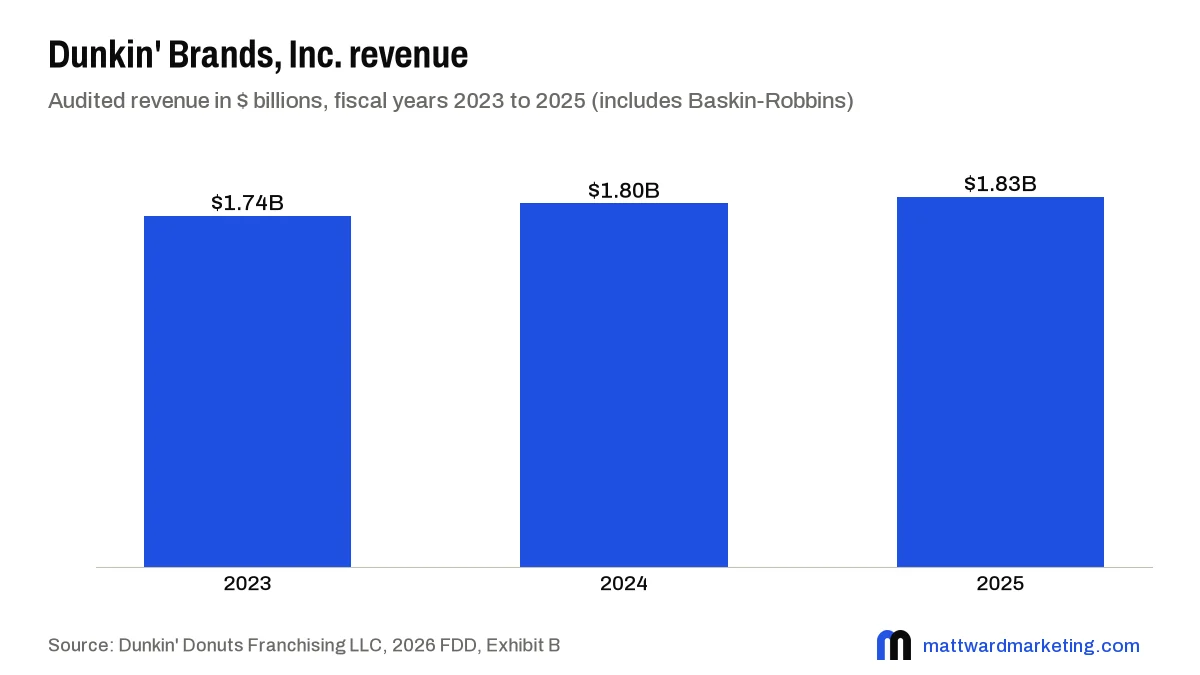
| Dunkin’ Brands, Inc. revenue | $1.83B in fiscal 2025, up 1.8% (includes Baskin-Robbins) |
| Dunkin’ Brands, Inc. net income | $406.5M in fiscal 2025 (2024: $418.5M) |
| Average sales per U.S. franchised restaurant | $1.37M in 2025 (7,010 restaurants) |
| Same-store sales | Not disclosed since 2020 |
What are Dunkin’s biggest strengths?
Dunkin’s biggest strengths are scale, brand reach and a franchise model that needs little capital. Inspire Brands reports $14.5 billion in 2025 system sales across more than 14,200 restaurants, and calls Dunkin’ the “Leading Coffee & Donuts Brand in the U.S.” Franchisees own almost every restaurant and pay a 5.9% royalty on gross sales.
1. A large, beverage-led brand
Dunkin’ reached its 10,000th U.S. location in Darien, Illinois, in October 2025. Back in 2019, its last 10-K said Dunkin’ sold about 1.6 billion servings of hot and iced coffee a year. Inspire’s 75th anniversary story says that by its 2018 name change, Dunkin’ was serving more than 2 billion cups of coffee a year.
2. An asset-light franchise model
Only 36 of 9,999 U.S. restaurants were company-owned at the end of 2025. New franchisees pay a continuing franchise fee of 5.9% and an advertising fee of 5.0% of gross sales. This is why Dunkin’ Brands, Inc. earned $406.5 million on $1.83 billion of revenue in fiscal 2025.
3. Strong drive-thru economics
Of the 7,010 franchised restaurants in the 2026 FDD’s sales sample, 4,840 had a drive-thru window. Traditional restaurants with a drive-thru averaged $1,547,899 in 2025 sales. Those without one averaged $1,124,559.
4. Many formats and places to buy
Dunkin’ runs freestanding restaurants, shopping center units, gas stations, airports and other non-traditional sites. Its coffee is also sold in grocery stores as packaged coffee, K-Cup® pods and bottled iced coffee, under license.
What is Dunkin’s main weakness?
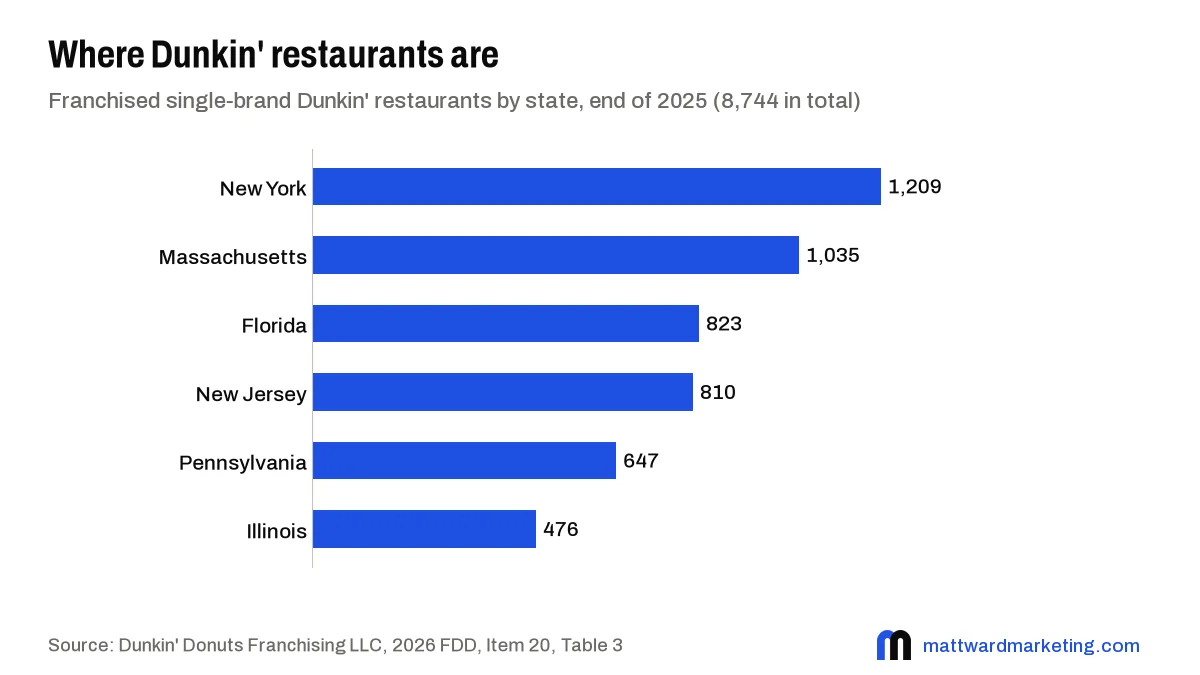
Dunkin’s main weakness is that its U.S. business is concentrated in the Northeast. At the end of 2025, 4,745 of its 8,744 franchised single-brand U.S. restaurants, or 54%, were in nine Northeast states. New York and Massachusetts alone had 2,244. California had just 140 and Texas 181.
1. A thin presence in the West and South
The FDD’s franchised restaurant table covers 43 states and Washington, D.C., but more than half of them have fewer than 100 Dunkin’ restaurants. That limits national reach in fast-growing Sun Belt markets.
2. Modest sales per restaurant
The average franchised U.S. restaurant sold $1,372,069 in 2025, and the median was $1,297,694. The bottom quarter of restaurants averaged just $718,088. Low-volume units are harder to remodel and to staff.
3. Heavy debt and little transparency
Dunkin’ Brands, Inc. carried $4.6 billion in long-term debt at the end of 2025. Inspire does not publish same-store sales, so outsiders cannot tell how traffic is trending. Net income fell 2.9% in fiscal 2025, even as revenue grew.
4. Closures and disputes with franchisees
Franchisees closed 81 Dunkin’ restaurants in 2025 that had been open for at least a year. The 2026 FDD also lists pending lawsuits, including one brought by a New Hampshire franchisee after Dunkin’ ended its agreement over missed remodel deadlines.
What opportunities does Dunkin’ have?
Dunkin’s opportunities sit in new markets, new channels and new drinks. In 2026, Inspire Brands signed deals to bring Dunkin’ back to Canada and Puerto Rico, and Dunkin’ reached 150 locations inside Walmart stores. The menu is also moving beyond coffee, with energy drinks, protein drinks and refreshers.
- Canada: in May 2026, Inspire signed a master franchise agreement with Foodtastic to open “hundreds” of Dunkin’ locations across Canada.
- Puerto Rico: in August 2026, Inspire signed with Fusion Restaurant Group, with restaurants expected to open in 2027.
- Walmart: Dunkin’ reached its 150th in-store Walmart location in August 2026. In September 2026, Inspire and Walmart announced Dunkin’ delivery through the Walmart app, starting with those 150 locations.
- New drinks: Dunkin’ launched Protein Milk in January 2026 and Dunkin’ Zero, a zero-sugar energy drink, in March 2026.
- More drive-thrus: the 2026 FDD shows drive-thru restaurants sell about 38% more than those without one, so new NextGen and drive-thru formats can lift average sales.
What threats does Dunkin’ face in 2026?
Dunkin’s main threats are coffee competitors, price-sensitive guests and franchisee strain. Starbucks had $37.2 billion in fiscal 2025 revenue and 40,990 stores. Dutch Bros grew to 1,273 shops by September 30, 2026, up 17.8% in a year. McDonald’s competes for the same breakfast and coffee visit.
1. Starbucks and Dutch Bros
Starbucks had 18,311 stores in North America on September 28, 2025. Dutch Bros, a drive-thru coffee chain, had $1.64 billion in fiscal 2025 revenue and shops in 27 states. Both target the same iced and specialty drink buyer that Dunkin’ wants.
2. Fast-food breakfast
McDonald’s reported $139.4 billion in 2025 systemwide sales. Its 10-K lists breakfast sandwiches such as the Egg McMuffin, hash browns, coffee and McCafé beverages, which makes it a direct rival for Dunkin’s morning visit.
3. Value-seeking guests
Dunkin’ itself now leans on bundles. It introduced a $5 Meal Deal in January 2026 and brought back a $6 Meal Deal in March 2026. Price promotions can protect traffic but squeeze franchisee margins.
4. Franchisee economics
Building a freestanding Dunkin’ costs from $532,400 to $1,832,500, according to the 2026 FDD. With average sales of $1.37 million per restaurant, remodel requirements and rising costs can cause friction, as the pending franchisee lawsuits show.
Dunkin’ SWOT matrix
| Strengths | Weaknesses |
|---|---|
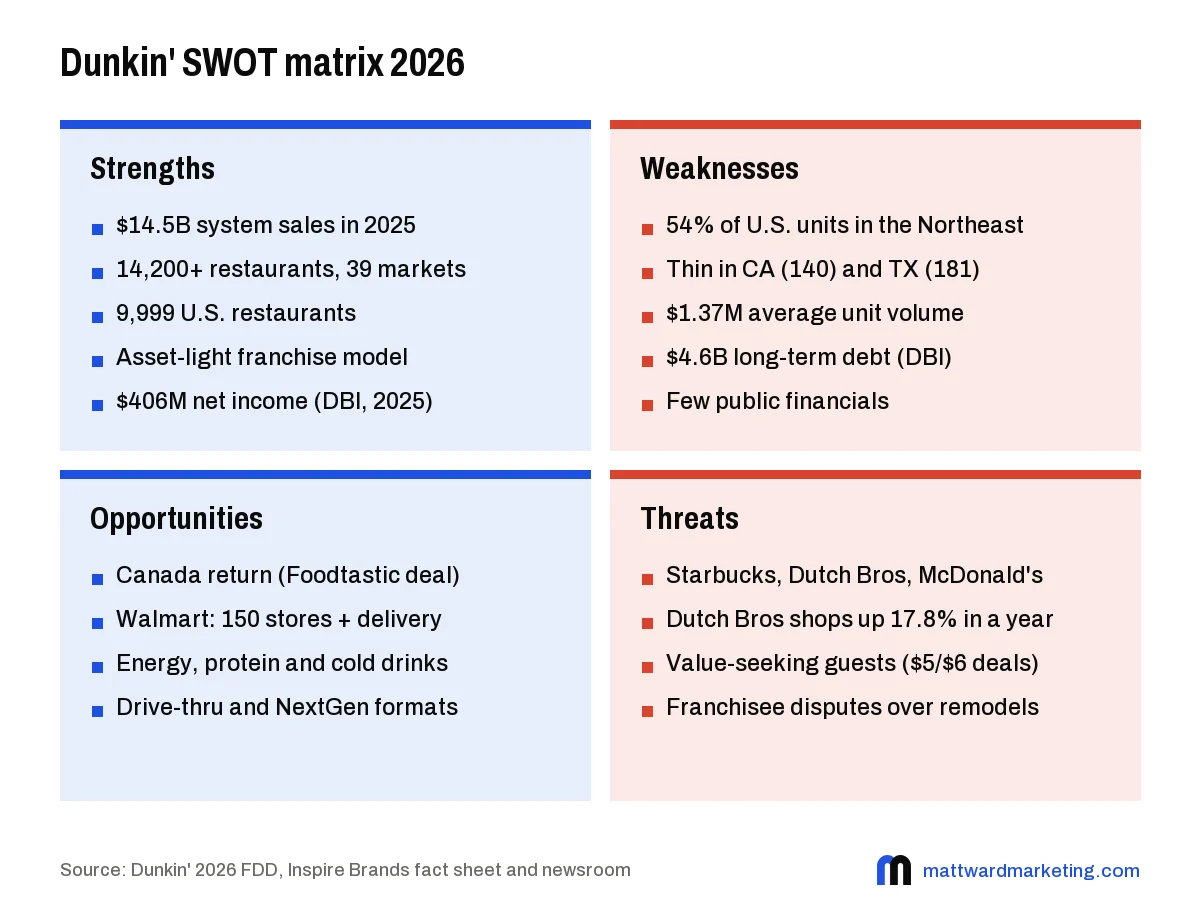
| $14.5B system sales in 2025; 14,200+ restaurants in 39 markets; 9,999 U.S. restaurants; 5.9% royalty, asset-light model; drive-thru units average $1.55M | 54% of franchised single-brand U.S. units in the Northeast; 140 in California and 181 in Texas; $1.37M average unit volume; $4.6B long-term debt; no public same-store sales |
| Opportunities | Threats |
| Canada return with Foodtastic; Puerto Rico in 2027; 150 Walmart locations and Walmart delivery; Protein Milk and Dunkin’ Zero; more drive-thrus | Starbucks ($37.2B revenue); Dutch Bros (1,273 shops, up 17.8%); McDonald’s breakfast; $5 and $6 value deals; franchisee disputes over remodels |
What does Dunkin’s SWOT mean for marketers?
Dunkin’s SWOT shows how a regional habit can become a national brand, and where it gets hard. Its fans are concentrated in the Northeast, so growth depends on winning new markets where Starbucks, Dutch Bros or McDonald’s are already the default. For marketers, the lesson is to pair a strong identity (“America Runs on Dunkin'”) with formats that make buying easy: 4,840 of its sampled restaurants had a drive-thru window.
Compare this with the coffee leader in our Starbucks SWOT analysis and the breakfast giant in our McDonald’s SWOT analysis. For how fast-casual chains fight for the same visit, see Chipotle competitors. You can find more examples in our SWOT analysis section.
FAQ
What are Dunkin’s biggest strengths?
Dunkin’s biggest strengths are scale and an asset-light franchise model. Inspire Brands reports $14.5 billion in 2025 system sales and more than 14,200 restaurants in 39 markets, and franchisees run 9,963 of its 9,999 U.S. restaurants, paying a 5.9% royalty on sales.
What is Dunkin’s main weakness?
Its main weakness is geographic concentration. About 54% of its franchised single-brand U.S. restaurants are in nine Northeast states, while California has only 140 and Texas 181. Limited public financial data since the 2020 buyout is a second weakness for anyone analyzing the brand.
What threats does Dunkin’ face in 2026?
Dunkin’ faces Starbucks ($37.2 billion in fiscal 2025 revenue), a fast-growing Dutch Bros (1,273 shops in September 2026) and McDonald’s breakfast. Price-sensitive guests and franchisee disputes over remodel costs add pressure on margins.
Sources
- Dunkin’ Donuts Franchising LLC, Franchise Disclosure Document, issuance date March 26, 2026, filed with the Minnesota Department of Commerce, including Items 1, 3, 6, 7, 19 and 20 and the audited financial statements of Dunkin’ Brands, Inc. in Exhibit B (Minnesota CARDS).
- Inspire Brands, Global Fact Sheet 2026, FY2025 figures (inspirebrands.com) and About Us page (inspirebrands.com/about).
- Dunkin’ Brands Group, Inc. Form 8-K on completion of the merger with Inspire Brands, December 15, 2020 (SEC EDGAR).
- Dunkin’ Brands Group, Inc. Form 10-K for fiscal 2019, filed February 24, 2020 (SEC EDGAR).
- Inspire Stories (Inspire Brands newsroom): “Inspire Celebrates 10K Dunkin’ U.S. Location,” October 7, 2025; “Dunkin’ Through the Decades,” May 30, 2025; Dunkin’ Protein Milk, January 2026; Dunkin’ Zero, March 2026; Dunkin’ to open in Canada, May 2026; Walmart and Dunkin’ reach 150 locations, August 2026; Dunkin’ in Puerto Rico, August 2026; Walmart restaurant delivery with Dunkin’, September 2026 (stories.inspirebrands.com).
- Starbucks Corporation Form 10-K for the fiscal year ended September 28, 2025, filed November 14, 2025 (SEC EDGAR).
- Dutch Bros Inc. Form 10-K for fiscal 2025 and Form 10-Q for the quarter ended September 30, 2026 (SEC EDGAR).
- McDonald’s Corporation Form 10-K for fiscal 2025, filed February 24, 2026 (SEC EDGAR).