Target SWOT Analysis (2026): Strengths, Weaknesses, Opportunities & Threats
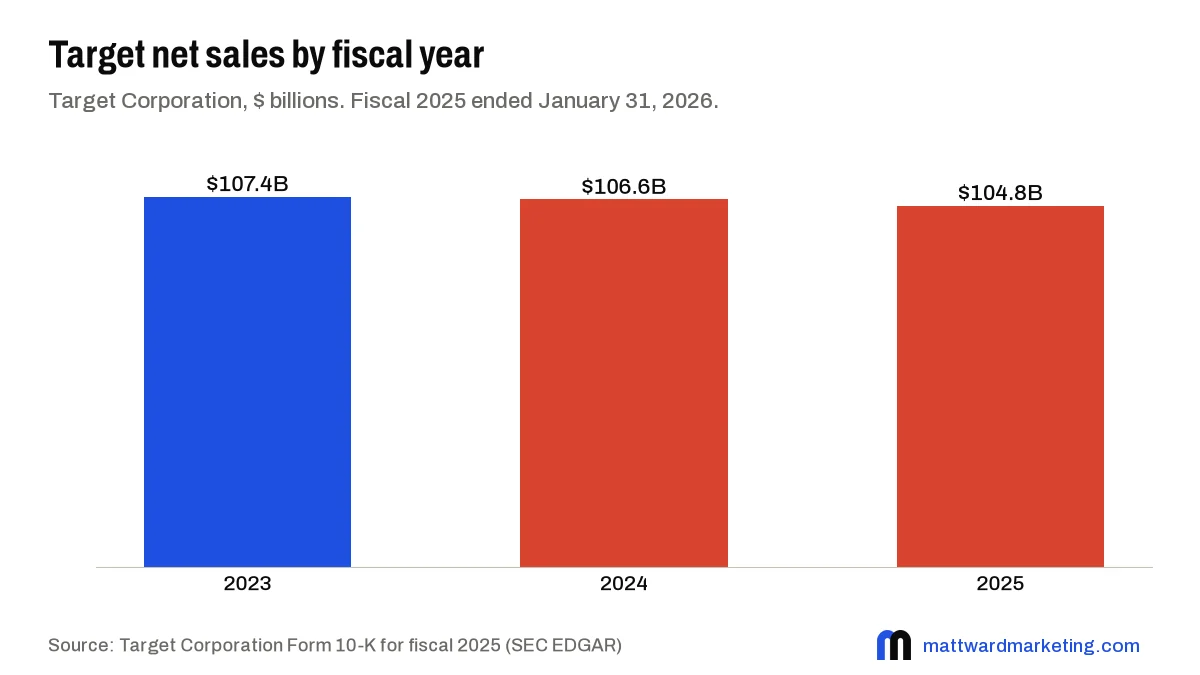
A Target SWOT analysis for 2026 shows a $104.8 billion retailer coming out of a sales slump: comparable sales fell 2.6% in fiscal 2025, then rose 3.8% in the second quarter of 2026. This guide sets out Target’s strengths, weaknesses, opportunities and threats, with every figure taken from its fiscal 2025 annual report and its latest quarterly results.
Key takeaways
- Target’s biggest strength is its store network: 2,019 U.S. stores on August 1, 2026, which fulfill the vast majority of its sales, including same-day orders.
- Its main weakness is a slump in store traffic: comparable sales fell 2.6% in fiscal 2025, the year ended January 31, 2026, with store comps down 4.0%.
- Owned and exclusive brands make up about 30% of merchandise sales and generally carry higher margins than national brands.
- The clearest opportunity is the 2026 rebound: second-quarter comparable sales grew 3.8%, digital comps rose 8.7% and same-day delivery grew more than 25%.
- The biggest threats are tariffs on imported goods, cautious shoppers, competition from clubs, off-price chains and online marketplaces, and reputation risk.
What is a SWOT analysis of Target?
A Target SWOT analysis lists the company’s internal strengths and weaknesses and the external opportunities and threats it faces. For 2026, that means a well-known discount retailer with strong owned brands and store-based delivery, recovering from falling sales. For example, net sales fell 1.7% in fiscal 2025 but grew 5.3% in the second quarter of 2026.
Target Corporation was incorporated in Minnesota in 1902 and is based in Minneapolis. It operates as a single retail segment, with about 415,000 team members on January 31, 2026. Michael Fiddelke became CEO in February 2026, and Brian Cornell moved to executive chair.
| Target at a glance | Fiscal 2025 (year ended January 31, 2026) |
|---|---|
| Net sales | $104.8B (down 1.7%) |
| Comparable sales | Down 2.6% (stores down 4.0%, digital up 3.1%) |
| Operating income | $5.1B (down 8.1%) |
| Net earnings | $3.7B (down 9.4%) |
| Stores | 1,995 (2,019 on August 1, 2026) |
| Team members | About 415,000 |
What are Target’s biggest strengths?
Target’s biggest strengths are its stores, its owned brands and its loyalty programs. Its nearly 2,000 stores fulfill the vast majority of sales, and two-thirds of digital sales in 2025 went through same-day options. Owned and exclusive brands make up about 30% of merchandise sales, and they generally earn higher margins.
1. Stores that double as fulfillment hubs
Target ships, hands over pickup orders and runs same-day delivery from its stores. That keeps delivery fast and costs low. It opened 18 new stores in 2025 and had 2,019 stores by August 1, 2026.
2. Owned brands with style
Target’s owned brands include Good & Gather, A New Day, Cat & Jack, Threshold and up & up, among others. In 2025 it added a fresh floral brand, Good Little Garden, plus design collaborations such as kate spade new york x Target.
3. Loyalty through Target Circle
Target Circle Card holders get 5% off nearly all purchases, free standard and 2-day shipping on eligible items and extended returns. The paid Target Circle 360 membership adds unlimited same-day delivery on eligible orders over $35.
4. A growing retail media business
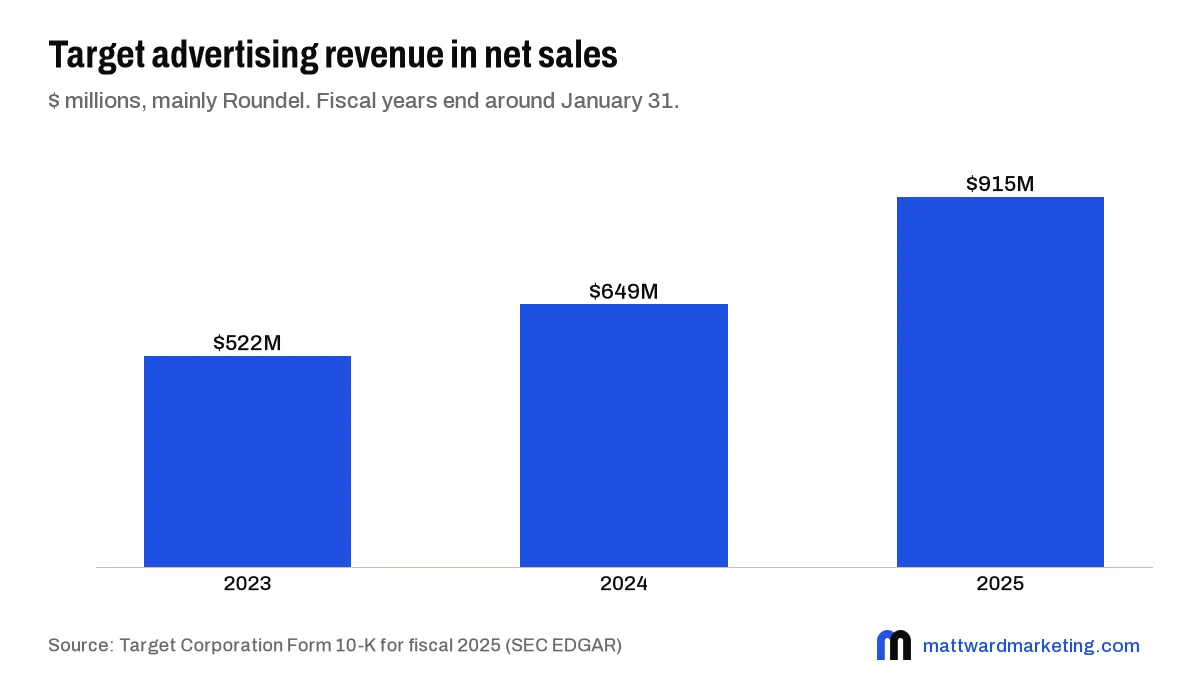
Advertising revenue recorded in net sales, mostly from Roundel, rose 41% to $915 million in fiscal 2025. In the fourth quarter of 2025, membership revenue more than doubled and the marketplace grew over 30%.
What is Target’s main weakness?
Target’s main weakness is falling traffic and sales in its stores. In fiscal 2025, comparable sales fell 2.6%, store comparable sales fell 4.0% and the number of transactions fell 2.2%. Net sales declined for a second straight year, to $104.8 billion, and net earnings dropped 9.4% to $3.7 billion.
1. Weak discretionary categories
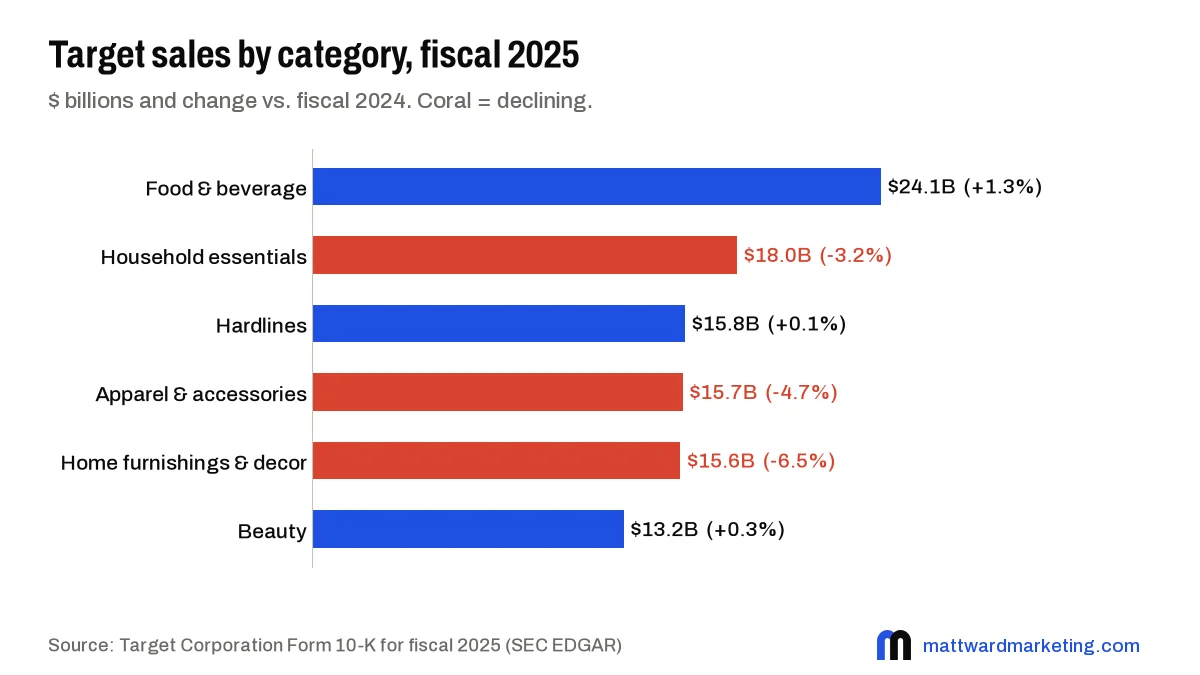
Home furnishings and decor sales fell 6.5% to $15.6 billion in fiscal 2025, and apparel and accessories fell 4.7% to $15.7 billion. Food and beverage, beauty and hardlines held roughly flat.
2. Markdowns hurt margins
Target’s gross margin rate slipped from 28.2% in fiscal 2024 to 27.9% in fiscal 2025. Target blamed higher markdowns, purchase order cancellation costs and category mix.
3. Lower return on capital
After-tax return on invested capital fell to 13.8% for fiscal 2025, from 15.4% a year earlier. Target bought back no shares in the fourth quarter of 2025.
4. Forecasting misses
Target’s 10-K admits it has “not always been able to accurately forecast consumer demand.” Past misses led to too much or too little inventory and more markdowns.
What opportunities does Target have?
Target’s opportunities lie in the 2026 recovery, faster delivery and non-merchandise income. In the quarter ended August 1, 2026, net sales grew 5.3%, comparable traffic rose 3.6% and non-merchandise sales grew more than 20%. Target raised its full-year 2026 outlook to net sales growth of around 5%.
1. Same-day delivery and digital growth
Digital comparable sales grew 8.7% in the second quarter of 2026, led by more than 25% growth in same-day delivery. Digitally originated sales were 19.6% of merchandise sales in the quarter.
2. Value and newness
CEO Michael Fiddelke said in August 2026 that “we’ve reduced prices on more than 10,000 frequently purchased items.” All six core categories grew in the quarter.
3. Fun 101 and owned brands
Hardlines, rebranded as “Fun 101,” grew about 11% to $3.9 billion in the second quarter of 2026. Food and beverage and beauty each grew about 7%.
4. Marketplace, membership and ads
Roundel ad revenue, Target Circle 360 membership fees and the Target Plus marketplace drove non-merchandise growth. Precision Plus by Roundel, launched in 2025, uses data and AI to improve ad results.
What threats does Target face in 2026?
Target’s main threats are trade policy, cautious consumers and strong competitors. About half of the merchandise it offers is sourced outside the United States, with China the largest country of origin. Its 10-K describes 2025 as a year of shoppers who stayed “value-focused and selective in discretionary spending,” plus tariff volatility.
1. Tariffs and trade policy
In February 2026, the U.S. Supreme Court ruled that IEEPA tariffs were not authorized. Target recognized $994 million of tariff refunds in the second quarter of 2026. The government then imposed new Section 122 tariffs, so import costs remain uncertain.
2. Target competitors
Target’s 10-K lists department stores, off-price retailers, wholesale clubs, category specialists, drug stores, supermarkets, direct-to-consumer brands and online marketplaces as competitors. Walmart is the closest comparison; read our Walmart SWOT analysis for its side.
3. Reputation risk
Target warns that negative publicity or incidents can quickly erode trust and lead to consumer boycotts, walkouts or lawsuits. It says it has modified and concluded some social and governance goals, and that stakeholders hold conflicting expectations.
4. Labor and operating costs
Workforce costs are Target’s largest operating expense. In the second quarter of 2026, its SG&A expense rate rose to 21.6% because of higher compensation, more field team hours and incentive pay.
Target vs. Walmart at a glance
Target is much smaller than Walmart but is growing faster in its latest quarter. Walmart’s fiscal 2026 and Target’s fiscal 2025 both ended on January 31, 2026.
| Metric | Target | Walmart |
|---|---|---|
| Latest full-year sales | $104.8B net sales | $713.2B total revenues |
| Stores (January 31, 2026) | 1,995 in the U.S. | 10,955 in 19 countries |
| Employees | About 415,000 | About 2.1 million |
| Latest quarter comparable sales | Up 3.8% (quarter ended August 1, 2026) | Walmart U.S. up 2.6% (quarter ended July 31, 2026) |
Target SWOT matrix
| Strengths | Weaknesses |
|---|---|
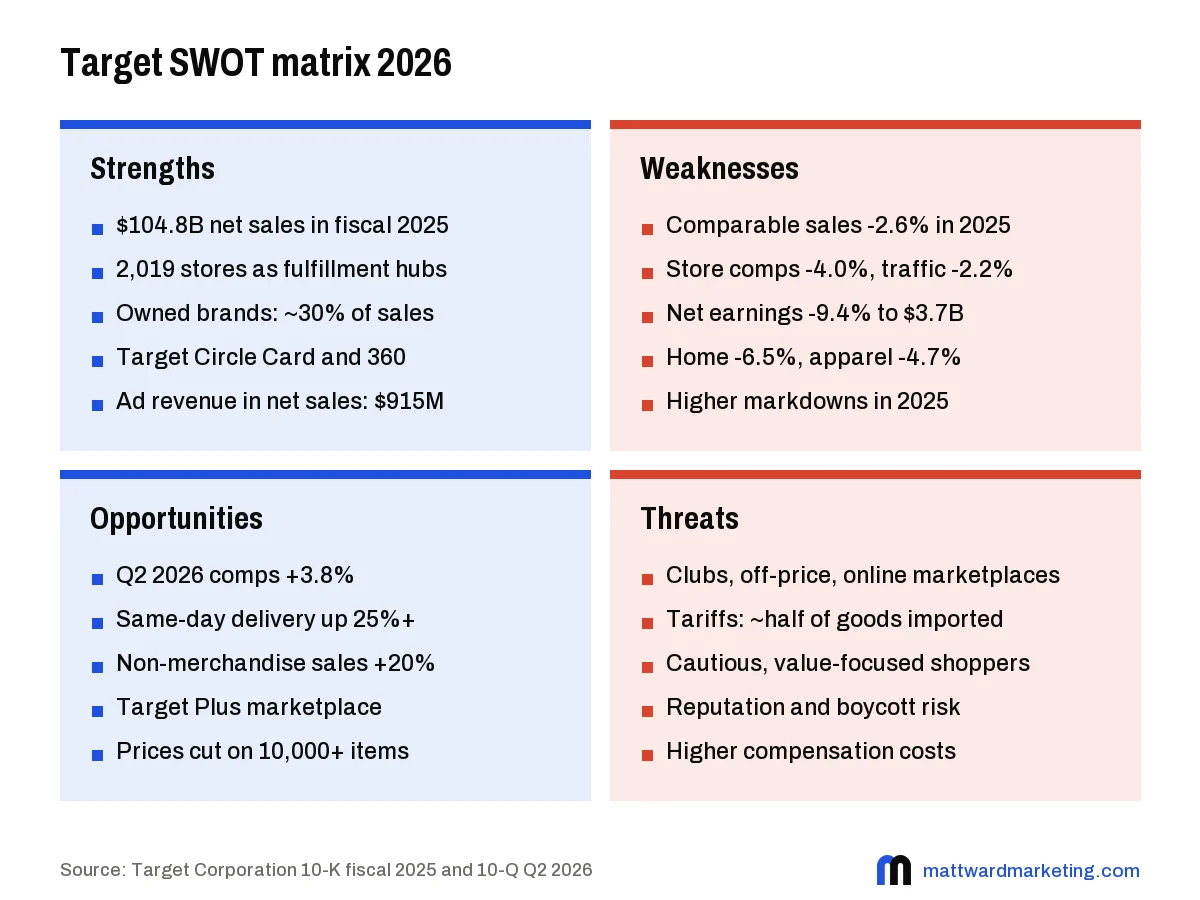
| $104.8B net sales in fiscal 2025; 2,019 stores that work as fulfillment hubs; owned brands about 30% of sales; Target Circle Card and Circle 360; $915M of advertising revenue | Comparable sales down 2.6%; store comps down 4.0%; traffic down 2.2%; net earnings down 9.4%; home down 6.5% and apparel down 4.7%; higher markdowns |
| Opportunities | Threats |
| Q2 2026 comparable sales up 3.8%; same-day delivery up more than 25%; non-merchandise sales up 20%; Target Plus marketplace; price cuts on 10,000+ items; Fun 101 growth | Clubs, off-price chains and online marketplaces; tariffs on about half of its goods; cautious, value-focused shoppers; reputation and boycott risk; higher compensation costs |
What does Target’s SWOT mean for marketers?
Target’s SWOT shows that style and brand loyalty cannot replace traffic. When shoppers cut back on home and apparel in 2025, store comps fell 4.0% even though owned brands and loyalty programs stayed strong. The 2026 rebound came from lower prices on everyday items, newness and faster delivery.
For a small business, the lesson is to pair a distinctive brand with clear everyday value. For brands that sell through Target, Roundel and the Target Plus marketplace are now part of the media plan. You can compare more brands in our SWOT analysis library.
FAQ
What are Target’s biggest strengths?
Its store network, owned brands and loyalty programs. Target’s 2,019 stores fulfill the vast majority of its sales, owned and exclusive brands make up about 30% of merchandise sales, and Target Circle Card holders save 5% on nearly all purchases.
What is Target’s main weakness?
Falling store traffic. In fiscal 2025, comparable sales fell 2.6%, store comps fell 4.0%, transactions fell 2.2% and net earnings dropped 9.4% to $3.7 billion, with home and apparel the weakest categories.
What threats does Target face in 2026?
Tariffs on the roughly half of its merchandise sourced abroad, cautious shoppers, competition from Walmart, clubs, off-price chains and online marketplaces, reputation and boycott risk, and rising labor costs.
Sources
- Target Corporation Form 10-K for the fiscal year ended January 31, 2026, filed March 11, 2026 (SEC EDGAR).
- Target Corporation Form 10-Q for the quarter ended August 1, 2026, filed August 28, 2026 (SEC EDGAR).
- Target Corporation fourth quarter and full-year 2025 earnings release, Form 8-K Exhibit 99, March 3, 2026 (SEC EDGAR).
- Target Corporation second quarter 2026 earnings release, Form 8-K Exhibit 99, August 19, 2026 (SEC EDGAR).
- Walmart Inc. Form 10-K for fiscal 2026 and second quarter fiscal 2027 earnings release, for the comparison table (SEC EDGAR).