
Nike SWOT Analysis (2026): Strengths, Weaknesses, Opportunities & Threats
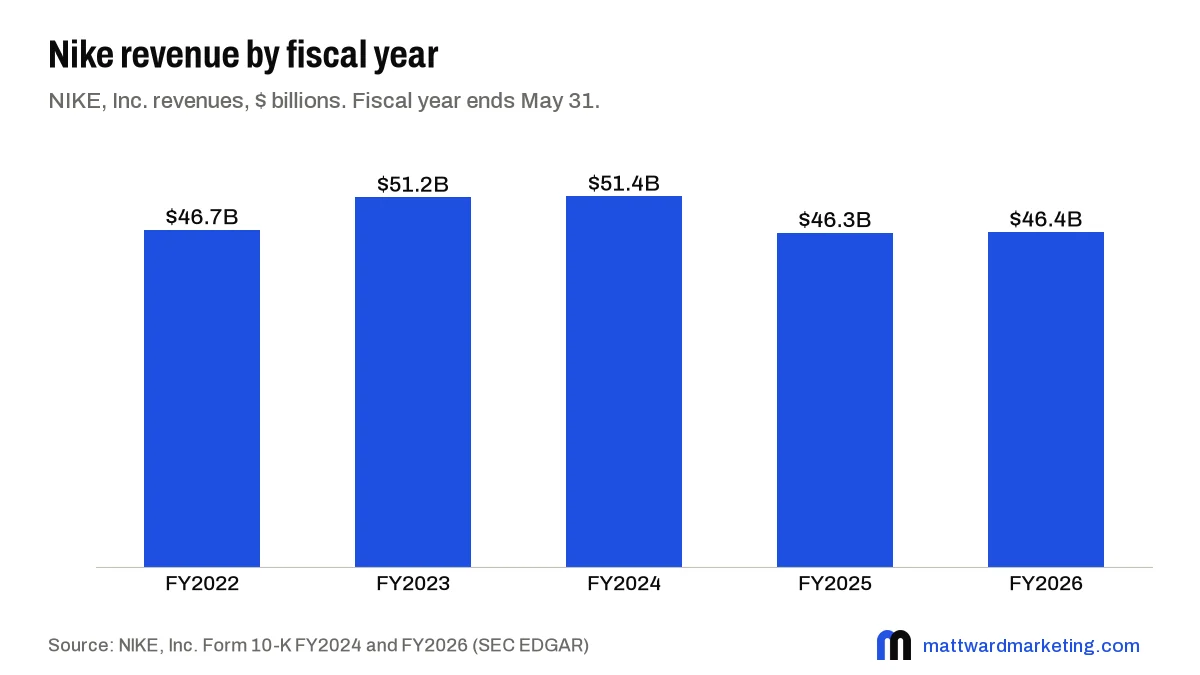
A Nike SWOT analysis for 2026 shows a $46.4 billion brand with growing wholesale and North America sales, but falling digital, Converse and Greater China revenue. This guide sets out Nike’s strengths, weaknesses, opportunities and threats, with every figure taken from its fiscal 2026 annual report and latest quarterly results.
Key takeaways
- Nike’s biggest strength is scale: fiscal 2026 revenue was $46.4 billion, and the Swoosh is registered in more than 190 jurisdictions.
- Its main weakness is Greater China, where revenue fell 11% in fiscal 2026 and 22% in the first quarter of fiscal 2027.
- Nike’s own channels are shrinking: NIKE Direct fell 6% in fiscal 2026, with digital sales down 12%.
- The clearest opportunity is wholesale and performance product, which drove 6% wholesale growth in fiscal 2026.
- The biggest threats are crowded competition from adidas, On, Deckers’ Hoka and lululemon, plus tariffs on imported goods.
What is a SWOT analysis of Nike?
A Nike SWOT analysis lists the company’s internal strengths and weaknesses and the external opportunities and threats it faces. For fiscal 2026, that means a $46.4 billion brand with growing wholesale and North America sales, but falling digital, Converse and Greater China revenue. For example, wholesale grew 6% while NIKE Direct fell 6%.
NIKE, Inc. designs and sells athletic footwear, apparel and equipment under the Nike, Jordan and Converse brands. It is based near Beaverton, Oregon, on the Philip H. Knight Campus, and had about 73,000 employees on May 31, 2026.
| Nike at a glance | Fiscal 2026 (year ended May 31, 2026) |
|---|---|
| Revenue | $46.4B (flat; down 2% currency-neutral) |
| Net income | $3.1B (down 3%) |
| Gross margin | 42.9% |
| Wholesale / NIKE Direct | $27.5B (up 6%) / $17.7B (down 6%) |
| Jordan Brand | $7.0B (down 3%) |
| Employees | About 73,000 |
What are Nike’s biggest strengths?
Nike’s biggest strengths are brand power, scale and cash. The Swoosh and NIKE trademarks are registered in over 190 jurisdictions, revenue reached $46.4 billion in fiscal 2026, and the company held $9.0 billion in cash and short-term investments. Even in a flat year, it returned $2.5 billion to shareholders.
1. A global brand portfolio
Nike calls the NIKE and Swoosh trademarks among its most valuable assets. Jordan Brand alone sold $7.0 billion of footwear, apparel and accessories in fiscal 2026.
2. North America keeps growing
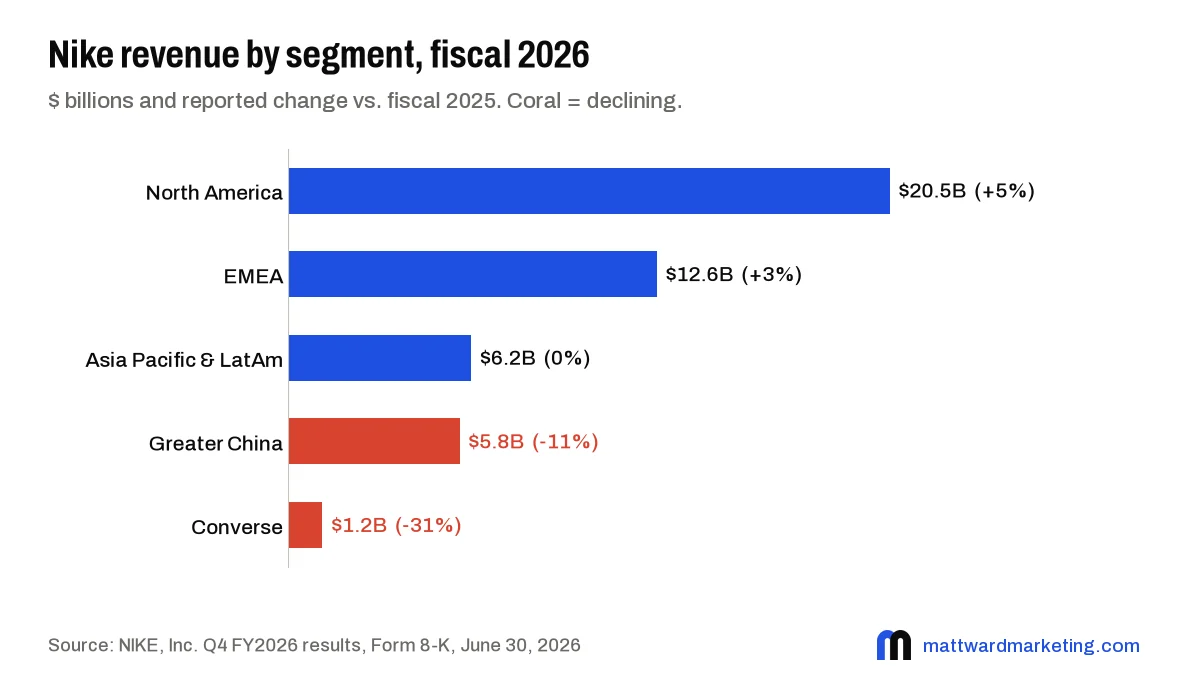
North America revenue rose 5% to $20.5 billion in fiscal 2026. In the first quarter of fiscal 2027, wholesale sales there grew another 9%.
3. A deep contract factory network
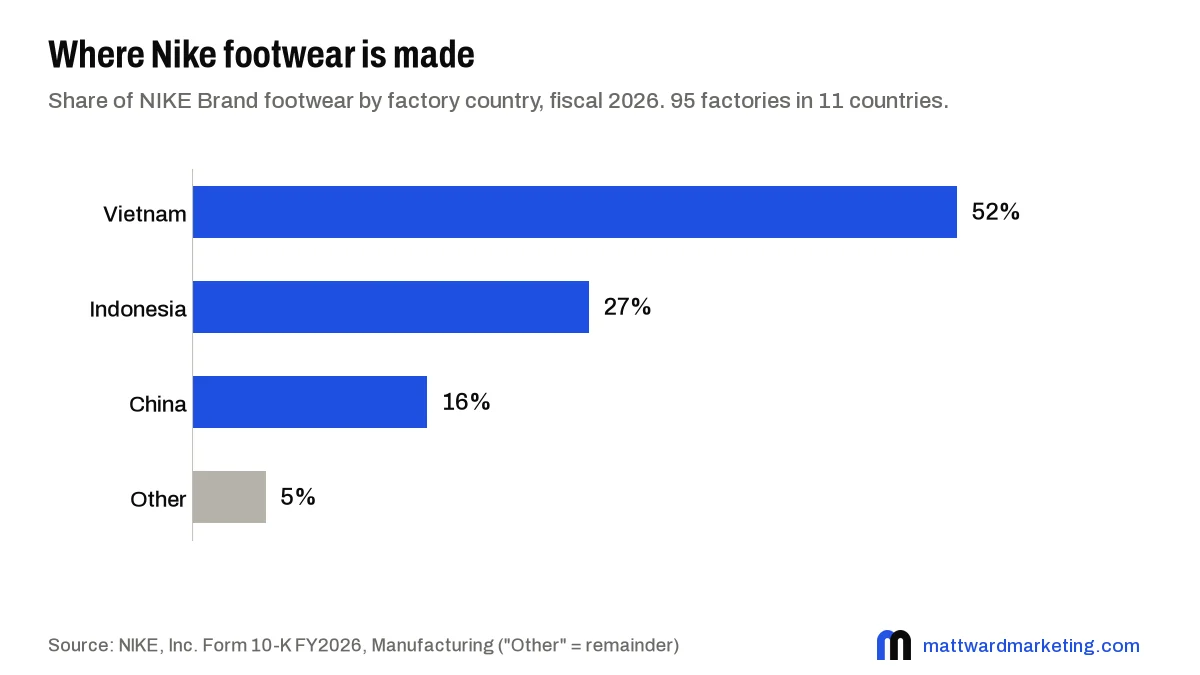
Nearly all footwear and apparel is made by independent contract manufacturers. In fiscal 2026 they ran 95 footwear factories in 11 countries and 321 apparel factories in 34 countries.
4. Financial room to invest
Nike paid $2.4 billion in dividends in fiscal 2026. Its new Pace program targets about $2.5 billion in cumulative savings through fiscal 2031.
What is Nike’s main weakness?
Nike’s main weakness is falling demand in its own channels and in China. NIKE Direct revenue dropped 6% in fiscal 2026 as digital sales fell 12%, and Greater China revenue fell 11%. In the first quarter of fiscal 2027, Greater China sales dropped 22% and its EBIT fell 34%.
1. Greater China is shrinking
Greater China revenue fell to $5.8 billion in fiscal 2026. Nike’s 10-K names local rivals Anta and Li Ning among its competitors.
2. Converse has lost a third of its sales
Converse revenue fell 31% to $1.2 billion, and its EBIT dropped from $240 million to $18 million.
3. Concentrated footwear sourcing
Three countries made about 95% of Nike Brand footwear in fiscal 2026: Vietnam (52%), Indonesia (27%) and China (16%).
4. Bets that did not pay off
Nike wound down RTFKT, the digital sneaker studio it bought in 2021, with services ending in January 2025.
What opportunities does Nike have?
Nike’s opportunities sit in wholesale, performance sport and cost savings. Wholesale revenue grew 6% to $27.5 billion in fiscal 2026, and management says its “Sport Offense” is driving progress in performance product. Nike Brand apparel grew 4% in fiscal 2026 and 2% in the first quarter of fiscal 2027, while footwear fell.
- Rebuild wholesale partnerships, the channel that grew in fiscal 2026.
- Win back running and training shoppers in athletic footwear, where On and Hoka compete directly.
- Grow apparel and athleisure, which held up better than shoes.
- Use Pace savings to fund marketing: demand creation spending rose 5% in the first quarter of fiscal 2027.
What threats does Nike face in 2026?
Nike’s main threats are competition, trade policy and weaker consumer demand. Its 10-K lists rivals including adidas, Anta, ASICS, Deckers, Li Ning, lululemon, New Balance, On, Puma and Under Armour. Nike expects fiscal 2027 revenue to decline by a high-single-digit percentage.
1. Tariffs and trade policy
The U.S. Supreme Court ruled on February 20, 2026, that IEEPA tariffs were unauthorized, and Nike expects to recover $986 million. New trade measures remain a risk factor in its 10-K.
2. Rising endorsement costs
Nike warns that competition for athletes has intensified, partly because of athletes’ personal brands and athlete-led ventures.
3. Soft sell-through
Former CFO Matthew Friend said in June 2026 that “sell-through remains challenged.”
Nike SWOT matrix
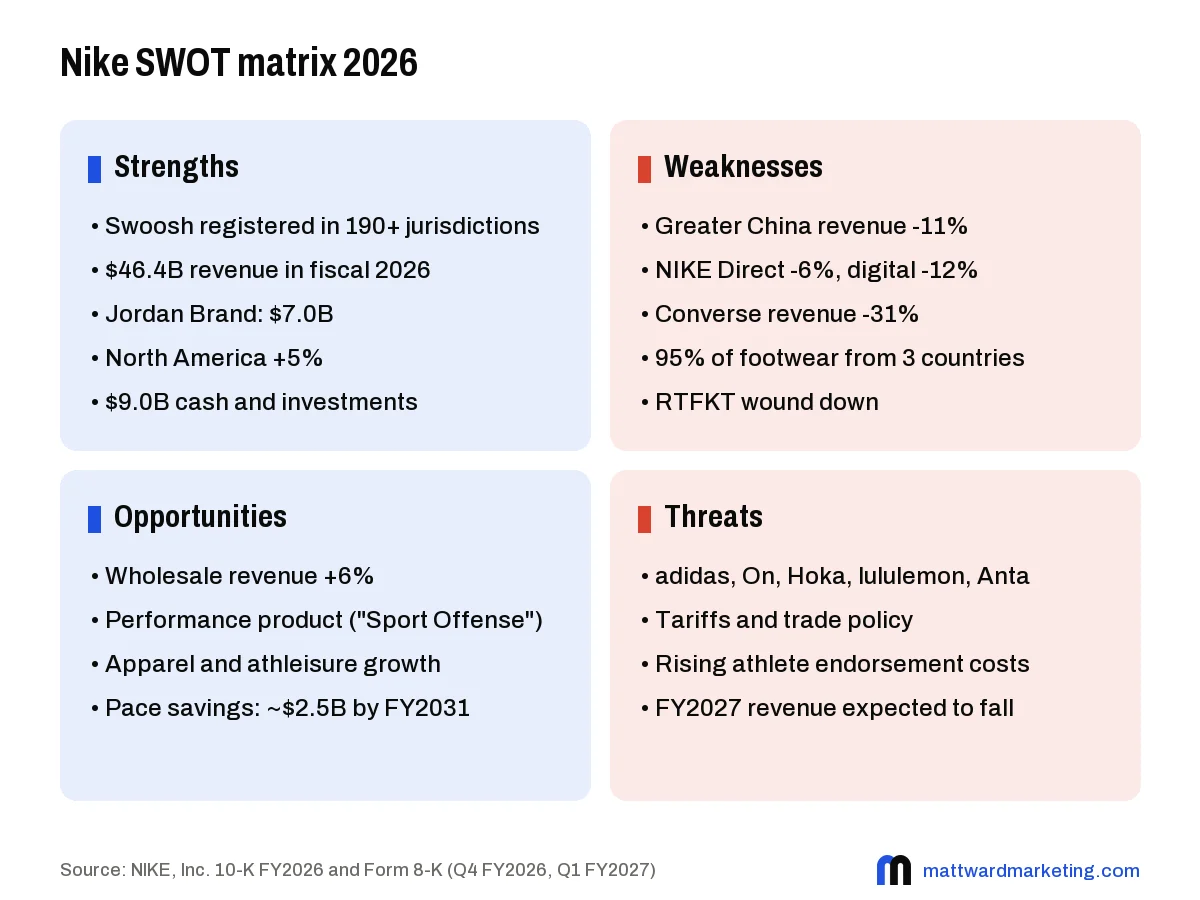
| Strengths | Weaknesses |
|---|---|
| Swoosh registered in 190+ jurisdictions; $46.4B revenue; Jordan Brand $7.0B; North America up 5%; $9.0B cash and investments | Greater China down 11%; NIKE Direct down 6%; digital down 12%; Converse down 31%; 95% of footwear from 3 countries |
| Opportunities | Threats |
| Wholesale up 6%; performance product; apparel and athleisure; $2.5B in Pace savings | adidas, On, Hoka, lululemon and Anta; tariffs; endorsement costs; expected fiscal 2027 revenue decline |
What does Nike’s SWOT mean for marketers?
Nike’s SWOT shows that a famous brand does not protect a business from channel mistakes. When it pushed shoppers to its own app and stores, NIKE Direct later shrank and wholesale had to carry growth. In fiscal 2026, wholesale grew 6% while digital fell 12%.
FAQ
What are Nike’s biggest strengths?
Brand power, scale and cash: the Swoosh is registered in over 190 jurisdictions, fiscal 2026 revenue was $46.4 billion and Nike held $9.0 billion in cash and short-term investments.
What is Nike’s main weakness?
Falling sales in Greater China (down 11% in fiscal 2026) and in its own channels, where NIKE Direct fell 6% and digital fell 12%.
What threats does Nike face in 2026?
Competition from adidas, On, Hoka, lululemon and Chinese brands, tariffs on imported goods, rising endorsement costs and an expected revenue decline in fiscal 2027.
Sources
- NIKE, Inc. Form 10-K for the fiscal year ended May 31, 2026, filed July 15, 2026 (SEC EDGAR).
- NIKE, Inc. fourth quarter and full year fiscal 2026 results, Form 8-K, June 30, 2026 (SEC EDGAR).
- NIKE, Inc. first quarter fiscal 2027 results, Form 8-K, October 1, 2026.
- NIKE, Inc. Form 10-K for fiscal 2024 (revenue for fiscal 2022 to 2024).
- Bloomberg and The Block, reporting on the RTFKT wind-down, December 2, 2024.