SWOT Analysis of Disney (2026): Strengths, Weaknesses, Opportunities & Threats
A SWOT analysis of Disney for 2026 shows a $94.4 billion company whose parks, cruises and streaming are growing while its cable TV networks shrink. This guide lists Disney’s strengths, weaknesses, opportunities and threats, with every figure dated and taken from its fiscal 2025 annual report and its fiscal 2026 quarterly results.
Key takeaways
- Disney’s biggest strength is its intellectual property: Disney, Pixar, Marvel, Star Wars and National Geographic feed its films, streaming, parks and merchandise at the same time.
- Experiences, the parks, resorts and cruises segment, earned a record $10.0 billion of operating income in fiscal 2025, more than half of Disney’s total segment operating income.
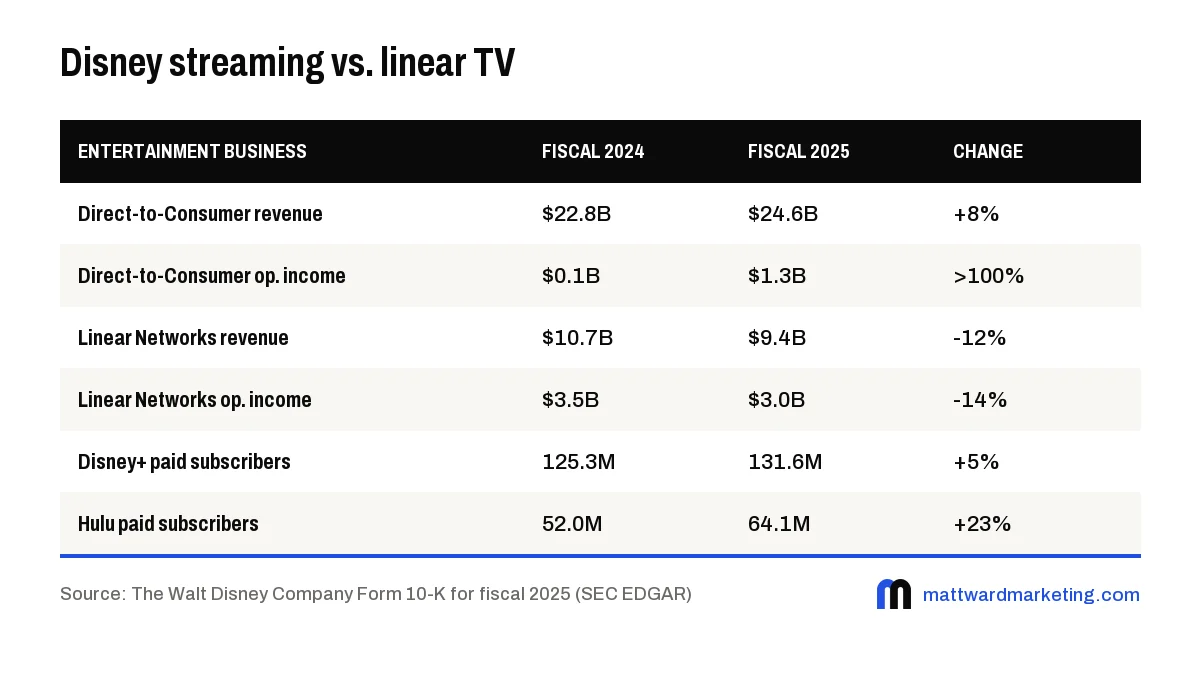
- Streaming has turned profitable: Direct-to-Consumer operating income rose from $143 million in fiscal 2024 to $1.3 billion in fiscal 2025.
- The main weakness is linear TV, where revenue fell 12% and operating income fell 14% in fiscal 2025.
- The biggest threats are competition for viewers’ time, $91.8 billion in programming commitments, a soft advertising market and weaker consumer demand in Asia.
What is a SWOT analysis of Disney?
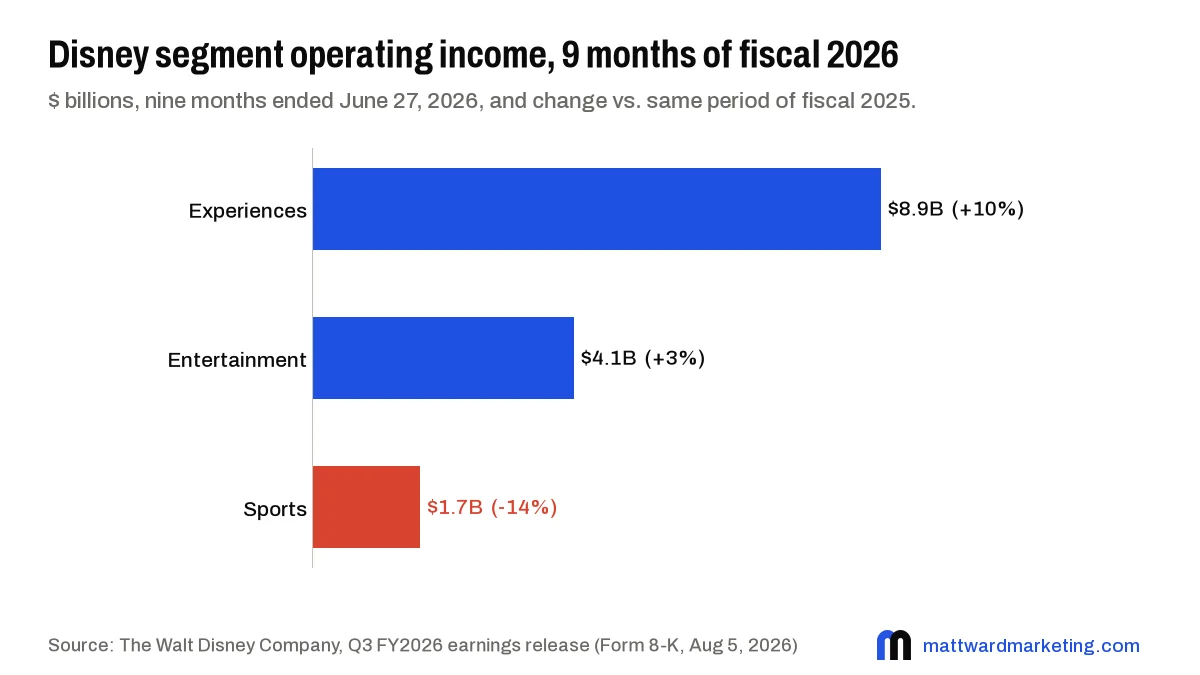
A SWOT analysis of Disney lists The Walt Disney Company’s internal strengths and weaknesses and the external opportunities and threats it faces. In 2026, that means a business that earns most of its profit from parks and cruises, is growing streaming profit and is managing the decline of cable TV. For example, Experiences grew operating income 10% in the first nine months of fiscal 2026.
Disney reports three segments. Entertainment holds the studios, Disney+, Hulu and the ABC and cable networks. Sports is mainly ESPN. Experiences covers theme parks, resorts, Disney Cruise Line and consumer products. Disney’s fiscal year ends on the Saturday closest to September 30, and the company employed about 231,000 people at the end of fiscal 2025.
Josh D’Amaro, previously Chairman of Disney Experiences, became chief executive officer on March 18, 2026, succeeding Robert A. Iger. Dana Walden became President and Chief Creative Officer on the same date.
| Disney at a glance | Figure and period |
|---|---|
| Revenue | $94.4B in fiscal 2025 (up 3%) |
| Total segment operating income | $17.6B in fiscal 2025 (up 12%) |
| Revenue, first nine months of fiscal 2026 | $76.4B (up 6%), nine months ended June 27, 2026 |
| Disney+ paid subscribers | 131.6M on September 27, 2025 (up 5%) |
| Cash provided by operations | $18.1B in fiscal 2025 (up 30%) |
| Employees | About 231,000 at the end of fiscal 2025 |

What are Disney’s biggest strengths?
Disney’s biggest strengths are its franchises, its parks and its scale. Disney, Pixar, Marvel, Star Wars and National Geographic content runs across film, Disney+, parks and products. Experiences earned a record $10.0 billion of operating income in fiscal 2025, and total revenue reached $94.4 billion. Toy Story 5 passed $1 billion at the global box office in 2026.
1. Franchises that pay off in every business
Disney uses one story many times. Toy Story 5 opened on June 19, 2026, and passed $1 billion in global box office. Its merchandise helped Consumer Products post its strongest quarter of year-over-year growth in 20 quarters, in the quarter ended June 27, 2026. Star Wars and Marvel already have themed lands, such as Star Wars: Galaxy’s Edge and Avengers Campus.
2. Parks, resorts and cruises
Disney operates 12 theme parks across six resorts: Walt Disney World, Disneyland, Disneyland Paris, Hong Kong, Shanghai and Tokyo, where it earns royalties. Experiences revenue rose 6% to $36.2 billion in fiscal 2025. In the first nine months of fiscal 2026, the segment’s operating margin was about 30%.
3. Streaming is now profitable
Disney+ and Hulu have moved from losses to profit. Direct-to-Consumer revenue rose 8% to $24.6 billion in fiscal 2025, and operating income rose to $1.3 billion from $143 million. Hulu paid subscribers grew 23% to 64.1 million.
4. ESPN and live sports
Disney calls ESPN the number one sports media brand. Its fiscal third quarter of 2026 was the most-watched for ESPN, ESPN2 and ESPN on ABC since 2016, helped by the NBA and NHL playoffs. ESPN launched its ESPN Select and ESPN Unlimited streaming plans in August 2025.
5. Cash to invest and return
Cash provided by operations rose 30% to $18.1 billion in fiscal 2025. Disney now targets at least $9 billion of share repurchases in fiscal 2026.
What is Disney’s main weakness?
Disney’s main weakness is its dependence on linear TV and sports rights, two businesses under pressure. Linear Networks revenue fell 12% to $9.4 billion in fiscal 2025, and its operating income fell 14%. In the first nine months of fiscal 2026, Sports operating income dropped 14% to $1.7 billion as rights costs rose.
1. Linear TV is shrinking
Domestic Linear Networks revenue fell 4% to $8.3 billion in fiscal 2025. Disney says lower affiliate revenue reflects fewer subscribers, partly offset by higher rates. In fiscal 2024, it recorded a $1.3 billion goodwill impairment on its entertainment linear networks.
2. Sports profit is under pressure
Sports operating income fell 17% in the quarter ended June 27, 2026. Disney blamed four-game sweeps in early NBA playoff rounds and a carriage dispute with a TV distributor. Contractual rate increases and new sports rights also raised costs.
3. Hits are not guaranteed
Disney’s shareholder letter of August 5, 2026, says Star Wars: The Mandalorian and Grogu and the live-action Moana both underperformed its box office expectations. A weak film hurts the studio first and then the parks, products and streaming that depend on it.
4. Softness in Asia
Strength at domestic parks, cruises and Disneyland Paris helped offset softness at Disney’s Asia parks in the quarter ended June 27, 2026. Disney expected that softness to continue in its fiscal fourth quarter.
5. A leadership transition
The CEO changed in March 2026. Disney is also mid-way through a cost review that includes possible reductions in labor and SG&A, so the new team is reshaping the company while it runs it.
What opportunities does Disney have?
Disney’s opportunities sit in cruises, new parks, streaming and sports. Its fleet grew from six to eight ships in fiscal 2026, with four more planned between 2027 and 2031. A planned Disney park in Abu Dhabi would earn royalties without Disney capital. On streaming, Disney+ plans a membership model from spring 2027.
- Cruise capacity. The Disney Destiny and Disney Adventure raised stateroom capacity by about 50% in the quarter ended June 27, 2026.
- Abu Dhabi. In May 2025, Disney agreed with Miral to create a Disney-branded resort that Miral will build and operate, while Disney earns royalties and fees and provides no capital. The 10-K says final agreements were still pending.
- Sports streaming. In October 2025, ESPN agreed to acquire the NFL Network and other NFL media assets in exchange for a 10% stake in ESPN.
- International originals. Disney plans to roughly triple the number of local original series on Disney+ over the next three years to win new users and reduce churn.
- Creators and AI. A deal with TikTok, announced August 5, 2026, brings fan-made creator content to Disney+. Disney’s 2,000-plus Imagineers also use its J.A.R.V.I.S. AI tool.
What threats does Disney face in 2026?
Disney’s main threats are competition for attention, high content costs and weaker demand. Its 10-K says its networks and streaming services compete with other streaming services, social media and video games. Disney had $91.8 billion of commitments for sports, film and other programming rights on September 27, 2025.
1. Competition for viewers and advertisers
Disney competes for advertising with television, streaming, online search, marketplaces and social media. Entertainment SVOD advertising revenue rose only 3% in the quarter ended June 27, 2026, which Disney linked to more ad supply in the market.
2. The cost of content and sports rights
Disney expected to spend about $24 billion on produced and licensed content, including sports rights, in fiscal 2026. Those costs are mostly fixed, while viewing and box office results are not.
3. Distribution disputes
Disney’s 10-Q warns that expired distribution deals have at times led to service blackouts. A carriage dispute already hurt Sports results in the quarter ended June 27, 2026.
4. Travel and the economy
Parks and cruises depend on discretionary spending. Disney reported headwinds from international visitors to its U.S. parks in fiscal 2026 and consumer softness in Asia.
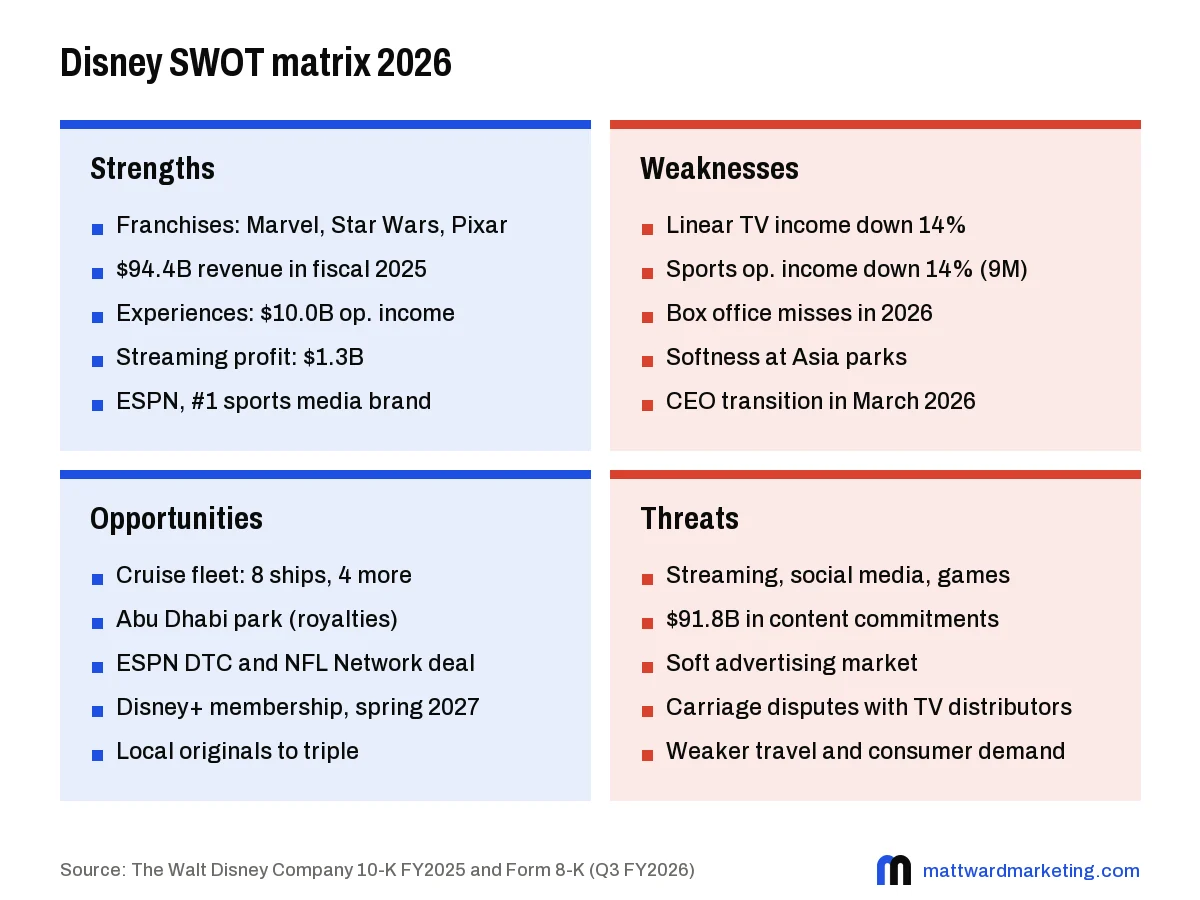
Disney SWOT matrix
| Strengths | Weaknesses |
|---|---|
| Disney, Pixar, Marvel, Star Wars and National Geographic; $94.4B revenue in fiscal 2025; Experiences operating income of $10.0B; streaming operating income of $1.3B; ESPN | Linear Networks revenue down 12% and operating income down 14% in fiscal 2025; Sports operating income down 14% in the first nine months of fiscal 2026; box office misses; Asia parks softness; CEO transition |
| Opportunities | Threats |
| Eight cruise ships and four more planned; Abu Dhabi resort royalties; ESPN streaming and the NFL Network deal; Disney+ membership from spring 2027; more local originals | Streaming, social media and video games; $91.8B in programming commitments; soft advertising market; carriage disputes; weaker travel and consumer demand |
What does Disney’s SWOT mean for marketers?
Disney’s SWOT shows the value of building a brand that people can use in many places. One film can sell tickets, streaming subscriptions, toys, hotel nights and cruises. In fiscal 2025, Experiences earned more than half of Disney’s segment operating income because fans pay to step inside the stories.
Small businesses can apply the same idea at their own scale. Turn your best-known product or story into several touchpoints: content, an event, a membership or merchandise. Then measure which channel brings people back. Disney is doing the same with Disney+, which it wants to become the “digital centerpiece” of the company.
Disney’s leadership puts it this way in the August 5, 2026, shareholder letter: “We are the only entertainment company with a profitable, scaled leadership position in both the physical and digital worlds.” You can compare this approach with other brands in our Nike SWOT analysis and Google SWOT analysis, or browse every SWOT analysis on the site.
FAQ
What are Disney’s biggest strengths?
Its franchises, parks and scale. Disney, Pixar, Marvel and Star Wars feed film, streaming, parks and products; Experiences earned a record $10.0 billion of operating income in fiscal 2025; and total revenue reached $94.4 billion. Streaming also became profitable, with $1.3 billion of operating income in fiscal 2025.
What is Disney’s main weakness?
Its reliance on shrinking linear TV and costly sports rights. Linear Networks revenue fell 12% and operating income fell 14% in fiscal 2025, and Sports operating income dropped 14% in the first nine months of fiscal 2026.
What threats does Disney face in 2026?
Competition for viewers’ time from streaming services, social media and video games; $91.8 billion in programming commitments; a soft advertising market; carriage disputes with TV distributors; and weaker travel and consumer demand, especially in Asia.
Who is Disney’s CEO in 2026?
Josh D’Amaro. The board appointed him on February 2, 2026, and he became CEO on March 18, 2026, succeeding Robert A. Iger, who stayed on as Senior Advisor and as a director through December 31, 2026.
Sources
- The Walt Disney Company Form 10-K for the fiscal year ended September 27, 2025, filed November 13, 2025 (SEC EDGAR).
- The Walt Disney Company fourth quarter and full year fiscal 2025 earnings release, Form 8-K, November 13, 2025 (SEC EDGAR).
- The Walt Disney Company Form 10-Q for the quarter ended June 27, 2026, filed August 5, 2026 (SEC EDGAR).
- The Walt Disney Company third quarter fiscal 2026 earnings release and shareholder letter, Form 8-K, August 5, 2026 (SEC EDGAR).
- The Walt Disney Company Form 8-K on the appointment of Josh D’Amaro as CEO, February 2, 2026 (SEC EDGAR).
- The Walt Disney Company Form 8-K, March 18, 2026 (SEC EDGAR).