Google SWOT Analysis (2026): Strengths, Weaknesses, Opportunities & Threats
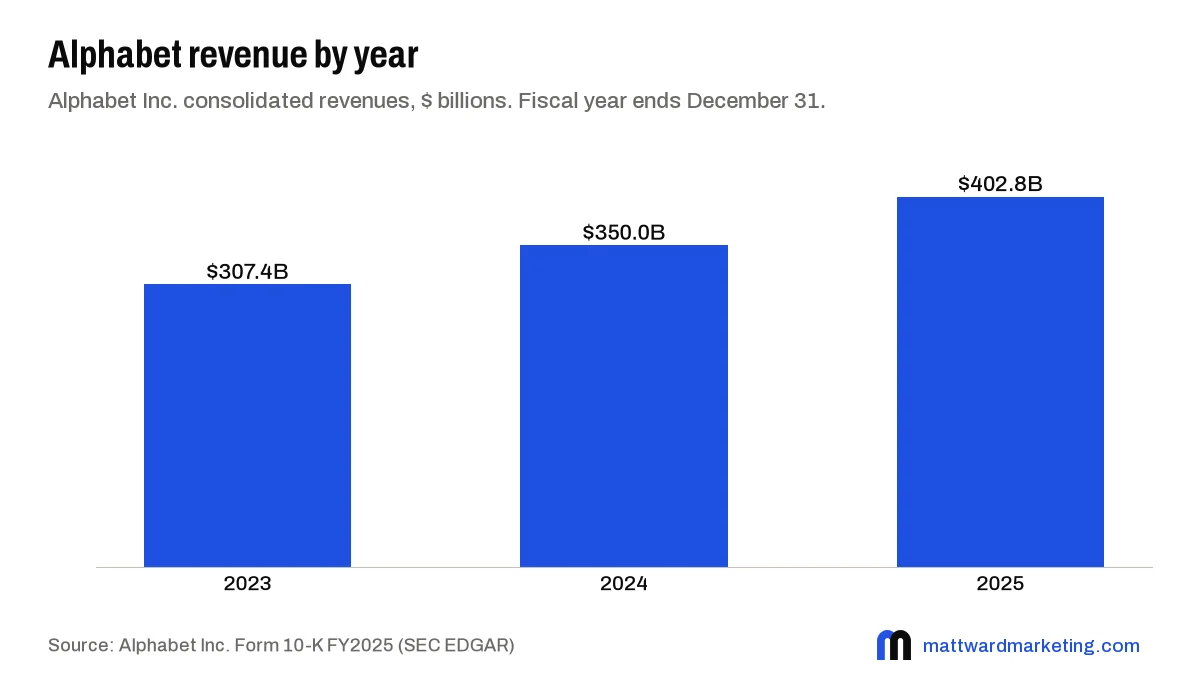
A Google SWOT analysis for 2026 shows a search and advertising giant that is now growing fastest in cloud computing and AI. This guide sets out Google’s strengths, weaknesses, opportunities and threats, with every figure taken from Alphabet’s fiscal 2025 annual report and its results for the third quarter of 2026.
Key takeaways
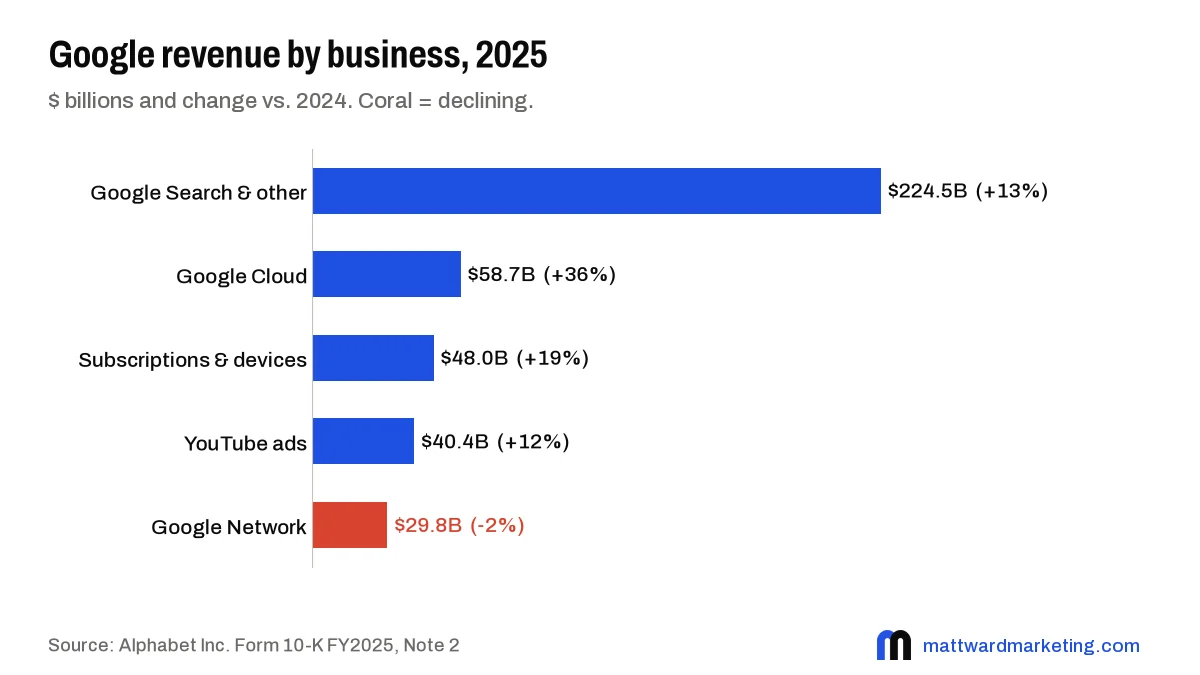
- Google’s biggest strength is Search: Google Search & other brought in $224.5 billion in 2025, more than half of Alphabet’s $402.8 billion revenue.
- Its main weakness is dependence on ads, which made up more than 70% of Alphabet revenue in 2025.
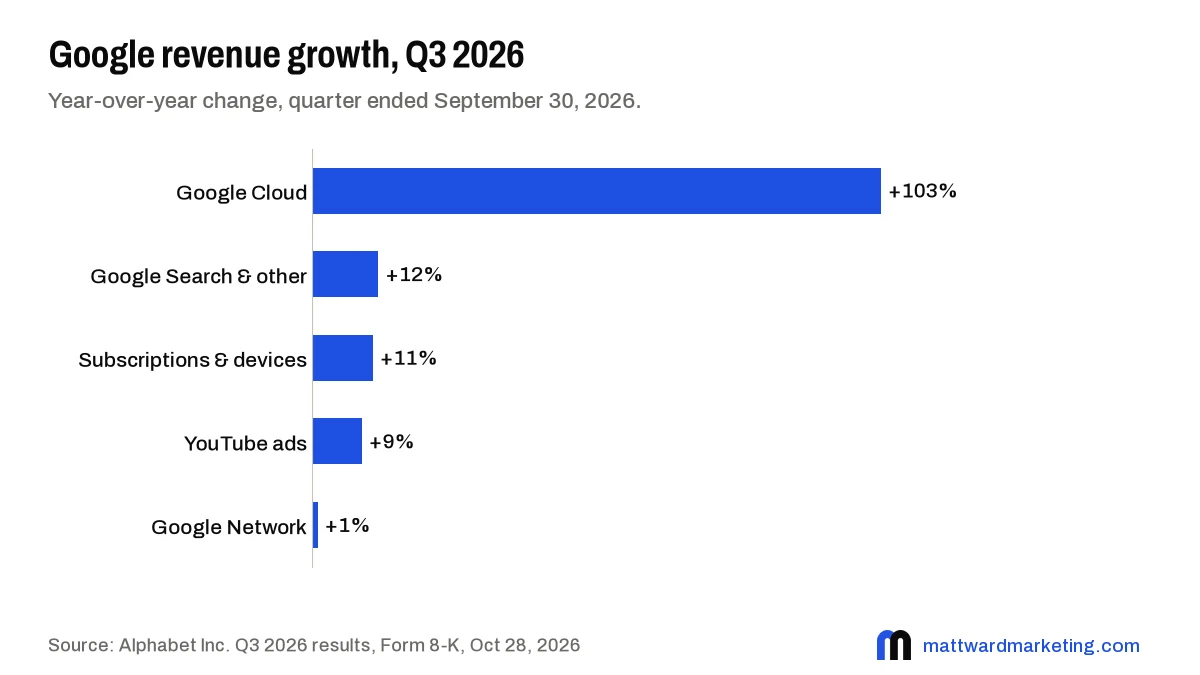
- Google Cloud is the clearest opportunity: revenue grew 103% to $30.7 billion in the quarter ended September 30, 2026.
- AI is both an opportunity and a threat: the Gemini app reached one billion users, but AI chatbots also give people new ways to find information.
- The biggest external threat is regulation, from the DOJ Search remedies in the US to Digital Markets Act fines in the EU.
What is a SWOT analysis of Google?
A Google SWOT analysis lists the internal strengths and weaknesses of Google and the external opportunities and threats it faces. For 2026, that means a business with dominant Search revenue and a fast-growing cloud unit, but heavy reliance on advertising and a long list of antitrust cases. For example, Search grew 12% in the third quarter of 2026 while Google Cloud doubled.
Google is the largest business of Alphabet Inc., its parent company. Alphabet reports Google in two segments, Google Services and Google Cloud, and groups everything else, such as Waymo, as Other Bets. Sundar Pichai is CEO of both Google and Alphabet. Alphabet had 204,757 employees on September 30, 2026.
| Google at a glance | Figure |
|---|---|
| Alphabet revenue, 2025 | $402.8B (up 15%) |
| Alphabet net income, 2025 | $132.2B (up 32%) |
| Google Services revenue, 2025 | $342.7B (up 12%) |
| Google Cloud revenue, 2025 | $58.7B (up 36%) |
| Alphabet revenue, Q3 2026 | $127.6B (up 25%) |
| Operating margin, Q3 2026 | 31.8% |
| Employees, September 30, 2026 | 204,757 |
What are Google’s biggest strengths?
Google’s biggest strengths are Search, scale across billions of users and the cash to fund AI. Google Search & other earned $224.5 billion in 2025, and Alphabet says 15 of its products have at least half a billion users. On September 30, 2026, Alphabet held $265.1 billion in cash, cash equivalents and marketable securities.
1. Search is still the engine
Google Search & other revenue rose 13% to $224.5 billion in 2025. In the third quarter of 2026 it grew another 12%, to $63.4 billion, and paid clicks rose 8%. Pichai said in October 2026 that “our AI investments are driving overall Search query growth, including commercial queries.”
2. Products with billions of users
Alphabet’s 10-K says all 15 of its half-billion-user products use Gemini models, and seven of them have two billion users. Those products include Android, Chrome, Gmail, Google Drive, Google Maps, Google Play, Search and YouTube. The Gemini app reached one billion users by October 2026.
3. A full AI stack
Google builds its own AI chips, called Tensor Processing Units (TPUs), its own Gemini models and the products that use them. Alphabet calls this AI-optimized infrastructure “a key differentiator.” Its first-party model APIs processed nearly 32 billion tokens per minute in the third quarter of 2026.
4. Money to keep investing
Alphabet generated $164.7 billion of operating cash flow in 2025. It says it has invested more than $200 billion in research and development over the last five years.
What is Google’s main weakness?
Google’s main weakness is its dependence on advertising. Alphabet generated more than 70% of its total revenue from online advertising in 2025, so a drop in ad spending hits the whole company. Google Network, the ads Google places on partner sites and apps, is also shrinking: its revenue fell $567 million in 2025.
1. Too much revenue from ads
Search, YouTube and Google Network ads brought in $294.7 billion in 2025. Alphabet warns that advertisers can end many of their contracts at any time.
2. Google Network is losing ground
Google Network revenue fell to $29.8 billion in 2025 because of lower AdSense revenue. In the third quarter of 2026, Network impressions fell 14%.
3. Expensive moonshots
Other Bets, which include Waymo, lost $7.5 billion in 2025, including a $2.1 billion compensation charge for Waymo. In February 2026, Waymo raised $16.0 billion, most of it from Alphabet.
4. Huge spending on data centers
Capital expenditures reached $91.4 billion in 2025 and $132.0 billion in the first nine months of 2026. If AI demand slows, that spending could weigh on margins.
5. Costly legal losses
In July 2026, Google paid $5.2 billion for the EU Android fine plus interest, after the European Court of Justice denied its final appeal.
What opportunities does Google have?
Google’s biggest opportunities are cloud computing, AI products and subscriptions. Google Cloud revenue grew 103% to $30.7 billion in the third quarter of 2026, and its revenue backlog reached $560.8 billion. Google is also testing new ad formats built for AI Mode in Search and selling more YouTube and Google One subscriptions.
1. Google Cloud and enterprise AI
Google Cloud competes with other large enterprise cloud providers. Its operating income rose from $3.6 billion to $11.1 billion in the third quarter of 2026. Google completed its $29.5 billion purchase of the cloud security firm Wiz on March 11, 2026.
2. Selling TPU systems
Google now sells TPU systems to customers, not just cloud access to them. Alphabet says these sales were a meaningful contributor to revenue growth in the third quarter of 2026.
3. Ads inside AI answers
At Google Marketing Live on May 20, 2026, Google announced Conversational Discovery ads and Highlighted Answers for AI Mode. Both formats stay labeled as “Sponsored.”
4. Subscriptions and devices
Google subscriptions, platforms and devices revenue rose 19% to $48.0 billion in 2025. YouTube Music and Premium passed 150 million subscribers, including trials, in October 2026. Higher Pixel sales also lifted devices revenue in the third quarter of 2026.
5. Waymo and quantum computing
Waymo already runs paid, fully autonomous ride-hailing in several cities. Alphabet also names quantum computing among the frontier technologies it invests in for the long term.
What threats does Google face in 2026?
Google’s main threats are AI competition, antitrust remedies and new tech regulation. Alphabet’s 10-K warns that new entrants may offer experiences that are “substantially similar to or better than ours.” Courts and regulators in the US and the EU have also ordered Google to change how Search and its ad technology work.
1. AI chatbots and new entrants
Alphabet’s 10-K lists AI model developers among its competitors, along with general search engines, e-commerce sites and social networks. That group includes rival search engines and the makers of AI chatbots. If people get answers from a chatbot, they may run fewer Google queries.
2. The DOJ Search case
A US court ruled against Google in August 2024. The final judgment of December 2025 restricts how Google distributes its services and requires it to share some search data with competitors. Both sides appealed in early 2026.
3. Ad tech rulings
In September 2026, a US court denied the DOJ’s request to break up Google’s ad tech business but ordered behavioral remedies. In the EU, Google is appealing a €3.0 billion ad tech fine from September 2025.
4. The Digital Markets Act
In July 2026, the European Commission fined Google €430 million over Google Play and €460 million over Search under the Digital Markets Act. Google appealed both decisions in October 2026.
5. Competition for AI talent
Alphabet says competition for AI talent is intense and that some rivals have directly targeted its employees.
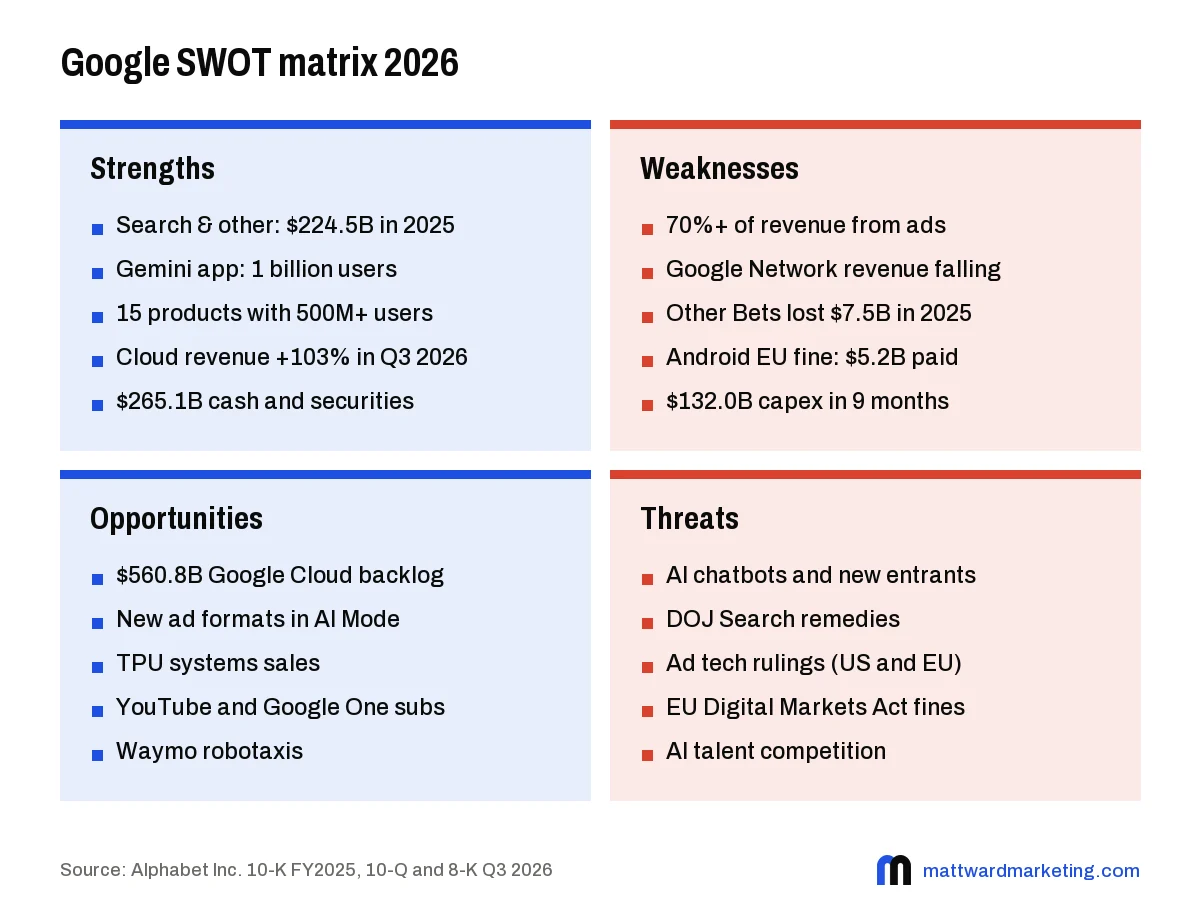
Google SWOT matrix
| Strengths | Weaknesses |
|---|---|
| Search & other: $224.5B in 2025; 15 products with 500M+ users; Gemini app with 1 billion users; own TPUs and Gemini models; $265.1B in cash and securities | More than 70% of revenue from ads; Google Network revenue falling; Other Bets lost $7.5B in 2025; $132.0B capex in nine months of 2026; $5.2B Android fine paid |
| Opportunities | Threats |
| Google Cloud up 103% in Q3 2026; $560.8B Cloud backlog; TPU systems sales; ads in AI Mode; subscriptions up 19% in 2025; Waymo | AI chatbots and new entrants; DOJ Search remedies; ad tech rulings in the US and EU; Digital Markets Act fines; competition for AI talent |
What does Google’s SWOT mean for marketers?
Google’s SWOT shows that the company is rebuilding its core product around AI while protecting its ad revenue. For marketers, Search is changing but not shrinking: paid clicks rose 8% in the third quarter of 2026. The practical move is to prepare campaigns and content for AI answers, not only for ten blue links.
- Test the new AI-driven campaign types, such as AI Max and Performance Max, before the new AI Mode formats roll out widely.
- Watch YouTube: its ad revenue grew 9% in the third quarter of 2026, led by brand advertising.
- Do not rely on Google Network alone for reach, since its impressions are falling.
- Compare Google with other big platforms: read our Amazon SWOT analysis and Apple SWOT analysis, or browse all our SWOT analysis guides.
FAQ
What are Google’s biggest strengths?
Search, scale and cash. Google Search & other earned $224.5 billion in 2025, 15 Google products have at least half a billion users, the Gemini app reached one billion users, and Alphabet held $265.1 billion in cash and marketable securities on September 30, 2026.
What is Google’s main weakness?
Its dependence on advertising. Online ads made up more than 70% of Alphabet’s revenue in 2025, and Google Network revenue is falling as AdSense shrinks.
What threats does Google face in 2026?
AI chatbots and other new ways to find information, the DOJ Search remedies, ad tech rulings in the US and the EU, Digital Markets Act fines of €430 million and €460 million, and fierce competition for AI talent.
Sources
- Alphabet Inc. Form 10-K for the fiscal year ended December 31, 2025, filed February 5, 2026 (SEC EDGAR).
- Alphabet Inc. Form 10-Q for the quarter ended September 30, 2026, filed October 29, 2026 (SEC EDGAR).
- Alphabet Announces Third Quarter 2026 Results, Exhibit 99.1 to Form 8-K, October 28, 2026 (SEC EDGAR).
- Google, “New ad formats built with Gemini coming to Google Search,” The Keyword, May 20, 2026 (blog.google).