Mercedes-Benz SWOT Analysis (2026): Strengths, Weaknesses, Opportunities & Threats
A Mercedes-Benz SWOT analysis for 2026 shows a luxury car brand with record electric sales and growth in Europe and the U.S., but collapsing sales in China and thin car margins. This guide sets out Mercedes-Benz’s strengths, weaknesses, opportunities and threats, with every figure taken from its 2025 annual report and its results for the quarter ended September 30, 2026.
Key takeaways
- Mercedes-Benz’s biggest strength is its luxury brand: Mercedes-AMG delivered 145,000 cars in 2025 and the G-Class had its best year ever.
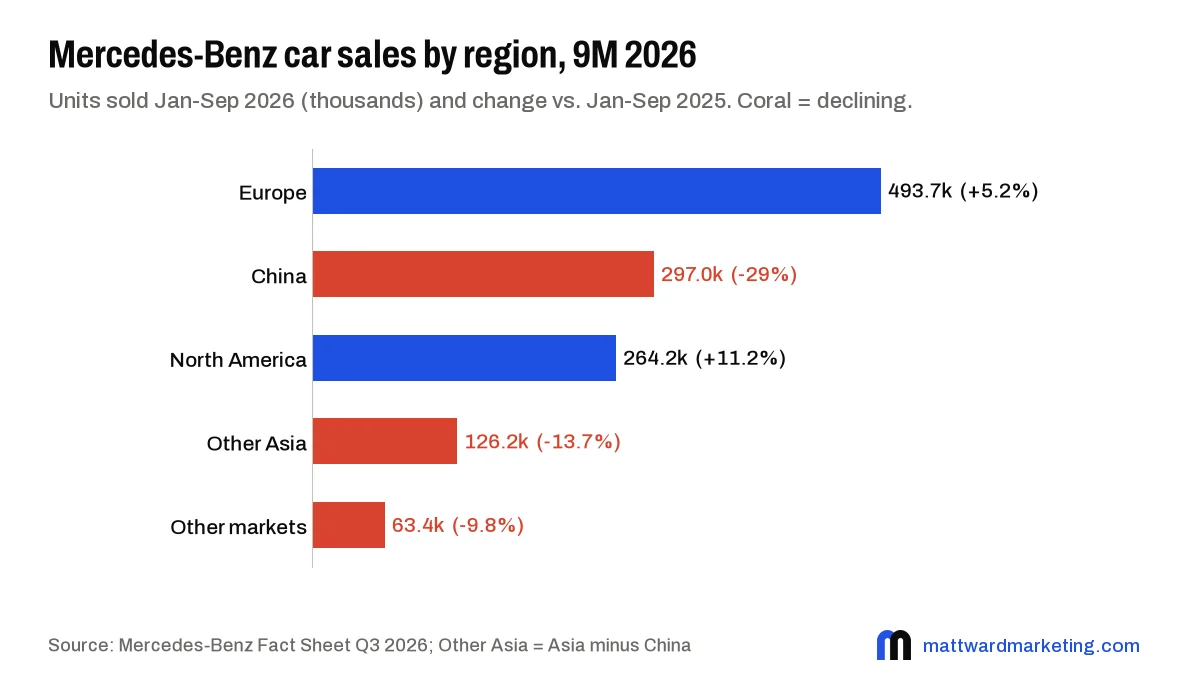
- Its main weakness is China, where Mercedes-Benz car sales fell 29.0% in the first nine months of 2026.
- Car profitability is thin: Mercedes-Benz Cars earned an adjusted return on sales of just 2.5% in the third quarter of 2026.
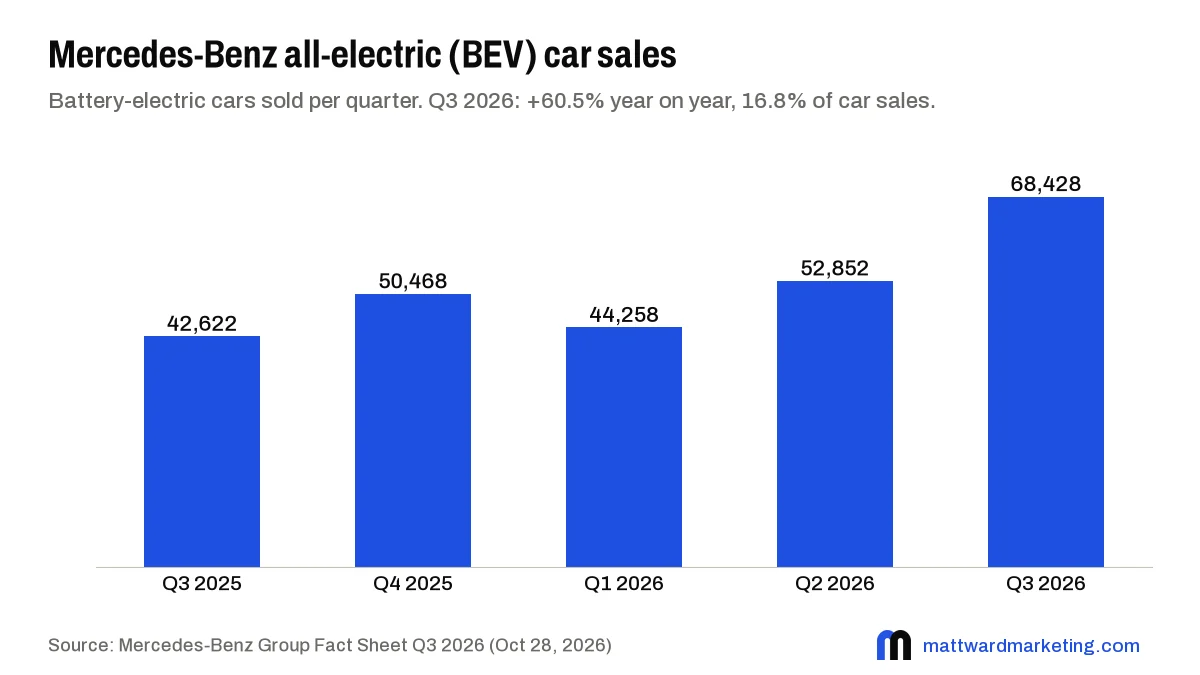
- The clearest opportunity is electric cars, with record battery-electric sales of 68,428 units in Q3 2026, up 60.5%.
- The biggest threats are intense competition in China, U.S. tariff policy and currency headwinds, which led Mercedes-Benz to cut its 2026 guidance in October.
What is a SWOT analysis of Mercedes-Benz?
A Mercedes-Benz SWOT analysis lists the company’s internal strengths and weaknesses and the external opportunities and threats it faces. For 2026, that means a German luxury automaker with strong brands and a solid balance sheet, but falling car sales in China. For example, car sales rose 5.2% in Europe but fell 29.0% in China from January to September 2026.
Mercedes-Benz Group AG, the former Daimler AG, is based in Stuttgart, Germany. It has three divisions: Mercedes-Benz Cars (sedans, SUVs and sports cars), Mercedes-Benz Vans and Mercedes-Benz Financial Services. It reports in euros and had 164,120 employees worldwide on December 31, 2025.
| Mercedes-Benz at a glance | 2025 (year ended Dec. 31, 2025) | Q1-Q3 2026 |
|---|---|---|
| Revenue | €132.2B (2024: €145.6B) | €94.4B (down 4.2%) |
| EBIT / adjusted EBIT | €5.8B / €8.2B (2024 adjusted: €13.7B) | €5.2B / €5.8B |
| Cars sold | About 1.8 million (down 9%) | 1,244,427 (down 7.2%) |
| Vans sold | 359,100 (down 11%) | 258,752 (down 0.5%) |
| Free cash flow, industrial business | €5.4B (2024: €9.2B) | €3.1B (Q1-Q3 2025: €5.6B) |
| Net liquidity, industrial business | €32.2B | €31.0B (September 30, 2026) |
What are Mercedes-Benz’s biggest strengths?
Mercedes-Benz’s biggest strengths are its luxury brands, its vans and finance units, and its cash. In 2025 it sold 268,000 Top-End vehicles such as the S-Class, AMG and Maybach models, 15% of its car sales. On September 30, 2026, its industrial business held €31.0 billion in net liquidity.
1. A portfolio of luxury brands
Mercedes-AMG delivered 145,000 performance cars in 2025, up 7%. The G-Class had its best year ever, with 49,700 deliveries (up 23%). Every third S-Class sold in 2025 was a Mercedes-Maybach.
2. Products that win awards
The new electric CLA was named Europe’s “Car of the Year 2026”. In October 2026, the new S-Class was named “2027 MotorTrend Car of the Year”, and the electric GLC was named “German Premium Car of the Year 2027”.
3. Vans and Financial Services carry profits
Mercedes-Benz Vans earned an adjusted return on sales of 9.9% in the first nine months of 2026. Adjusted EBIT at Mercedes-Benz Financial Services rose 52% to €1.35 billion over the same period. Nearly one in two vehicles sold in Q3 2026 was financed or leased through the company.
4. A strong balance sheet
In the first nine months of 2026, Mercedes-Benz spent €6.4 billion on research and development and returned €5.2 billion to shareholders through dividends and buybacks. Net liquidity still stayed close to the year-end level.
What is Mercedes-Benz’s main weakness?
Mercedes-Benz’s main weakness is its dependence on a shrinking Chinese market and its low car margins. Car sales in China fell 29.0% to 297,037 units in the first nine months of 2026. In the third quarter, Mercedes-Benz Cars earned an adjusted return on sales of 2.5%, down from 4.8% a year earlier.
1. China is falling fast
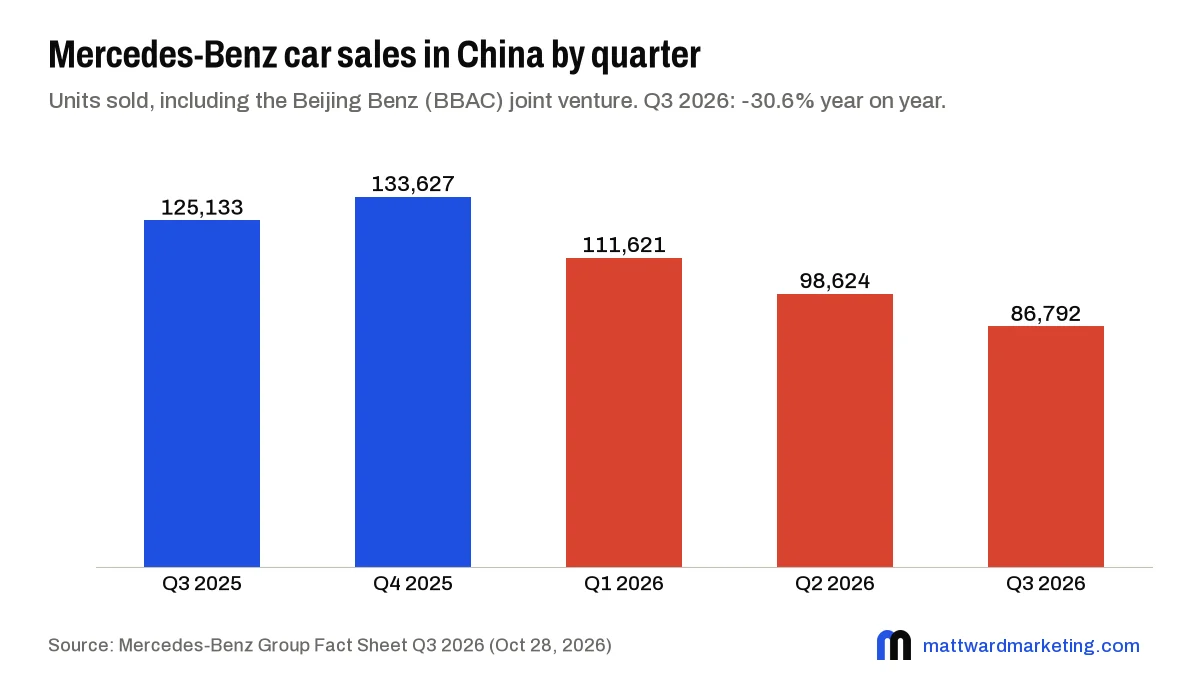
China was Mercedes-Benz’s largest single car market in 2025, with 551,900 sales, down 19%. In Q3 2026, sales there fell another 30.6% to 86,792 units. Group revenue from China dropped 23.9% in the first nine months of 2026.
2. Car profitability has collapsed
Adjusted EBIT at Mercedes-Benz Cars fell from €8.7 billion in 2024 to €4.8 billion in 2025. The adjusted return on sales dropped from 8.1% to 5.0%, against a medium-term goal of 8% to 10%.
3. The top of the range is shrinking
Top-End sales, which include the S-Class, GLS, EQS, AMG and Maybach, fell 12.3% to 173,486 units in the first nine months of 2026. Their share of car sales slipped to 13.9%.
4. Write-downs in China
The second and third quarters of 2026 included €752 million of impairments on Chinese equity-method investments. Mercedes-Benz also booked a €136 million risk provision for a financing commitment to smart.
What opportunities does Mercedes-Benz have?
Mercedes-Benz’s opportunities are electric cars, its new model wave and lower costs. Battery-electric car sales hit a record 68,428 in Q3 2026, up 60.5%, and reached 16.8% of car sales. The company is launching more than 40 new models by 2027 under its largest-ever product launch program.
- Grow electric sales: in Q3 2026, almost one in two cars sold in Europe was electrified, and one in three was fully electric.
- Sell the new models: order books for key models in Europe extend well into 2027.
- Build on Europe and the U.S.: car sales rose 5% in Europe, 13% in Germany and 6% in the U.S. in Q3 2026.
- Scale software: the MB.OS operating system goes into every new or updated model, and Mercedes-Benz is expanding its automated-driving partnership with NVIDIA.
- Cut costs: Mercedes-Benz targets a 10% fixed-cost reduction between 2024 and 2027 and 10% lower production costs per unit from 2027.
It does not bet only on electric cars. The company says it offers both all-electric vehicles and combustion engines with 48-volt hybrid technology, and it still sold 33,472 plug-in hybrids in Q3 2026.
What threats does Mercedes-Benz face in 2026?
Mercedes-Benz’s main threats are competition in China, trade policy and currency swings. On October 28, 2026, it cut its 2026 outlook for Mercedes-Benz Cars to an adjusted return on sales of 2% to 3%, from 3% to 5%. It now expects Group EBIT at the prior-year level and much lower free cash flow.
1. Intense competition in China
Mercedes-Benz blames “challenging market conditions and intense competition in China” for its Q3 2026 sales decline. CEO Ola Källenius said that “market conditions have become even more challenging over the course of the year, particularly in China.”
2. U.S. tariffs
The 2025 annual report says U.S. tariff policy “posed a significant challenge” and hurt results. Excluding tariffs, the 2025 adjusted return on sales at Mercedes-Benz Cars would have been 6.1% instead of 5.0%.
3. Currency and costs
Currency headwinds weighed on Q3 2026 results. The October 2026 guidance cut also cited higher fourth-quarter costs for raw materials and product lifecycle measures.
4. Falling cash generation
Free cash flow of the industrial business fell 44% to €3.1 billion in the first nine months of 2026. That included about €1.1 billion of cash outflows for restructuring, mainly a voluntary severance program in Germany.
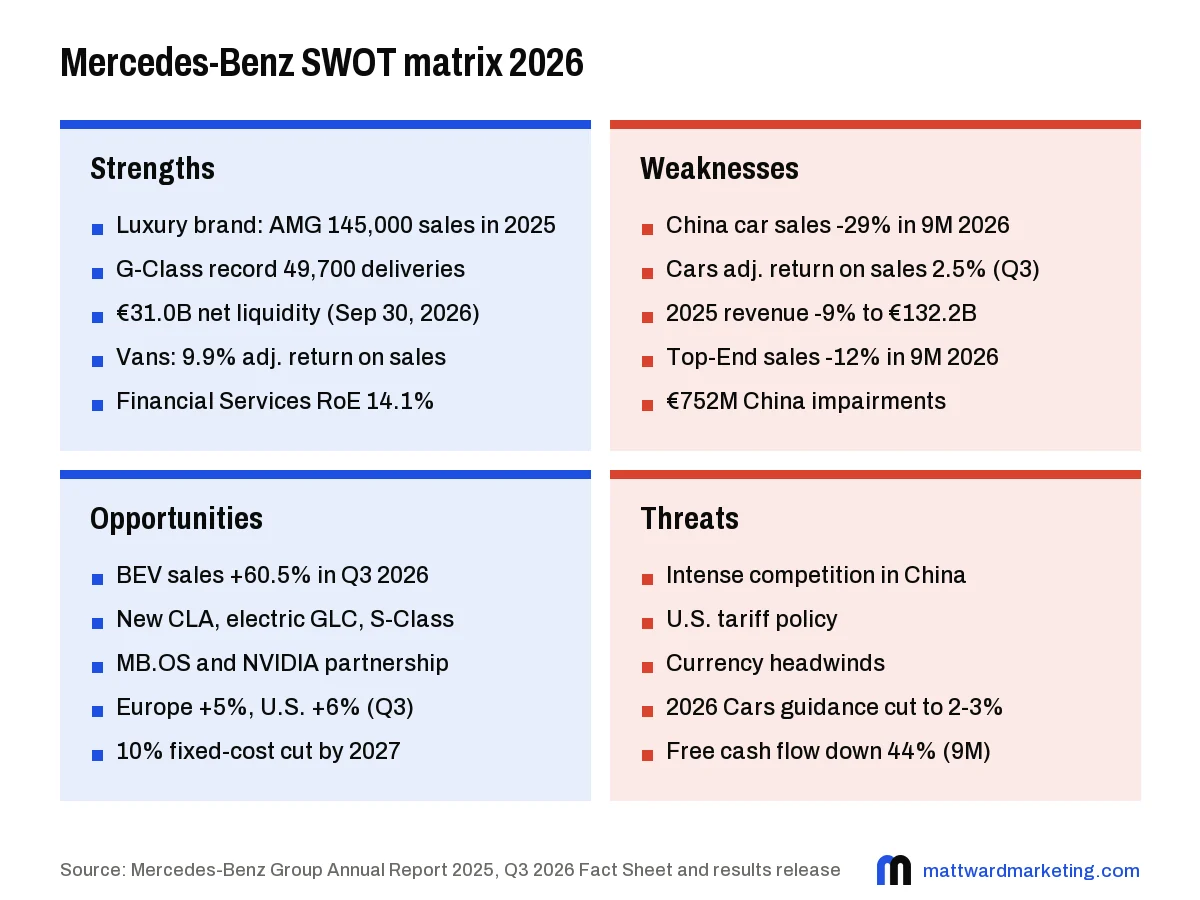
Mercedes-Benz SWOT matrix
| Strengths | Weaknesses |
|---|---|
| AMG delivered 145,000 cars in 2025; G-Class record of 49,700; Top-End vehicles 15% of 2025 car sales; Vans 9.9% adjusted return on sales; €31.0B net liquidity | China car sales down 29.0% in 9M 2026; Cars adjusted return on sales 2.5% in Q3 2026; 2025 revenue down 9% to €132.2B; Top-End sales down 12.3%; €752M China impairments |
| Opportunities | Threats |
| BEV sales up 60.5% in Q3 2026; new CLA, electric GLC and S-Class; MB.OS and NVIDIA partnership; growth in Europe and the U.S.; 10% fixed-cost cut by 2027 | Intense competition in China; U.S. tariff policy; currency headwinds; 2026 Cars guidance cut to 2-3%; free cash flow down 44% in 9M 2026 |
What does Mercedes-Benz’s SWOT mean for marketers?
Mercedes-Benz’s SWOT shows that a luxury brand still needs the right product in each market. Its new electric CLA and GLC are selling well in Europe, where car sales rose 5.2% in the first nine months of 2026. In China, where the company reports intense competition, the same brand lost 29.0% of its car sales.
Three lessons stand out:
- Premium pricing depends on product leadership. Awards for the CLA and S-Class give Mercedes-Benz a story to tell, but only new models with new technology are moving sales.
- Do not rely on one market. China was Mercedes-Benz’s largest car market in 2025, and its decline now drags on the whole Group.
- Give buyers a choice. Mercedes-Benz sells electric, plug-in hybrid and combustion models side by side, so it can follow demand in each region.
For more brand breakdowns, see our SWOT analysis library, including the Nike SWOT analysis.
FAQ
What are Mercedes’s biggest strengths?
Its luxury brands, profitable vans and finance units, and cash. Mercedes-AMG delivered 145,000 cars in 2025, the G-Class sold a record 49,700 units, and the industrial business held €31.0 billion in net liquidity on September 30, 2026.
What is Mercedes’s main weakness?
Falling sales and profits in China. Mercedes-Benz car sales in China fell 29.0% in the first nine months of 2026, and Mercedes-Benz Cars earned an adjusted return on sales of only 2.5% in Q3 2026.
What threats does Mercedes face in 2026?
Intense competition in China, U.S. tariff policy, currency headwinds and higher raw-material costs. In October 2026, Mercedes-Benz cut its 2026 margin outlook for cars to 2% to 3% and now expects much lower free cash flow.
Sources
- Mercedes-Benz Group, Annual Report 2025 (employees, tariffs), published 2026 (PDF).
- Mercedes-Benz Group, Full Year Results 2025, February 12, 2026 (investor relations).
- Mercedes-Benz Group, “Mercedes-Benz sold 2.2 million cars and vans in 2025”, sales release, January 12, 2026 (newsroom).
- Mercedes-Benz Group, 3rd Quarter Results 2026, October 28, 2026 (investor relations).
- Mercedes-Benz Group, Fact Sheet for Q3 2026, October 28, 2026 (PDF).
- Mercedes-Benz Group, Outlook 2026, updated October 28, 2026 (investor relations).