Tesla SWOT Analysis (2026): Strengths, Weaknesses, Opportunities & Threats
A Tesla SWOT analysis for 2026 shows the best-known electric car brand turning into an AI, robotaxi and energy company, while its car business stalls. This guide sets out Tesla’s strengths, weaknesses, opportunities and threats, with every figure taken from its fiscal 2025 10-K and its filings for the quarter ended September 30, 2026.
Key takeaways
- Tesla’s biggest strength is its balance sheet and network: it held $45.4 billion in cash and investments and ran 84,465 Supercharger connectors on September 30, 2026.
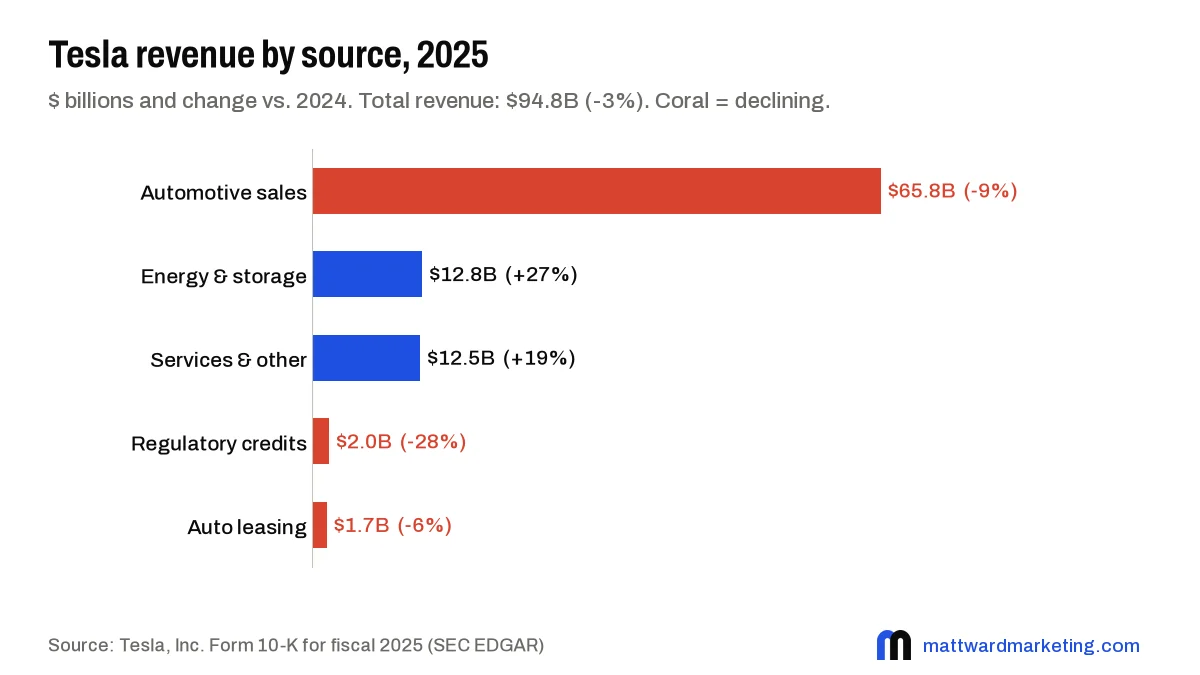
- Its main weakness is a shrinking car business: automotive sales revenue fell 9% in 2025, and total revenue fell 3% to $94.8 billion.
- Profits are under pressure: net income attributable to stockholders fell from about $7.1 billion in 2024 to $3.79 billion in 2025.
- The clearest opportunities are autonomy and energy storage: active FSD subscriptions reached 1.74 million, and Robotaxi rides in Cybercabs began in Austin in September 2026.
- The biggest threats are more EV rivals, the loss of U.S. EV tax credits and regulatory credit sales, tariffs and capital spending above $20 billion in 2026.
What is a SWOT analysis of Tesla?
A Tesla SWOT analysis lists the company’s internal strengths and weaknesses and the external opportunities and threats it faces. For 2026, that means a cash-rich EV maker with a fast-growing energy business, but flat car sales and falling profits. For example, energy storage revenue grew 27% in 2025 while automotive sales revenue fell 9%.
Tesla, Inc. designs, makes and sells electric vehicles, batteries and energy storage, solar products, and software such as FSD (Supervised). Its 10-K states the mission as “building a world of amazing abundance.” It had 134,785 employees worldwide on December 31, 2025, and Elon Musk is its CEO.
| Tesla at a glance | Fiscal 2025 (year ended Dec. 31, 2025) | Q3 2026 (quarter ended Sep. 30, 2026) |
|---|---|---|
| Total revenue | $94.8B (down 3%) | $28.0B (flat year on year) |
| Net income to common stockholders (GAAP) | $3.79B | $787M (Q3 2025: $1,373M) |
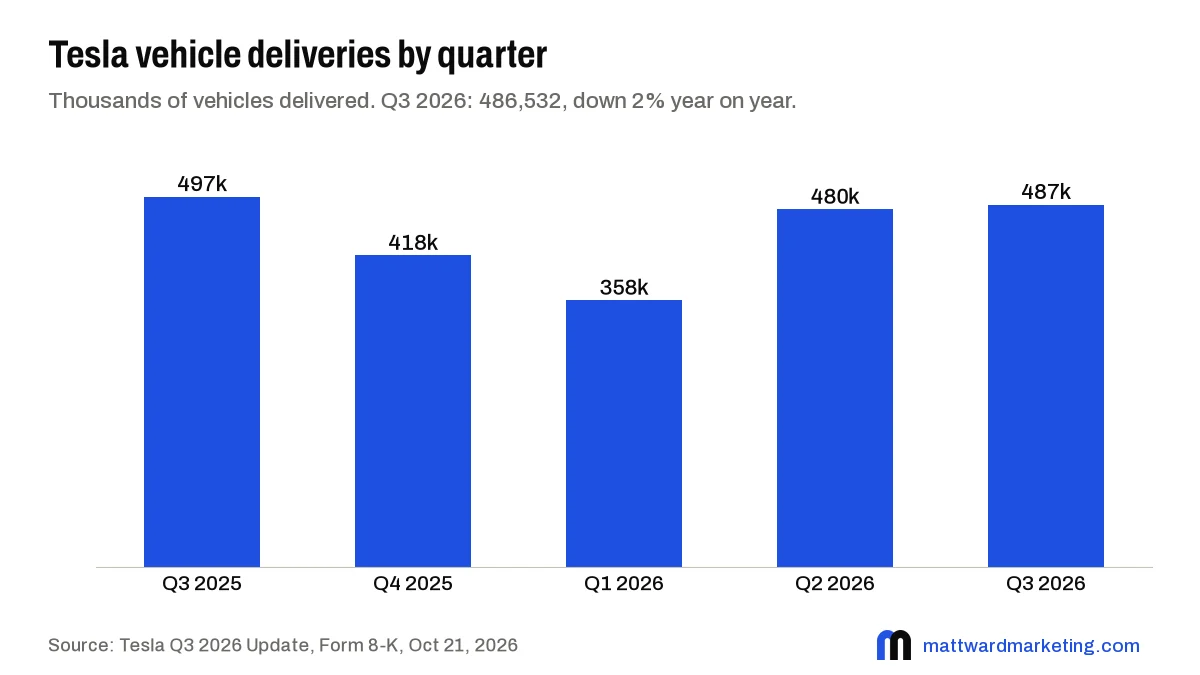
| Vehicles delivered | 1,636,129 | 486,532 (down 2%) |
| Energy storage deployed | 46.7 GWh | 13.7 GWh |
| Total gross margin | 18.0% | 19.6% |
| Cash, cash equivalents and investments | $44.1B | $45.4B |
What are Tesla’s biggest strengths?
Tesla’s biggest strengths are its cash, its charging network and its in-house technology. It ended Q3 2026 with $45.4 billion in cash and short-term investments, 8,904 Supercharger stations and 1.74 million active FSD subscriptions. All major automakers have announced adoption of Tesla’s North American Charging Standard (NACS) in certain markets.
1. A strong balance sheet
Tesla generated $14.75 billion of operating cash flow in 2025 and $6.3 billion in Q3 2026 alone. The 10-K says this growth has allowed the business to generally fund itself.
2. The Supercharger network
Supercharger connectors grew from 73,817 to 84,465 in the year to September 30, 2026. Paid Supercharging sessions helped services and other revenue rise 19% in 2025.
3. A profitable energy business
Energy generation and storage revenue rose 27% to $12.8 billion in 2025, with a 29.8% gross margin. That is far above the 17.8% margin on total automotive.
4. Vertical integration
Tesla makes its own 4680 battery cells and shipped the first Megapacks built only with its own LFP cells in Q3 2026. It also builds its own AI training compute and plans to reach 400 MW by the end of 2026.
What is Tesla’s main weakness?
Tesla’s main weakness is a car business that has stopped growing. Automotive sales revenue fell 9% to $65.8 billion in 2025 on lower deliveries and prices. In Q3 2026, deliveries fell 2% to 486,532 and operating income dropped to $718 million from $1,624 million a year earlier.
1. Falling profits
Net income attributable to common stockholders fell $3.30 billion to $3.79 billion in 2025. Research and development spending rose 41% to $6.41 billion, mainly for AI programs.
2. A narrow product line
Model 3 and Model Y made up 1,585,279 of the 1,636,129 vehicles Tesla delivered in 2025. Model S and Model X were discontinued in mid-2026, which cut “other models” deliveries to 8,295 in Q3 2026.
3. Battery supply limits growth
Tesla’s Q3 2026 update says “battery availability continued to be the limiting factor” in raising car volumes. It produced 464,391 vehicles in the quarter, fewer than it delivered.
4. Dependence on Elon Musk
The 10-K warns that Tesla is “highly dependent on the services of Elon Musk.” It also notes that he does not devote his full time to Tesla, since he also holds management positions at SpaceX, xAI, Neuralink and The Boring Company.
What opportunities does Tesla have?
Tesla’s opportunities are autonomy, energy storage and new products. Its Robotaxi service has logged nearly two million unsupervised miles, and Cybercab joined the Austin fleet on September 3, 2026. Energy storage had its highest-ever order rate and backlog in Q3 2026, driven partly by data center demand.
- Scale Robotaxi: Tesla launched the service in June 2025 and now runs it in Austin from 6 a.m. to midnight.
- Sell more software: FSD (Supervised) is approved in nine EU countries and used by over 100,000 customers there. Active FSD subscriptions grew from 1.04 million to 1.74 million in a year.
- Grow energy storage: Megafactory Texas started production in Q3 2026 with a planned capacity of 50 GWh.
- Expand services: services and other revenue rose 33% to $4.6 billion in Q3 2026.
- Launch new products: Tesla Semi entered volume production in Nevada, Optimus robot production began in Fremont, and the Next Gen Roadster was unveiled on October 15, 2026.
Tesla also ended Q3 2026 with what it calls the largest backlog for its passenger vehicles in four years. If battery supply improves, that backlog could turn into higher deliveries.
What threats does Tesla face in 2026?
Tesla’s main threats are rising competition, policy changes and heavy spending. Its 10-K says a “significant and growing number” of established and new automakers are entering the EV market. The OBBBA, enacted July 4, 2025, removed U.S. tax credits for electric vehicles and restricted the regulatory credit programs Tesla earns from.
1. More competition in EVs
Model 3 and Model Y compete with small and midsize sedans and compact SUVs, which the 10-K calls “extremely competitive markets.” Legacy luxury brands are also pushing EVs: Mercedes-Benz sold a record 68,428 battery-electric cars in Q3 2026, as our Mercedes-Benz SWOT analysis shows.
2. Lost tax and regulatory credits
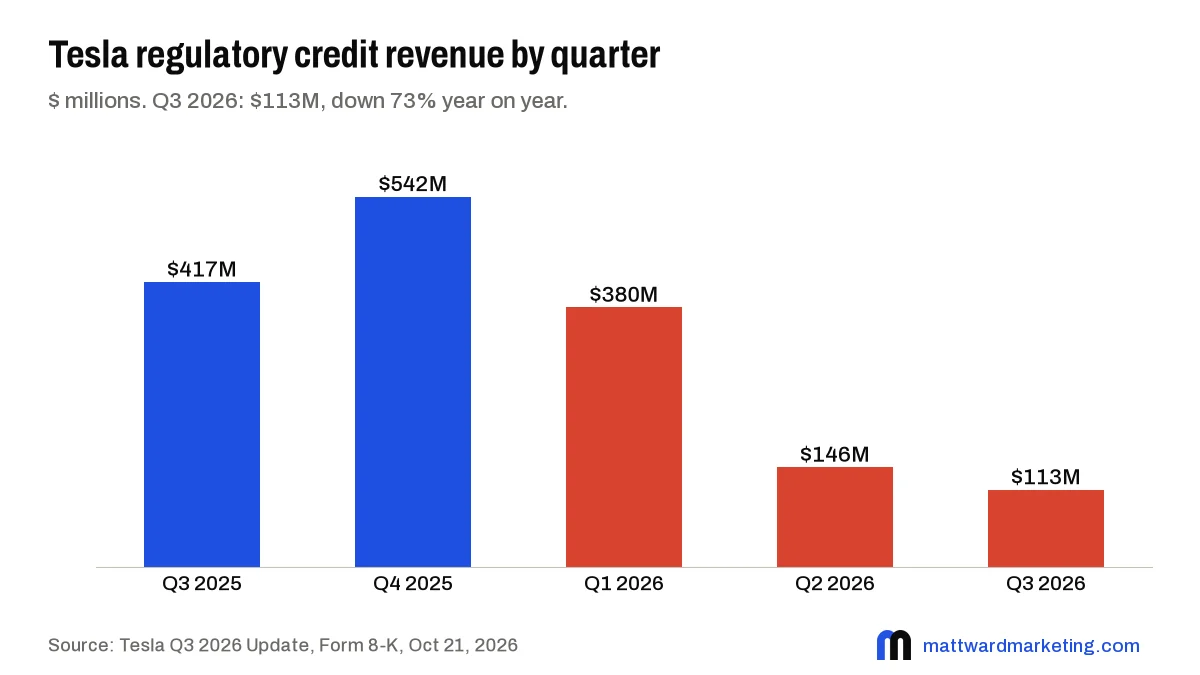
Regulatory credit revenue fell 28% to $2.0 billion in 2025 and 73% to $113 million in Q3 2026. The 10-K names lower credit revenue as a main reason automotive gross margin fell in 2025.
3. Tariffs and trade policy
Tesla says tariffs affect its energy business more than its car business. After the U.S. Supreme Court struck down IEEPA tariffs in February 2026, Tesla recognized $786 million of tariff refunds in Q3 2026, but trade policy remains a listed risk.
4. Heavy capital spending
Tesla expects capital expenditures above $20 billion in 2026, mainly for AI compute, factories and its own fleet. It spent $13.01 billion in the first nine months of 2026, against $6.13 billion a year earlier.
5. Governance questions
In March 2026, Tesla invested $2.00 billion in SpaceX common stock, after its xAI stake converted. Its board has also formed a special committee to explore a closer relationship with SpaceX, possibly a business combination.
Tesla SWOT matrix
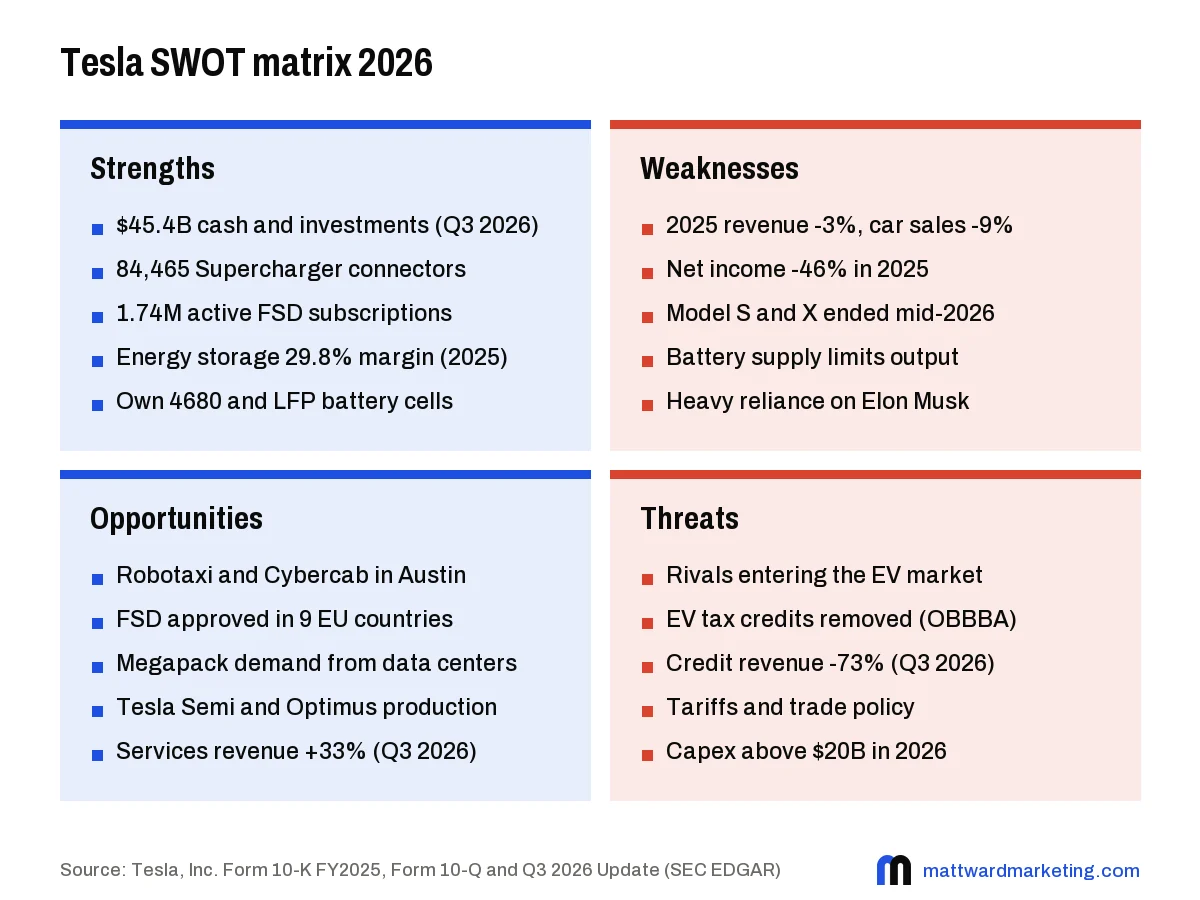
| Strengths | Weaknesses |
|---|---|
| $45.4B cash and investments; 84,465 Supercharger connectors; 1.74M active FSD subscriptions; energy storage gross margin of 29.8% in 2025; in-house 4680 and LFP cells | 2025 revenue down 3% and automotive sales down 9%; 2025 net income down about 46%; Model S and X discontinued in mid-2026; battery supply limits output; heavy reliance on Elon Musk |
| Opportunities | Threats |
| Robotaxi and Cybercab in Austin; FSD approved in 9 EU countries; Megapack demand from data centers; Tesla Semi and Optimus production; services revenue up 33% in Q3 2026 | More automakers in EVs; U.S. EV tax credits removed; regulatory credit revenue down 73% in Q3 2026; tariffs and trade policy; capex above $20B in 2026 |
What does Tesla’s SWOT mean for marketers?
Tesla’s SWOT shows how a brand can shift its story before its numbers shift. It now sells itself as an AI and robotics company, yet cars still produced $65.8 billion of its $94.8 billion revenue in 2025. Its Q3 2026 outlook expects hardware profits to be joined by faster growth in AI, software and fleet-based profits.
Three lessons stand out:
- Infrastructure is marketing. Opening Superchargers to other brands put Tesla’s network in front of drivers who have never owned a Tesla.
- Recurring revenue changes the relationship. FSD subscriptions and paid charging keep customers paying after the sale.
- A founder-led brand carries founder risk. Tesla’s own 10-K lists its dependence on Elon Musk as a risk factor.
For more brand breakdowns, see our SWOT analysis library.
FAQ
What are Tesla’s biggest strengths?
Its cash, its charging network and its technology. Tesla held $45.4 billion in cash and investments on September 30, 2026, ran 84,465 Supercharger connectors and had 1.74 million active FSD subscriptions. Its energy storage business earned a 29.8% gross margin in 2025.
What is Tesla’s main weakness?
A car business that has stopped growing. Automotive sales revenue fell 9% in 2025, deliveries fell 2% in Q3 2026, and the product line now rests almost entirely on Model 3 and Model Y after Model S and X ended in mid-2026.
What threats does Tesla face in 2026?
More automakers selling EVs, the end of U.S. EV tax credits, a 73% drop in regulatory credit revenue in Q3 2026, tariffs and trade policy, and capital spending above $20 billion in 2026.
Sources
- Tesla, Inc. Form 10-K for the fiscal year ended December 31, 2025, filed January 29, 2026 (SEC EDGAR).
- Tesla, Inc. Form 10-Q for the quarter ended September 30, 2026, filed October 22, 2026 (SEC EDGAR).
- Tesla Q3 2026 Update, Form 8-K Exhibit 99.1, October 21, 2026 (SEC EDGAR).
- Tesla Third Quarter 2026 Production, Deliveries & Deployments, Form 8-K Exhibit 99.1, October 2, 2026 (SEC EDGAR).
- Tesla Fourth Quarter 2025 Production, Deliveries & Deployments, Form 8-K Exhibit 99.1, January 2, 2026 (SEC EDGAR).
- Mercedes-Benz Group, Fact Sheet for Q3 2026, October 28, 2026 (Mercedes-Benz BEV sales) (PDF).