Lululemon SWOT Analysis (2026): Strengths, Weaknesses, Opportunities & Threats
A lululemon SWOT analysis for 2026 shows a premium athletic apparel brand with $11.1 billion in revenue and high margins, but falling sales in its home market and a new CEO who says the company has “work to do.” This guide sets out lululemon’s strengths, weaknesses, opportunities and threats, with every figure taken from its fiscal 2025 10-K and its 2026 quarterly filings.
Key takeaways
- lululemon’s biggest strength is a premium brand with high margins: fiscal 2025 revenue was $11.1 billion, with a 56.6% gross margin and a 19.9% operating margin.
- Its main weakness is the Americas, 71% of revenue, where comparable sales fell 12% in the second quarter of fiscal 2026.
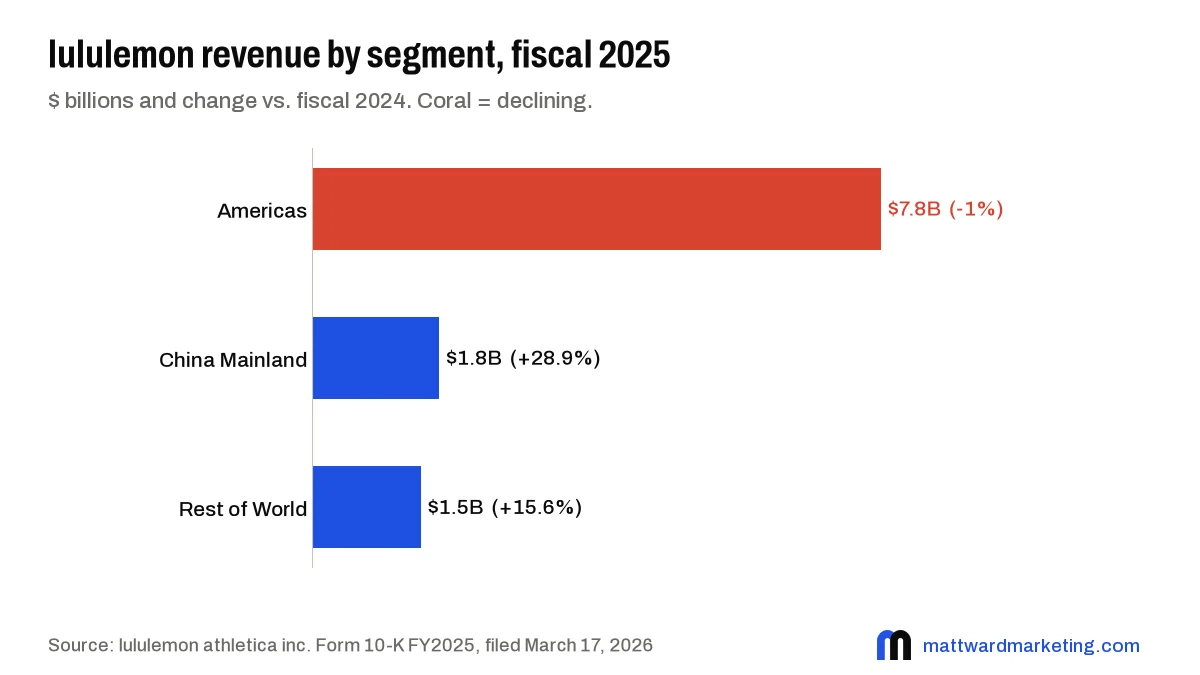
- International markets are the growth engine: China Mainland revenue rose 28.9% and Rest of World 15.6% in fiscal 2025.
- lululemon now expects fiscal 2026 revenue to fall 5% to 7%, to between $10.35 billion and $10.50 billion.
- The main threats are US tariffs, lower-priced “dupe” products, tougher competition and a year of boardroom and leadership change.
What is a SWOT analysis of lululemon?
A lululemon SWOT analysis lists the company’s internal strengths and weaknesses and the external opportunities and threats it faces. For 2026, that means a profitable brand that keeps growing abroad while sales in the US and Canada shrink. For example, in fiscal 2025, Americas revenue fell 1% while international revenue rose 22%.
lululemon athletica inc. designs, distributes and sells technical athletic apparel, footwear and accessories for yoga, running, training and other activities. It opened its first store in Vancouver, British Columbia, in 1998, and Chip Wilson is its founder. It operates in 30 countries and had about 39,000 employees on February 1, 2026.
| lululemon at a glance | Fiscal 2025 (year ended February 1, 2026) |
|---|---|
| Net revenue | $11.1B (up 5%; up 7% excluding the 53rd week of 2024) |
| Income from operations | $2.2B (down 12%), margin 19.9% |
| Gross margin | 56.6% (down 260 basis points) |
| Women’s / Men’s / Accessories and other | $7.0B / $2.7B / $1.4B |
| Company-operated stores / E-commerce | $5.0B / $4.9B |
| Company-operated stores | 811 (44 net new) |
| Employees | About 39,000 |
What are lululemon’s biggest strengths?
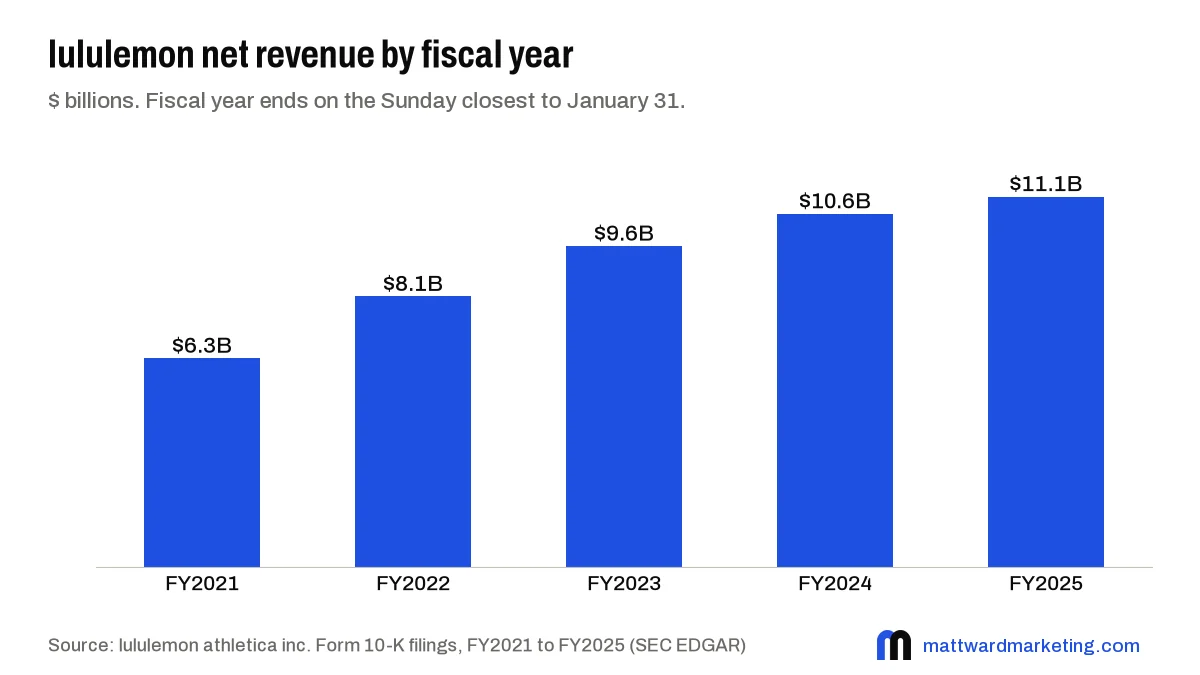
lululemon’s biggest strengths are its premium brand, its high margins and its omni-channel model. Revenue grew from $6.3 billion in fiscal 2021 to $11.1 billion in fiscal 2025. Even after tariffs and markdowns, its fiscal 2025 gross margin was 56.6%. For comparison, see our Nike SWOT analysis.
1. A premium brand built on product
lululemon says it competes on “premium brand image,” technical product innovation and quality. Its range includes pants, shorts, tops and jackets for yoga, running and training. It works with yogis and athletes in local communities for product feedback.
2. Strong profitability
lululemon earned $2.2 billion in income from operations in fiscal 2025, a 19.9% operating margin. It bought back 5.0 million shares for $1.2 billion and ended the year with $1.8 billion in cash.
3. A balanced omni-channel model
Company-operated stores brought in $5.0 billion and e-commerce $4.9 billion in fiscal 2025. Stores and websites share one inventory pool, so guests can buy online and pick up in store, or return online orders in a shop.
4. Fast growth in China Mainland
China Mainland revenue rose 28.9% to $1.75 billion in fiscal 2025, or 16% of the total. lululemon opened 21 net new stores there, ending the year with 172.
What is lululemon’s main weakness?
lululemon’s main weakness is slowing demand in the Americas, its biggest market. In the second quarter of fiscal 2026, Americas revenue fell 8% and comparable sales fell 12%. The company blamed lower conversion rates, less store traffic and a smaller average order.
1. Dependence on the Americas
The Americas made up 71% of fiscal 2025 revenue, or $7.8 billion, and that revenue fell 1%. Sales per square foot dropped from $1,574 in fiscal 2024 to $1,426 in fiscal 2025.
2. Heavy reliance on women’s apparel
Women’s apparel brought in $7.0 billion, or 63% of fiscal 2025 revenue. Men’s was 24%, and accessories and other categories, including footwear, were 13%.
3. Concentrated sourcing
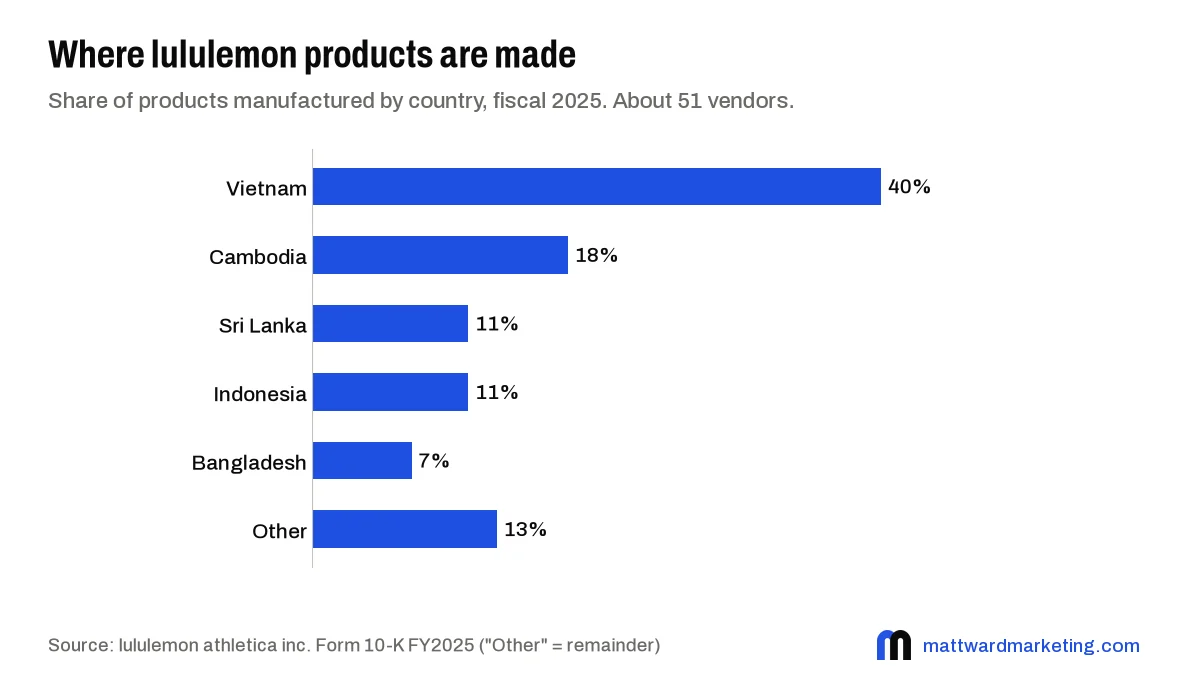
lululemon owns no factories. It works with about 51 vendors, and five of them made 47% of its products in fiscal 2025. Vietnam alone made 40%. It has no long-term contracts with most of its suppliers.
4. Leadership turnover
lululemon spent much of 2026 without a permanent CEO. Meghan Frank and André Maestrini served as interim co-CEOs until Heidi O’Neill started on September 8, 2026. In October, O’Neill created new President and COO roles, and two senior executives were due to leave on November 6, 2026.
What opportunities does lululemon have?
lululemon’s opportunities are a reset under new leadership, international growth and new categories. International revenue grew 22% in fiscal 2025, and the company calls its men’s range “a key pillar” of its growth plans. O’Neill wants to put product, design and innovation at the center of how lululemon operates.
- Rebuild the product pipeline. O’Neill brings more than three decades of experience in performance apparel, footwear and sport, much of it at Nike. lululemon named Maggie Gauger President and Chief Product Officer from October 26, 2026.
- Grow men’s. Men’s apparel revenue rose to $2.7 billion in fiscal 2025, up from $2.3 billion in fiscal 2023.
- Keep expanding abroad. lululemon plans new stores in markets where it sees growth, including new countries in APAC and EMEA. Rest of World revenue rose 15.6% to $1.5 billion in fiscal 2025.
- Broaden the range. Footwear and accessories sit in a category that grew to $1.4 billion in fiscal 2025.
- Win back full-price shoppers. Interim co-CEO Meghan Frank called better full-price sales “a key priority, particularly in North America” for 2026.
What threats does lululemon face in 2026?
lululemon’s main threats are a falling top line, tariffs and imitation products. It expects fiscal 2026 revenue to decline 5% to 7% and third-quarter revenue to drop 10% to 11%. Its 10-K warns that “dupe” products could make shoppers see less difference between lululemon and cheaper alternatives.
1. US tariffs and the end of de minimis
Higher US tariffs since April 2025 raised the cost of lululemon’s US inventory. The US also ended the de minimis duty-free exemption, which a US court upheld on August 13, 2026. lululemon received $134.5 million in IEEPA tariff refunds in the second quarter of fiscal 2026, but new tariffs remain.
2. Dupes and competitors
lululemon holds limited patents on its fabrics and processes, so rivals can sell similar products. It competes with other apparel sellers, including yoga and activewear specialists. adidas, for example, grew Training revenue at double digits in 2025, as our adidas SWOT analysis shows.
3. Boardroom pressure
On December 29, 2025, founder Chip Wilson, who owns about 8.7% of the stock, moved to nominate three directors. lululemon settled with him in a cooperation agreement on May 26, 2026, and added new directors, including Marc Maurer, former co-CEO of On.
4. Rising costs and legal risk
Selling, general and administrative expenses rose to 41.7% of revenue in the second quarter of fiscal 2026, from 37.7% a year earlier. lululemon also faces a securities class action filed in 2024 over past statements about its business.
Lululemon SWOT matrix
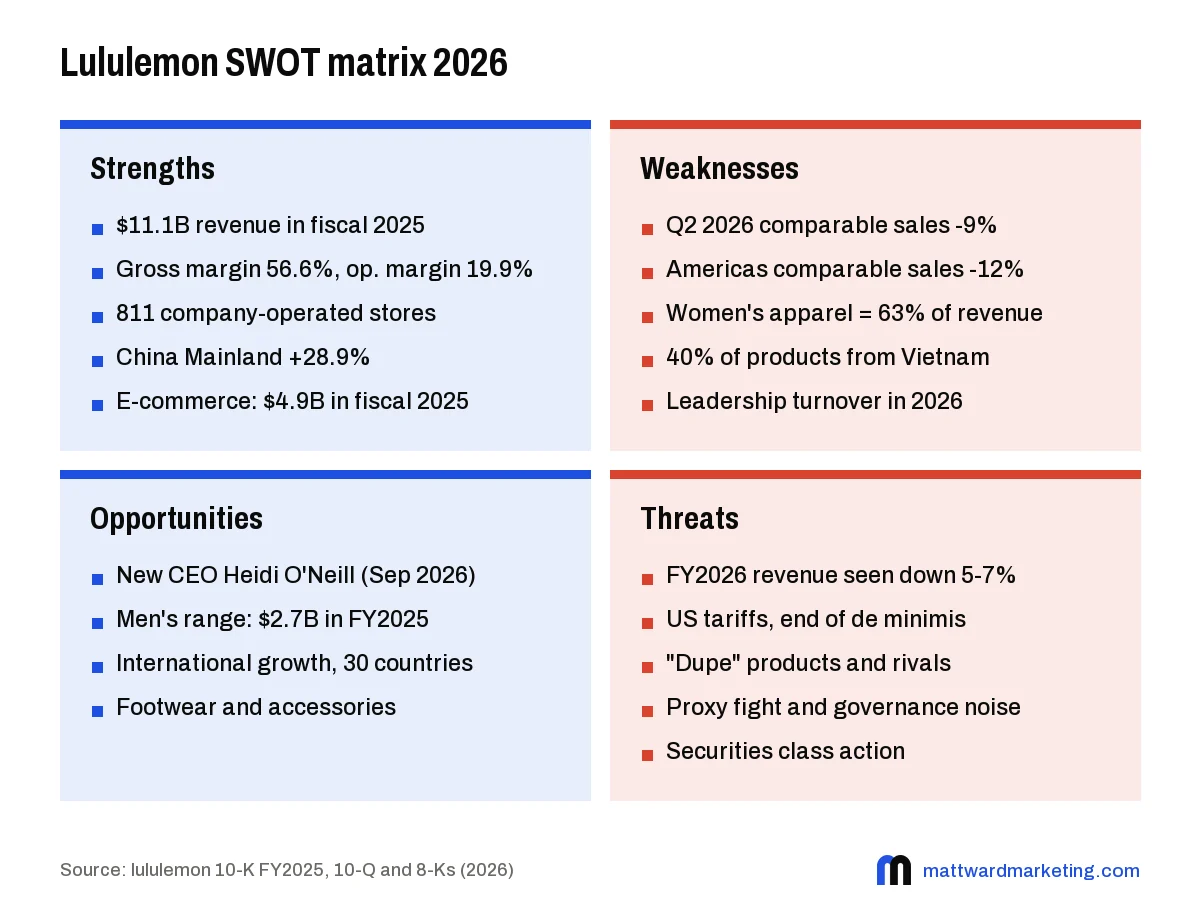
| Strengths | Weaknesses |
|---|---|
| $11.1B revenue in fiscal 2025; 56.6% gross margin and 19.9% operating margin; 811 company-operated stores; China Mainland up 28.9%; $4.9B in e-commerce | Q2 2026 comparable sales down 9%; Americas comparable sales down 12%; women’s apparel is 63% of revenue; 40% of products made in Vietnam; leadership turnover |
| Opportunities | Threats |
| New CEO Heidi O’Neill and a product-first reset; men’s range at $2.7B; international expansion; footwear and accessories | Fiscal 2026 revenue expected to fall 5% to 7%; US tariffs and the end of de minimis; dupes and rivals; proxy fight; securities class action |
What does lululemon’s SWOT mean for marketers?
lululemon’s SWOT shows that a premium price needs fresh product to back it up. When shoppers see little difference between lululemon leggings and a cheaper copy, the brand loses its edge. In the second quarter of fiscal 2026, comparable sales fell 9% while selling, general and administrative costs rose to 41.7% of revenue.
O’Neill summed up the task in October 2026: “lululemon is a rare, extraordinary brand, but we have work to do to build a stronger and more competitive company.” Three lessons stand out:
- Community is part of the product. lululemon uses ambassadors and local yogis and athletes for brand awareness and product feedback.
- Growth can hide a weak core. International sales rose 22% in fiscal 2025 while the home market shrank.
- Guard your difference. Limited patents mean design, fit and brand story are the real moat.
For more brand breakdowns built the same way, see our SWOT analysis guide, with a free template and examples.
FAQ
What are lululemon’s biggest strengths?
A premium brand, high margins and a strong omni-channel model. In fiscal 2025, lululemon earned $11.1 billion in revenue with a 56.6% gross margin and a 19.9% operating margin, and split sales almost evenly between its 811 stores and e-commerce.
What is lululemon’s main weakness?
Falling demand in the Americas, which made up 71% of fiscal 2025 revenue. Americas comparable sales fell 3% in fiscal 2025 and 12% in the second quarter of fiscal 2026. Heavy reliance on women’s apparel, 63% of revenue, adds to the risk.
What threats does lululemon face in 2026?
A forecast revenue decline of 5% to 7% for fiscal 2026, US tariffs and the end of the de minimis exemption, lower-priced dupes, tougher competition, and pressure from founder Chip Wilson and a securities class action.
Sources
- lululemon athletica inc. Form 10-K for the fiscal year ended February 1, 2026, filed March 17, 2026 (SEC EDGAR).
- lululemon athletica inc. fourth quarter and full year fiscal 2025 results, Form 8-K, March 17, 2026 (SEC EDGAR).
- lululemon athletica inc. Form 10-Q for the quarter ended August 2, 2026, filed September 3, 2026 (SEC EDGAR).
- lululemon athletica inc. second quarter fiscal 2026 results, Form 8-K, September 3, 2026 (SEC EDGAR).
- lululemon athletica inc. Form 8-K on the appointment of Heidi O’Neill as CEO, April 2026 (SEC EDGAR).
- lululemon athletica inc. Form 8-K on the cooperation agreement with Chip Wilson, May 27, 2026 (SEC EDGAR).
- lululemon athletica inc. Form 8-K on the new leadership structure, October 7, 2026 (SEC EDGAR).
- lululemon athletica inc. Form 8-K on the appointment of Tara Poseley, October 2026 (SEC EDGAR).
- lululemon athletica inc. Form 10-K filings for fiscal 2022 to fiscal 2024 (revenue for fiscal 2021 and 2022), via SEC EDGAR XBRL data (SEC EDGAR).