Adidas SWOT Analysis (2026): Strengths, Weaknesses, Opportunities & Threats
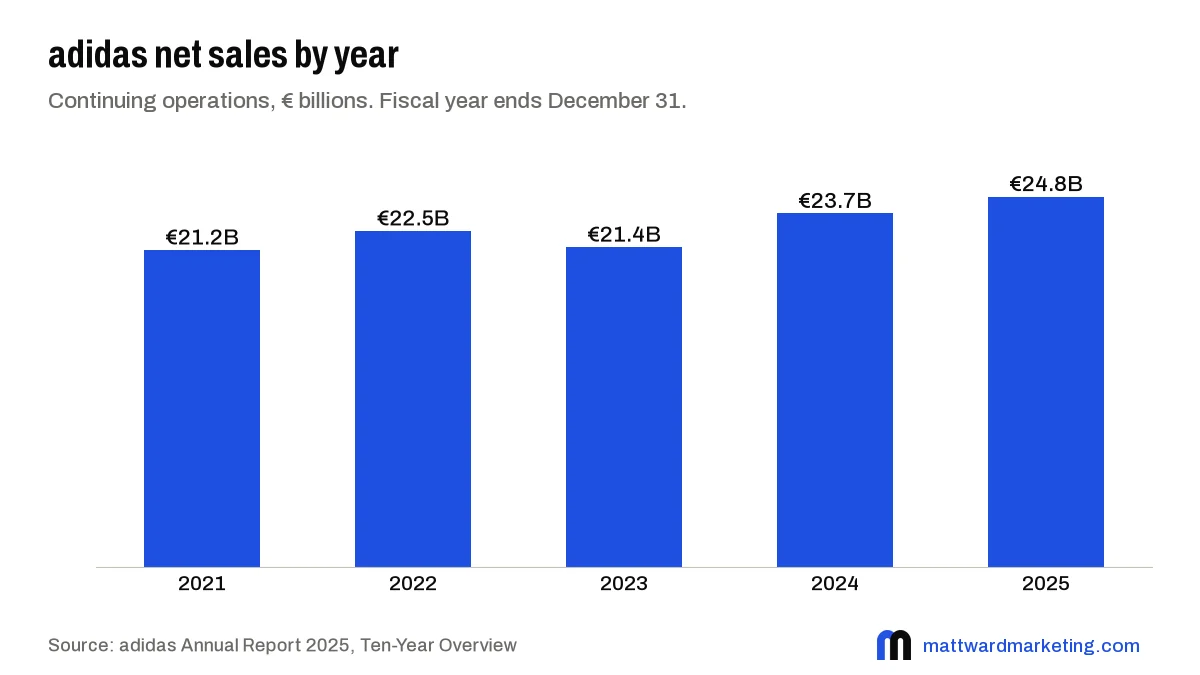
An adidas SWOT analysis for 2026 shows a brand on a record run: net sales hit €24.8 billion in 2025, and the third quarter of 2026 brought the highest quarterly profit in its history. This guide sets out adidas’s strengths, weaknesses, opportunities and threats, with every figure taken from its 2025 Annual Report and its Q3 2026 results.
Key takeaways
- adidas’s biggest strength is brand momentum: net sales reached a record €24.8 billion in 2025, and currency-neutral sales grew 11% in the first nine months of 2026.
- Profit is recovering fast: operating profit rose 54% to €2.1 billion in 2025, and adidas expects around €2.5 billion in 2026.
- Its main weakness is Europe and lifestyle footwear: Europe sales fell 4% in Q3 2026, and footwear revenue was flat in a market full of discounts.
- The largest opportunity is the US, where CEO Bjørn Gulden says adidas wants to double its business.
- The main threats are US tariffs, heavy discounting, a growing field of specialist brands and currency swings.
What is a SWOT analysis of adidas?
An adidas SWOT analysis lists the company’s internal strengths and weaknesses and the external opportunities and threats it faces. For 2026, that means a German sportswear group with record sales and fast DTC growth, but soft sales in Europe and pressure in lifestyle shoes. For example, DTC sales grew 17% in Q3 2026 while Europe fell 4%.
adidas AG designs and sells footwear, apparel and accessories for sport and lifestyle. It is based in Herzogenaurach, Germany, where Adolf “Adi” Dassler registered the company in 1949. It had 64,938 employees at the end of 2025 and reports in euros under IFRS.
| adidas at a glance | 2025 (year ended December 31, 2025) |
|---|---|
| Net sales | €24.8B (up 5%; up 10% currency-neutral) |
| Operating profit | €2.1B (up 54%), margin 8.3% |
| Net income from continuing operations | €1.4B (up 67%) |
| Gross margin | 51.6% |
| Footwear / Apparel / Accessories | €14.2B / €8.8B / €1.8B |
| Wholesale / DTC | €14.8B / €9.9B |
| Employees | 64,938 |
What are adidas’s biggest strengths?
adidas’s biggest strengths are brand heat, broad growth and improving profit. In 2025, the adidas brand grew 13% currency-neutral, with double-digit growth in every market and channel. In Q3 2026, it posted record quarterly net sales of €7.3 billion and a record operating profit of €1.0 billion, up 37%.
1. A heritage brand with fresh demand
adidas has more than 75 years of history to draw on, from the 3-Stripes to the Trefoil, Samba and Superstar. Its classics still sell. In Q3 2026, Superstar and the Low Profile shoes kept growing strongly, while Originals apparel grew at double digits.
2. Ownership of football
Football is adidas’s core sport. The FIFA World Cup 2026 ended in an all-adidas final, and the company has supplied the official match ball for every World Cup since 1970. Club kits for Arsenal, Real Madrid, FC Bayern Munich, Liverpool and Manchester United kept that momentum going after the tournament.
3. Fast-growing direct-to-consumer sales
adidas’s own channels are its fastest-growing business. DTC sales grew 21% currency-neutral in the first nine months of 2026. E-commerce rose 23% and own retail rose 19% over the same period.
4. A long-standing supplier network
adidas outsources almost 100% of production to independent manufacturing partners. In 2025, 65% of those partners had worked with adidas for at least ten years, and 37% for more than 20 years. No single customer made up more than 5% of sales.
What is adidas’s main weakness?
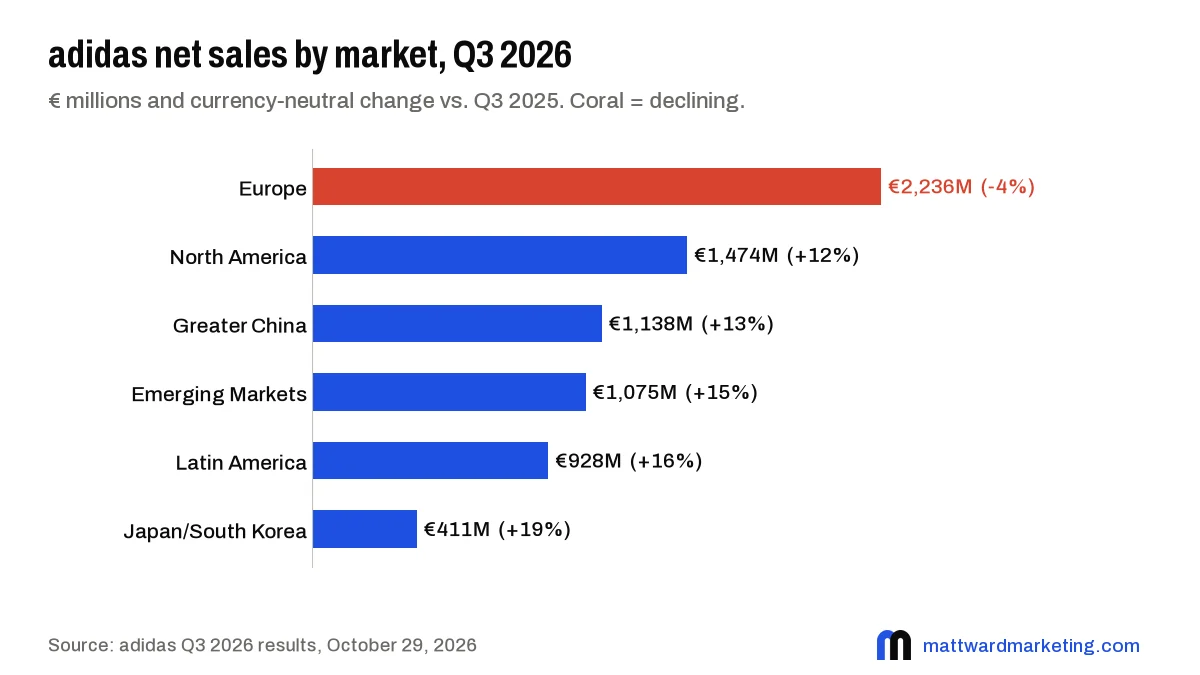
adidas’s main weakness is uneven demand. Europe, its largest market at €8.1 billion of 2025 sales, fell 4% in Q3 2026. Footwear revenue was flat in the quarter as adidas held back wholesale orders in a promotional market. Gulden said that “the footwear lifestyle business is currently challenging.”
1. Softness in Europe
Europe grew only 2% in the first nine months of 2026, while every other market grew at double digits. adidas blames high retail inventory, discounting and a planned SAP system move that pushed some shipments into Q4.
2. Thin margins compared with its past
The 2025 operating margin of 8.3% was a big step up from 1.3% in 2023. It was still below the 11.3% adidas reported in 2019. Gulden’s target is a margin above 10% in 2028.
3. A small share of the US market
North America sales were €5.1 billion in 2025, down 1% in euros. Gulden says adidas has a “relatively low market share in the US.”
4. Exposure to partner risk: the Yeezy lesson
On October 25, 2022, adidas ended its partnership with Ye (Kanye West) and stopped the Yeezy business. In 2023, adidas posted a net loss of €58 million from continuing operations. It finished selling Yeezy stock in 2024, so 2025 sales include no Yeezy revenue, against around €650 million in 2024.
5. Concentrated sourcing in Asia
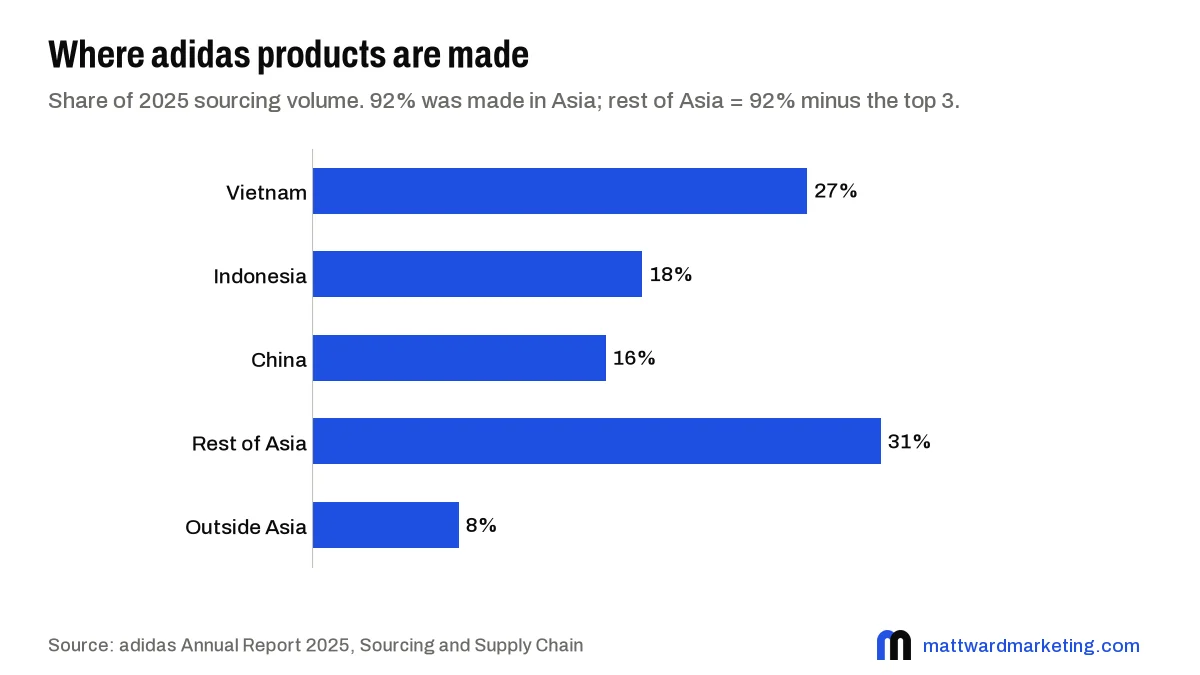
In 2025, 92% of adidas’s sourcing volume came from Asia. Vietnam made 27%, Indonesia 18% and China 16%.
What opportunities does adidas have?
adidas’s opportunities are the US, apparel and performance sports. In the first nine months of 2026, apparel grew 28% currency-neutral and Performance revenue rose 27%. adidas plans high-single-digit currency-neutral growth every year from 2026 to 2028, with operating profit rising at a mid-teens CAGR.
- Grow in the US. Gulden says: “Given our relatively low market share in the US, we have the ambition to double our business there.” North America grew 14% currency-neutral in the first nine months of 2026.
- Scale apparel. Apparel grew 19% currency-neutral in Q3 2026, led by Originals and Football.
- Win in running. Running growth topped 30% by the end of 2025, driven by the Adizero shoe family. adidas athletes took all six podium spots at the 2026 Berlin Marathon.
- Expand in fast-growing regions. Latin America grew 23%, Japan/South Korea 20% and Greater China 15% in the first nine months of 2026, all currency-neutral.
- Return cash to shareholders. adidas completed a €1 billion share buyback in 2026 and raised its 2025 dividend 40% to €2.80 per share.
What threats does adidas face in 2026?
adidas’s main threats are tariffs, discounting and a crowded market. It expected US tariffs and unfavorable currencies to cost around €400 million in 2026. Its 2025 Annual Report warns that rivals and retailers could trigger “sustained periods of heavy discounting.” Gulden also notes that specialist and local brands are multiplying.
1. US tariffs and trade policy
Higher US tariffs weighed on gross margin through 2025 and 2026. In Q3 2026, adidas booked a refund of around €200 million on US tariff claims, but higher US tariffs still weighed on gross margin in the quarter.
2. Discounting in lifestyle footwear
High inventory across the market led to heavy promotions in lifestyle shoes in 2026. adidas chose to sell less into wholesale rather than chase volume, which held back footwear and European sales.
3. More competitors
Gulden says the number of competitors has grown, with specialist brands focused on one or two categories and local players going global. adidas names its biggest competitor only indirectly. For the market leader’s own position, see our Nike SWOT analysis and our guide to Nike’s competitors.
4. Currency swings and hyperinflation
A stronger euro cut more than €1 billion from 2025 sales on translation. Hyperinflation effects also hurt adidas’s financial result in 2026.
5. Supply chain labor risks
adidas’s 2025 sustainability statement treats forced labor and child labor in the supply chain as a short-term risk. A breach of its Workplace Standards could bring negative media coverage and damage its reputation.
Adidas SWOT matrix
| Strengths | Weaknesses |
|---|---|
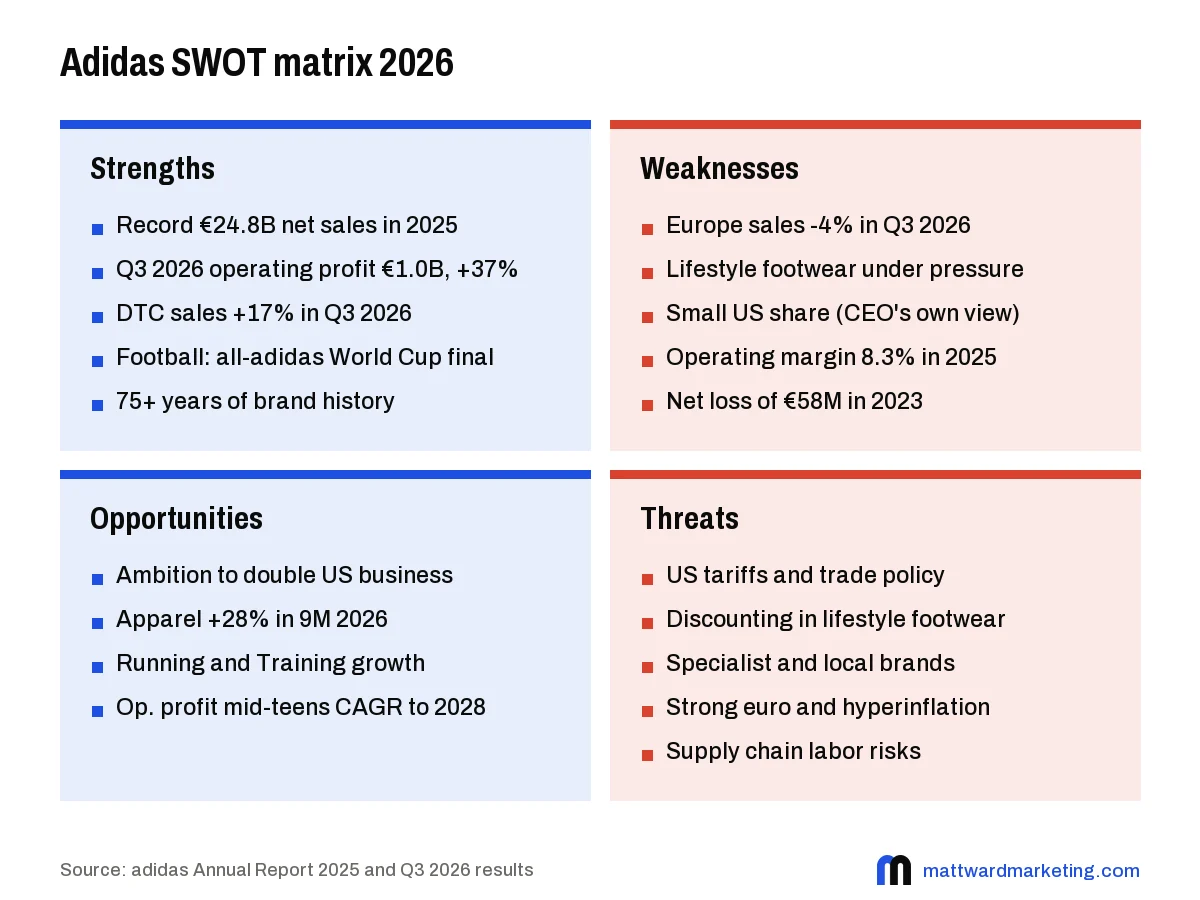
| Record €24.8B net sales in 2025; record Q3 2026 operating profit of €1.0B (up 37%); DTC up 21% in 9M 2026; football leadership; 75+ years of brand history | Europe down 4% in Q3 2026; flat footwear revenue in Q3 2026; small US market share; 8.3% operating margin in 2025; net loss of €58M in 2023 after the Yeezy exit |
| Opportunities | Threats |
| Ambition to double the US business; apparel up 28% in 9M 2026; running and training; operating profit growth at a mid-teens CAGR to 2028 | US tariffs; discounting in lifestyle footwear; specialist and local brands; strong euro and hyperinflation; forced labor risk in the supply chain |
What does adidas’s SWOT mean for marketers?
adidas’s SWOT shows how a heritage brand can grow by acting local. Gulden calls it “a global brand with a local mindset,” and adidas lets each market shape its own products and campaigns. The result was double-digit growth in every market in 2025.
Three lessons stand out:
- Big moments pay off when you plan for them. adidas spent more on marketing around the World Cup, then let spending normalize after July 2026.
- Protect full price before volume. adidas cut wholesale orders in a discount-heavy market and still lifted Q3 2026 gross margin to 54.3%.
- Do not tie a brand to one partner. The Yeezy exit shows the risk of depending on a single celebrity line.
For more brand breakdowns built the same way, see our SWOT analysis guide, with a free template and examples.
FAQ
What are adidas’s biggest strengths?
Brand momentum, football and fast DTC growth. adidas posted record net sales of €24.8 billion in 2025 and a record quarterly operating profit of €1.0 billion in Q3 2026. Its DTC sales grew 21% currency-neutral in the first nine months of 2026.
What is adidas’s main weakness as a company?
Uneven demand, above all in Europe and lifestyle footwear. Europe sales fell 4% in Q3 2026 and footwear revenue was flat. Its 8.3% operating margin in 2025 also trails its own past levels and its target of more than 10% in 2028.
What threats does adidas face in 2026?
US tariffs, heavy discounting in lifestyle footwear, more specialist and local competitors, and currency swings. adidas expected tariffs and currencies to cost it around €400 million in 2026, before a tariff refund of around €200 million in Q3.
Sources
- adidas AG, Annual Report 2025, including the Ten-Year Overview, Sourcing and Supply Chain, Risk and Opportunity Report and Sustainability Statement (PDF).
- adidas AG, full-year 2025 results press release, March 4, 2026 (PDF).
- adidas AG, third-quarter 2026 results press release, October 29, 2026 (PDF).
- adidas AG, “adidas terminates partnership with Ye immediately,” press release, October 25, 2022 (adidas Group).
- adidas AG, Financial Reports page (adidas Group investors).