
Nike PESTLE Analysis (2026): Political, Economic, Social and More
A Nike PESTLE analysis for 2026 shows a company squeezed by tariffs, weak demand in China and currency swings, while it works to keep up with digital shopping, AI and climate rules. This guide walks through the political, economic, social, technological, legal and environmental factors one by one, with every figure taken from Nike’s fiscal 2026 10-K, its latest quarterly report and its official website.
Key takeaways: Nike PESTLE at a glance
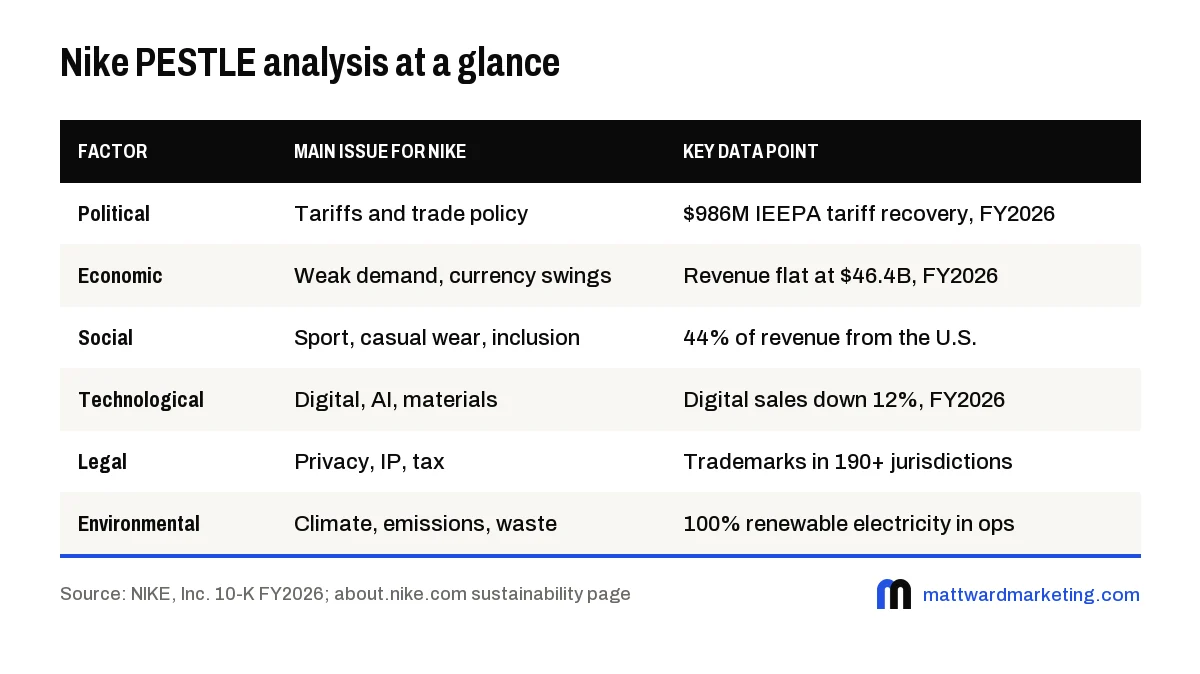
- Political: trade policy is Nike’s biggest outside risk. After the U.S. Supreme Court struck down IEEPA tariffs on February 20, 2026, Nike booked a $986 million recovery.
- Economic: revenue was flat at $46.4 billion in fiscal 2026 and fell 4% to $11.2 billion in the first quarter of fiscal 2027.
- Social: about 44% of Nike’s revenue comes from the U.S., and many of its sport products are worn for casual use.
- Technological: NIKE Brand Digital sales fell 12% to $8.6 billion in fiscal 2026, while Nike warns that AI is changing how people shop.
- Legal and environmental: Nike faces privacy laws on three continents, an open EU tax inquiry and climate risks to its raw materials.
What is a Nike PESTLE analysis?
A Nike PESTLE analysis is a review of the six outside forces that affect Nike: political, economic, social, technological, legal and environmental. Unlike a SWOT, it looks only at the external environment. For example, a tariff decision in Washington or a privacy law in China is a PESTLE factor, while Nike’s brand strength is not.
NIKE, Inc. is the largest seller of athletic footwear and apparel in the world. It sells the Nike, Jordan and Converse brands in nearly every country, and nearly all its products are made outside the United States by independent contract manufacturers. That global reach is why outside forces matter so much.
Political factors
The main political factor for Nike is trade policy. Nearly all its footwear, apparel and equipment is made outside the U.S., so tariffs, quotas and trade disputes change its costs directly. In its fiscal 2026 10-K, Nike says protectionist measures “have resulted in increased costs of our products.”
1. Tariffs and the IEEPA ruling
On February 20, 2026, the U.S. Supreme Court ruled that tariffs imposed under the International Emergency Economic Powers Act (IEEPA) were unauthorized. Nike recognized a $986 million benefit for the recovery of those tariffs in the fourth quarter of fiscal 2026. By its 10-K filing in July, it had received substantially all of the money.
2. Sourcing concentrated in Asia
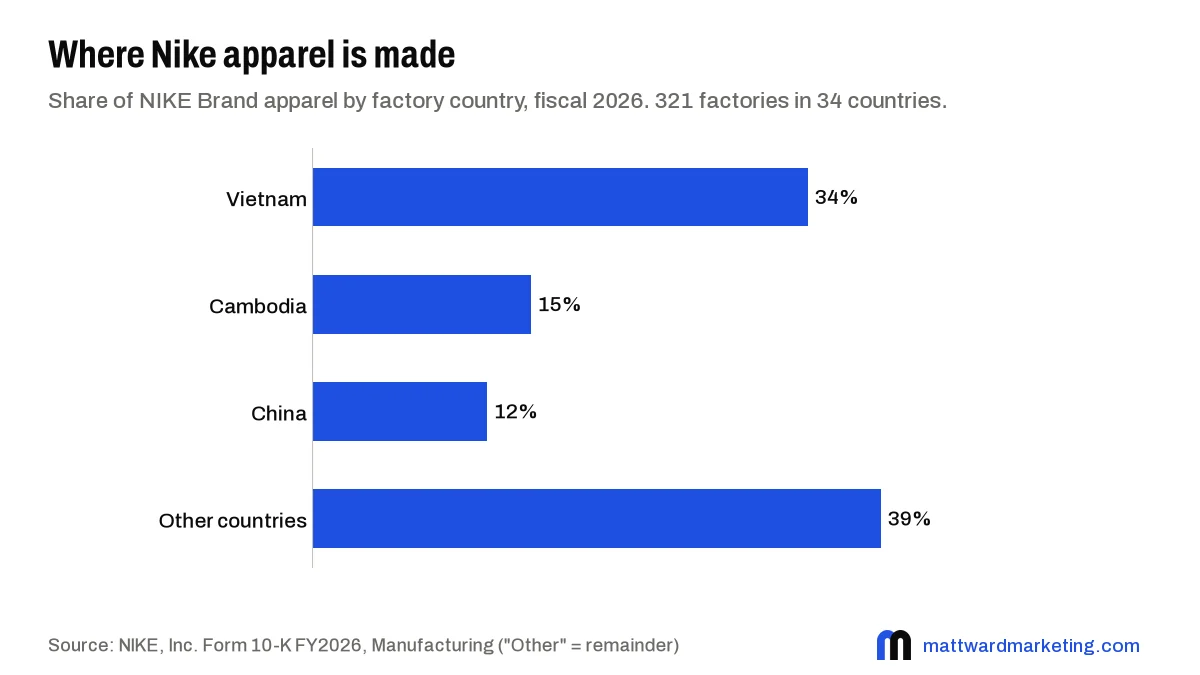
Factories in Vietnam, Indonesia and China made about 52%, 27% and 16% of NIKE Brand footwear in fiscal 2026. For apparel, Vietnam, Cambodia and China made about 34%, 15% and 12%. Any trade action against these countries hits Nike’s supply chain.
3. Geopolitics and anti-bribery rules
Nike names political tensions, conflicts, nationalism and sanctions as risks for its international operations. It also runs an ethics and compliance program for the U.S. Foreign Corrupt Practices Act.
Economic factors
Nike’s key economic factors are consumer demand, exchange rates and inflation. In fiscal 2026, revenue was flat at $46.4 billion on a reported basis and down 2% currency-neutral. For example, a stronger dollar lowers the value of Nike’s sales in euros or yuan when they are translated into U.S. dollars.
1. Slowing demand
First-quarter fiscal 2027 revenue, for the quarter ended August 31, 2026, fell 4% to $11.2 billion. Nike expects revenue to decline by a high-single-digit percentage in fiscal 2027.
2. Greater China
Greater China revenue fell 11% to $5.8 billion in fiscal 2026. In the first quarter of fiscal 2027 it dropped to $1.18 billion from $1.51 billion a year earlier, a 22% decline.
3. Currency and inflation
About 56% of Nike’s fiscal 2026 revenue came from outside the U.S. The 10-K warns that a weaker foreign currency against the dollar “adversely affects” reported sales and earnings, and that central banks fighting inflation raise its borrowing costs.
4. Commodity prices and retail partners
Prices of raw materials such as cotton and petroleum derivatives affect Nike’s margins. Its three largest U.S. customers made up about 29% of U.S. sales in fiscal 2026, so a retailer in financial trouble can hurt Nike too.
Social factors
Nike’s social factors are changing consumer tastes, the line between sport and casual wear, and expectations about culture and inclusion. Nike says a large share of its athletic shoes “are worn for casual or leisure purposes.” For example, a basketball shoe can succeed or fail on street style, not court performance.
1. Shifting consumer preferences
Nike’s 10-K says demand depends on the popularity of sports and fitness activities and on design trends. It lists the difficulty of anticipating consumer preferences as a core risk.
2. The power of athletes and creators
Nike says competition for endorsers has intensified, partly because of “the growing influence of athletes’ personal brands” and athlete-led businesses. That raises the cost of the sponsorships Nike relies on.
3. Inclusion and community
Nike’s mission includes the line “if you have a body, you are an athlete.” It aims to invest up to 2% of its prior fiscal year’s pre-tax income in communities, focused on youth sport. Its 10-K also notes growing legal and regulatory scrutiny of inclusion policies.
Technological factors
The main technological factors for Nike are digital commerce, artificial intelligence and material innovation. Nike runs its own digital platforms in more than 40 countries, but NIKE Brand Digital sales fell 12% to $8.6 billion in fiscal 2026. For example, shoppers who move to other apps or marketplaces take that spending with them.
1. Artificial intelligence
Nike’s 10-K says its markets are being disrupted by “the increased use of artificial intelligence” by consumers, competitors and retailers. It warns that falling behind on AI-enabled tools could weaken demand for its products.
2. Product technology
Nike’s innovation platforms include Nike Air, Zoom, Free, Dri-FIT, Flyknit, FlyEase, ZoomX, Air Max and React. Its subsidiary Air Manufacturing Innovation makes Air-Sole cushioning parts in Oregon, Missouri and Vietnam.
3. New materials
Nike’s Aero-FIT fabric is made from 100% textile waste, according to its sustainability page. Nike also uses both virgin and recycled yarns and threads in its apparel.
4. Cybersecurity
Nike depends on information systems for digital commerce, demand planning and inventory. A breach or outage could disrupt sales and expose consumer data.
Legal factors
Nike’s legal factors include data privacy, intellectual property, tax and supply chain rules. It must comply with the EU’s GDPR, the UK GDPR, U.S. state privacy laws and China’s Data Security Law and Personal Information Protection Law. For example, a privacy breach in Europe can bring fines under GDPR.
1. Data privacy and AI rules
Nike’s 10-K describes “a growing patchwork” of laws on AI, automated decision-making, targeted advertising and consumer protection. Each one affects how Nike can use customer data for marketing.
2. Intellectual property
Nike has registered the NIKE and Swoosh Design trademarks in over 190 jurisdictions. It warns that its actions to protect patents and trademarks may not stop imitation of its products.
3. Tax disputes
In January 2019, the European Commission opened a formal investigation into whether the Netherlands broke EU State Aid rules with tax rulings granted to Nike. Nike calls the probe “without merit,” but an adverse result could raise its taxes for prior years.
4. Supplier conduct
If contract factories break Nike’s code of conduct or local labor laws, Nike can face reputational damage or product recalls, even though it does not own those factories.
Environmental factors
Nike’s environmental factors are climate change, emissions targets and waste. The 10-K warns that climate change may make water and raw materials harder to get and that extreme weather can disrupt its operations. For example, a flood near a supplier’s factory could delay shoe deliveries to stores.
1. Climate risk to supply
Nike says its global reach makes it “particularly vulnerable to the physical risks of climate change.” Floods, droughts or storms near suppliers or distribution centers could delay deliveries and cause lost sales. Its own headquarters campus sits in a seismic zone.
2. Emissions targets
Nike says it set its first carbon targets in 2001. Its restated science-based targets aim to cut emissions from Nike-owned facilities (Scope 1 and 2) by 75% and from its extended supply chain (Scope 3) by 35% by 2030, from a fiscal 2020 baseline.
3. Progress so far
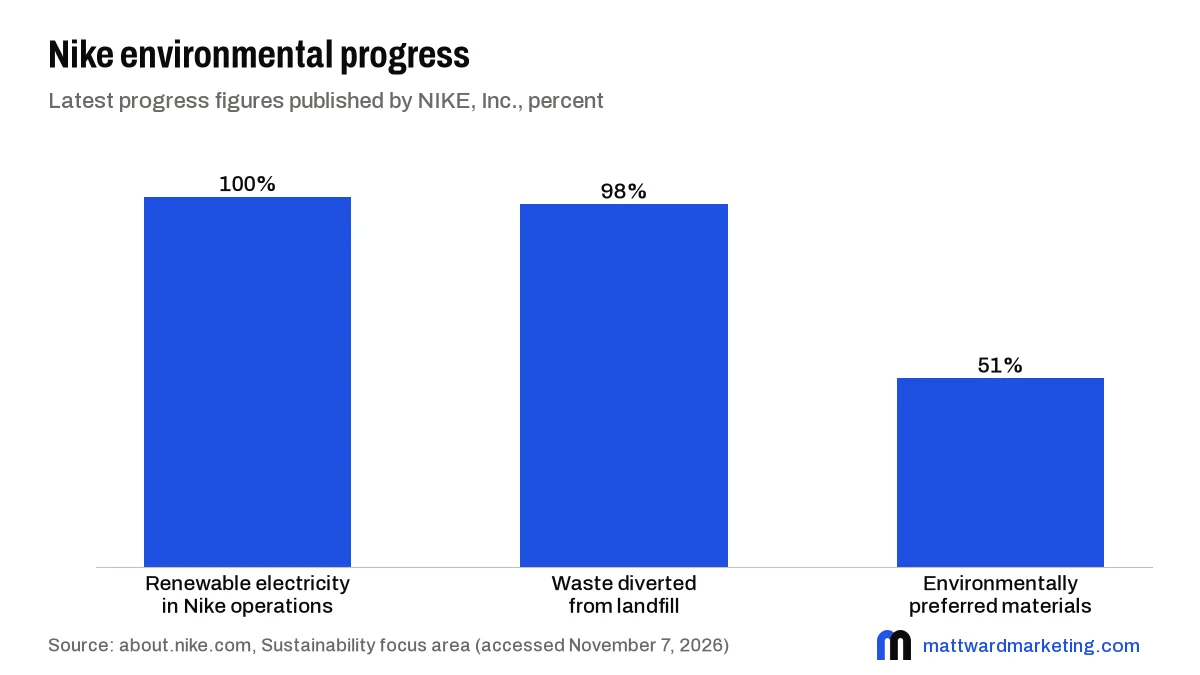
On its sustainability page, Nike reports 100% renewable electricity in its own operations and 98% of waste diverted from landfill, with 76% reused or recycled. Environmentally preferred materials make up 51% of materials used.
4. Shifting sustainability rules
Nike says sustainability rules “continue to evolve and diverge” across jurisdictions. That raises compliance costs and makes it harder to meet every stakeholder’s expectations at once.
Nike PESTLE table
| Factor | Key issue | Evidence (dated) | Impact on Nike |
|---|---|---|---|
| Political | Tariffs and trade policy | $986M IEEPA tariff recovery in Q4 fiscal 2026; 95% of footwear made in Vietnam, Indonesia and China | High |
| Economic | Weak demand, currency, China | Revenue flat at $46.4B in fiscal 2026; Greater China down 22% in Q1 fiscal 2027 | High |
| Social | Casual wear, athlete brands, inclusion | 44% of revenue from the U.S.; rising endorsement costs | Medium |
| Technological | Digital commerce, AI, materials | NIKE Brand Digital down 12% to $8.6B in fiscal 2026 | High |
| Legal | Privacy, IP, tax | GDPR, China PIPL; EU State Aid probe open since 2019 | Medium |
| Environmental | Climate, emissions, waste | Scope 3 target of -35% by 2030; 51% preferred materials | Medium |
The impact ratings are our own editorial judgment, based on how much revenue or cost each factor touched in fiscal 2026.
What does Nike’s PESTLE mean for marketers?
Nike’s PESTLE shows that outside forces can outweigh a great brand. Tariffs, a strong dollar and a slowdown in China hit results even when campaigns work. For a marketer, the lesson is to track these factors before setting prices, budgets and growth targets.
For the internal side of the story, read our Nike SWOT analysis. To see the brands Nike fights for shelf space and shoppers, read our guide to Nike competitors. More frameworks like this one live in our PESTEL analysis section.
FAQ
What is Nike PESTLE analysis?
A Nike PESTLE analysis studies the political, economic, social, technological, legal and environmental forces outside Nike’s control. In 2026 the biggest are tariffs, slowing demand in Greater China, digital and AI disruption, privacy laws and climate risk.
How do you do a Nike PESTLE analysis?
Start with Nike’s latest 10-K on SEC EDGAR and read Item 1A, Risk Factors. Sort each risk into one of the six PESTLE groups, add a dated figure from the filing or the latest quarterly results, and rate how strongly it affects revenue or costs.
What is an example of Nike PESTLE analysis?
A political example is the February 20, 2026, Supreme Court ruling on IEEPA tariffs, which led Nike to book a $986 million recovery. An economic example is Greater China revenue falling 22% in the first quarter of fiscal 2027.
Sources
- NIKE, Inc. Form 10-K for the fiscal year ended May 31, 2026, filed July 15, 2026 (SEC EDGAR).
- NIKE, Inc. Form 10-Q for the quarter ended August 31, 2026, filed October 2, 2026 (SEC EDGAR).
- NIKE, Inc. fiscal 2027 first quarter results, Form 8-K exhibit 99.1, October 1, 2026 (SEC EDGAR).
- NIKE, Inc. fiscal 2026 fourth quarter and full year results, Form 8-K exhibit 99.1, June 30, 2026 (SEC EDGAR).
- NIKE, Inc. Sustainability focus area, about.nike.com, accessed November 7, 2026 (about.nike.com).
- NIKE, Inc. Mission page, about.nike.com, accessed November 7, 2026 (about.nike.com).