
Nike Competitors: Top Rivals and Alternatives Compared
Nike competitors include adidas, Puma, Anta, ASICS, Deckers (maker of Hoka and UGG), Li Ning, lululemon, New Balance, On, Under Armour and VF Corporation, the rivals Nike names in its fiscal 2026 annual report. This guide compares them with figures from each company’s own latest annual report, explains which ones compete directly and shows how Nike still stands apart.
Key takeaways
- Nike’s 10-K for fiscal 2026 names 11 competitors: adidas, Anta, ASICS, Deckers, Li Ning, lululemon, New Balance, On, Puma, Under Armour and V.F. Corporation.
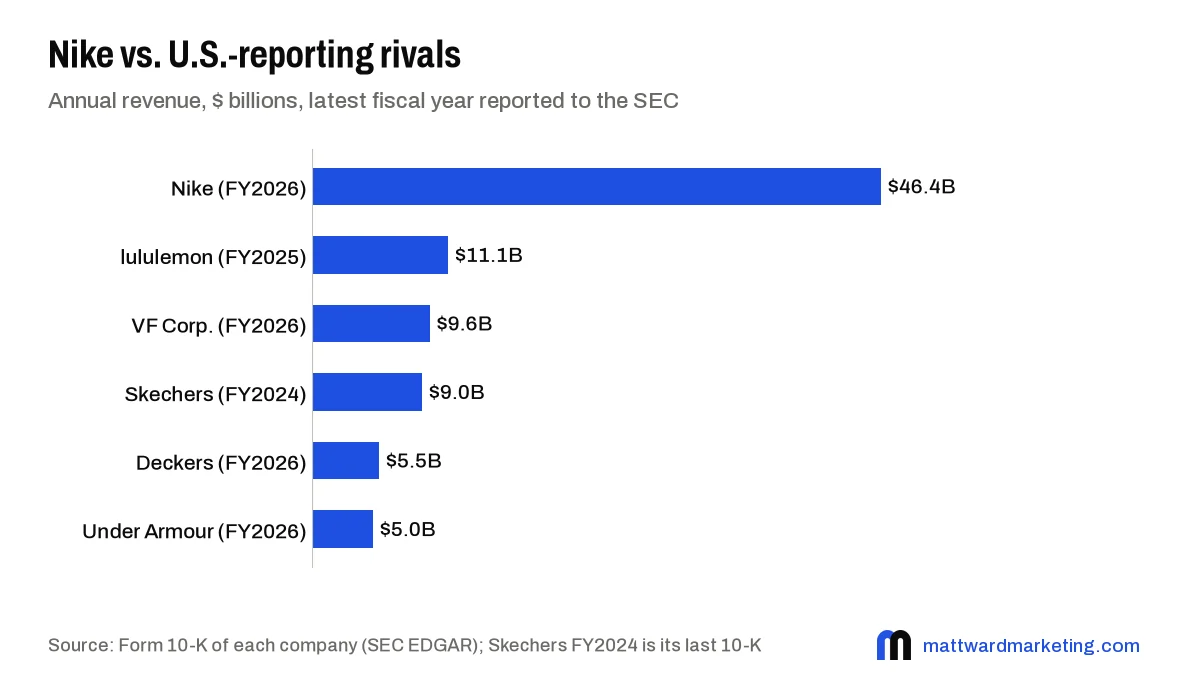
- Nike is still the largest seller of athletic footwear and apparel in the world, with $46.4 billion in revenue in fiscal 2026.
- adidas is Nike’s biggest competitor by revenue: it reported a record €24.8 billion in 2025, up 5% in euros and 10% currency-neutral.
- The fastest-growing rivals are running specialists: On grew 30.0% in 2025, and Deckers’ Hoka brand grew 15.9% in fiscal 2026.
- Nike’s revenue was flat in fiscal 2026, while most of its listed rivals grew; Puma and Under Armour were the main exceptions.
Who are Nike’s main competitors?
Nike’s main competitors are the 11 companies it lists in the Competition section of its fiscal 2026 10-K, filed July 15, 2026: adidas, Anta, ASICS, Deckers, Li Ning, lululemon athletica, New Balance, On, Puma, Under Armour and V.F. Corporation. For example, adidas competes in almost every sport Nike sells, while On and Hoka compete mainly in running shoes.
Nike describes its industry as “highly competitive on a worldwide basis.” It says it competes with athletic and leisure footwear companies, apparel companies, sports equipment makers and large diversified groups.
The list has changed over time. In its fiscal 2004 10-K, Nike named only “Reebok, Adidas and others.” Twenty-two years later, Reebok is gone from the list, and it includes two Chinese brands, an apparel company and two running specialists.
Here is who each rival is, in brief:
1. adidas
The German group is the closest match to Nike in size and range. In 2025, adidas sold €14.2 billion of footwear and €8.8 billion of apparel, and it grew in every one of its six market segments on a currency-neutral basis.
2. Puma
Puma is another German all-sport brand. Its sales fell 13.1% in euros to €7.3 billion in 2025, or 8.1% currency-adjusted, as the company ran what it calls “reset actions” to protect brand desirability.
3. Anta and FILA
Anta Sports is the leading sportswear group in China. Its 2025 revenue rose 13.3% to RMB 80.22 billion, of which the ANTA brand made RMB 34.75 billion and FILA made RMB 28.47 billion.
4. ASICS and Onitsuka Tiger
The Japanese company grew net sales 19.5% to ¥810.9 billion in 2025. Its Onitsuka Tiger lifestyle brand grew 43.0%, and its performance running category grew 11.2%.
5. Deckers: Hoka and UGG
Deckers’ net sales rose 9.8% to $5.47 billion in fiscal 2026, which ended March 31, 2026. Hoka sales rose 15.9% to $2.59 billion, and UGG sales rose 8.2% to $2.74 billion.
6. On
The Swiss running brand had net sales of CHF 3,014.0 million in 2025, up 30.0% (35.6% at constant currency). In its own 20-F, On lists Nike first among its primary competitors.
7. lululemon
lululemon competes with Nike in apparel, not in sport shoes as its core. Its net revenue rose 5% to $11.1 billion in fiscal 2025, which ended February 1, 2026, with China Mainland up 28.9%.
8. Under Armour
Under Armour’s net revenues fell 3.8% to $4.97 billion in fiscal 2026, which ended March 31, 2026. Its footwear revenue fell 10.8%. Under Armour names Nike, adidas, Puma and lululemon as its direct competitors.
9. VF Corporation (Vans)
VF owns Vans, its largest Active brand, plus outdoor labels. Revenues rose 1% to $9.6 billion in the year ended March 2026, while its Active segment fell 7%.
10. New Balance and Li Ning
Nike lists both as competitors. We could not open an official annual report for either one, so their figures are left out of this comparison.
Nike competitor comparison table
The table compares Nike with its main rivals using each company’s latest full fiscal year. Revenue is shown in the company’s reporting currency, so it is not converted. Growth is the reported change versus the prior year.
| Company | Main categories | Latest fiscal year | Revenue | Reported growth | Positioning |
|---|---|---|---|---|---|
| Nike (Nike, Jordan, Converse) | Footwear, apparel, equipment | FY2026 (May 31, 2026) | $46.4B | Flat | All sports, global leader |
| adidas | Footwear, apparel | 2025 | €24.8B | +5% | All sports, football, Originals |
| Anta Sports (ANTA, FILA, DESCENTE) | Footwear, apparel | 2025 | RMB 80.22B | +13.3% | Multi-brand, China leader |
| lululemon | Apparel | FY2025 (Feb 1, 2026) | $11.1B | +5% | Premium athleisure, yoga |
| ASICS (incl. Onitsuka Tiger) | Footwear | 2025 | ¥810.9B | +19.5% | Running, Japanese lifestyle |
| VF Corporation (Vans) | Footwear, apparel, outdoor | FY2026 (Mar 28, 2026) | $9.6B | +1% | Skate, outdoor, lifestyle |
| Puma | Footwear, apparel | 2025 | €7.3B | -13.1% | All sports, in a brand reset |
| Deckers (Hoka, UGG) | Footwear | FY2026 (Mar 31, 2026) | $5.47B | +9.8% | Running (Hoka), casual (UGG) |
| Under Armour | Apparel, footwear | FY2026 (Mar 31, 2026) | $4.97B | -3.8% | Training and team sports |
| On | Footwear, apparel | 2025 | CHF 3.01B | +30.0% | Premium running |
| Skechers | Footwear | 2024 (last 10-K) | $8.97B | +12.1% | Comfort and value shoes |
Skechers is not on Nike’s list, but shoppers often compare the two. Its last annual report covers 2024, when sales rose 12.1% to a record $8.97 billion. On September 12, 2025, Skechers was acquired by a private buyer group and stopped trading on the New York Stock Exchange, so it no longer publishes annual results.
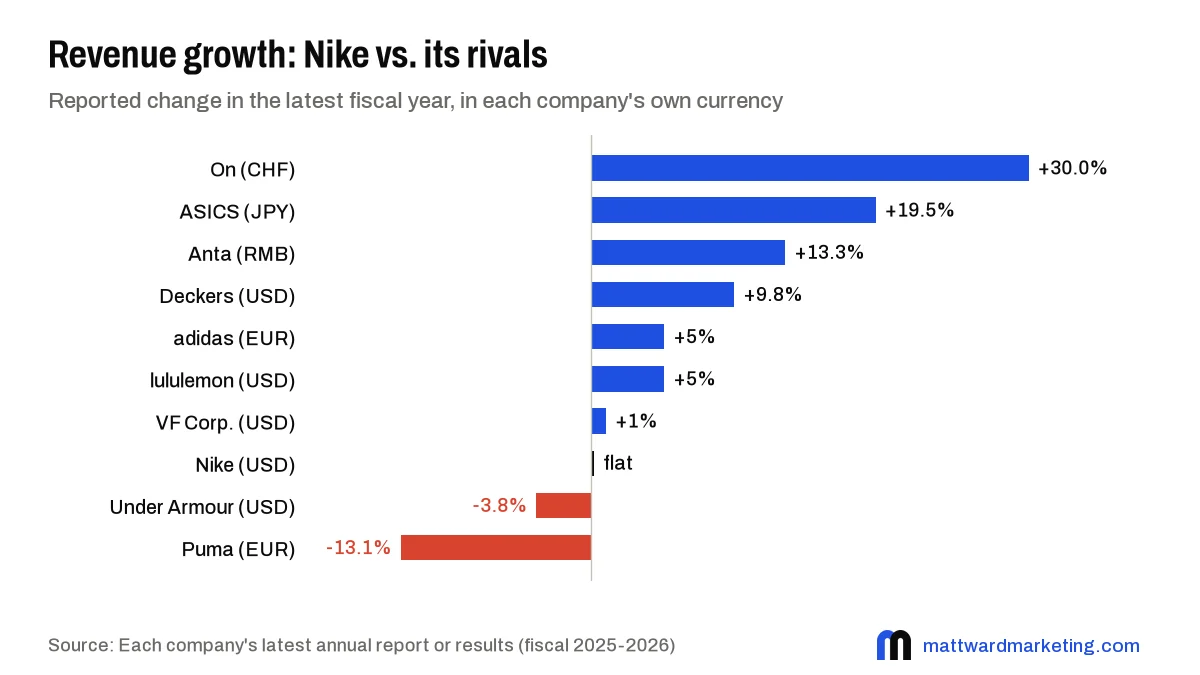
Growth matters as much as size. In their latest fiscal years, On, ASICS, Anta, Deckers, adidas and lululemon all grew faster than Nike. That is why Nike’s fiscal 2027 outlook, published October 1, 2026, still expects revenue to decline by a high-single-digit percentage.
Direct vs. indirect competitors
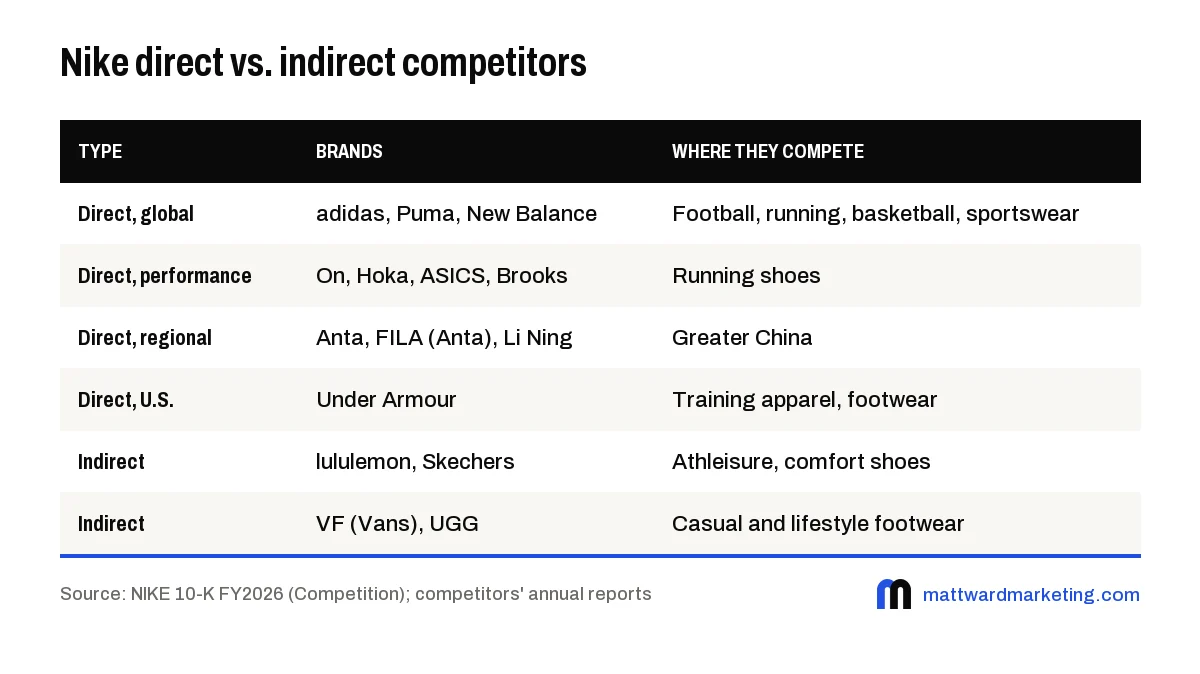
A direct competitor sells the same kind of product to the same buyer, such as a running shoe for a runner. An indirect competitor meets the same need with a different product, such as leggings worn for comfort instead of a training top. For example, Hoka is a direct rival to Nike running shoes, while UGG competes for casual footwear spending.
Direct competitors
- Global all-sport brands: adidas, Puma and New Balance compete in football, running, basketball and sportswear.
- Running specialists: On, Hoka and ASICS compete for performance runners. On’s 20-F also names Brooks Sports among its primary competitors.
- Chinese brands: Anta and Li Ning compete in Greater China, where Nike’s revenue fell 11% in fiscal 2026 and 22% in the first quarter of fiscal 2027.
- Training brands: Under Armour competes in training apparel and team sports.
Indirect competitors
- Athleisure: lululemon sells apparel worn for sport and for everyday life.
- Comfort and casual shoes: Skechers, Vans and UGG compete for shoppers who buy sneakers for daily wear, not sport.
- Retailers’ own labels: Deckers’ 10-K lists “retailers with their own private labels” among its competitors, a reminder that store brands also compete for casual footwear spending.
Nike also competes with itself. Converse, which Nike owns, sells casual sneakers that sit next to Nike Sportswear on the shelf. Converse revenue fell 31% to $1.2 billion in fiscal 2026.
How does Nike differentiate from its competitors?
Nike differentiates through brand, athletes, innovation and reach. Its 10-K names three areas of competition: product attributes, consumer connection through marketing and athletes, and sourcing and distribution. For example, Nike spent $4.75 billion on demand creation, its advertising and sports marketing budget, in fiscal 2026.
1. The Swoosh and Jordan
Nike calls the NIKE and Swoosh Design trademarks “among our most valuable assets,” registered in more than 190 jurisdictions. Jordan Brand alone sold $7.0 billion in fiscal 2026, more than the total revenue of Under Armour, On or Deckers.
2. Athlete endorsements
Nike builds authenticity through contracts with professional athletes, teams, leagues and influencers. Its 10-K warns that the cost of these deals has risen as more brands compete for endorsers.
3. Product technology
Nike lists Nike Air, Zoom, Free, Dri-FIT, Flyknit, FlyEase, ZoomX, Air Max and React as examples of its innovation. Its research teams include specialists in biomechanics, chemistry and exercise physiology.
4. Global distribution
Nike sells through wholesale accounts in nearly all countries, its own digital platforms in more than 40 countries and 988 owned stores (347 in the U.S. and 641 abroad) as of May 31, 2026. Wholesale revenue grew 6% to $27.5 billion in fiscal 2026.
What do Nike’s competitors mean for marketers?
Nike’s rivals show that a category leader can lose growth to focused challengers. On and Hoka won runners with one clear product story, and lululemon won apparel with one clear customer. A small brand can copy that playbook: pick a narrow use case and own it before going broad.
Nike’s own SWOT shows how it plans to respond, with wholesale growth, performance product and cost savings. You can read the full picture in our Nike SWOT analysis, and find more rival breakdowns in our competitive analysis section.
FAQ
Who are Nike’s competitors?
Nike’s fiscal 2026 10-K lists adidas, Anta, ASICS, Deckers, Li Ning, lululemon, New Balance, On, Puma, Under Armour and V.F. Corporation. Other brands often compared with Nike include Skechers, Brooks and FILA.
Who is Nike’s biggest competitor?
adidas is Nike’s biggest competitor. It reported record revenue of €24.8 billion in 2025, the highest of the rivals Nike lists, and it competes with Nike in almost every sport and region.
Who are Nike’s biggest competitors?
Besides adidas, Nike’s largest rivals include Anta (RMB 80.22 billion in 2025 revenue), lululemon ($11.1 billion in fiscal 2025), VF Corporation ($9.6 billion in fiscal 2026) and ASICS (¥810.9 billion in 2025).
Who are the competitors of Nike in running shoes?
In running, Nike competes mainly with On, Hoka (owned by Deckers), ASICS, Brooks, adidas and New Balance. On grew 30.0% in 2025, and Hoka grew 15.9% in fiscal 2026.
What shoe brand competes with Nike in China?
Anta and Li Ning are Nike’s main local rivals in China. Anta’s group, which also runs FILA in its portfolio, grew revenue 13.3% in 2025, while Nike’s Greater China revenue fell 11% in fiscal 2026.
Sources
- NIKE, Inc. Form 10-K for the fiscal year ended May 31, 2026, filed July 15, 2026 (SEC EDGAR).
- NIKE, Inc. fiscal 2026 fourth quarter and full year results, Form 8-K exhibit 99.1, June 30, 2026 (SEC EDGAR).
- NIKE, Inc. fiscal 2027 first quarter results, Form 8-K exhibit 99.1, October 1, 2026, and Form 10-Q for the quarter ended August 31, 2026 (SEC EDGAR).
- NIKE, Inc. Form 10-K for fiscal 2004, filed July 30, 2004 (SEC EDGAR).
- adidas AG, full year 2025 results release, March 4, 2026 (adidas Group investors).
- PUMA SE, Annual Report 2025 (PUMA investor relations).
- ANTA Sports Products Limited, 2025 annual results press release, March 25, 2026 (ANTA investor relations), and Annual Report 2025 (HKEXnews).
- ASICS Corporation, Consolidated Financial Summary for the fiscal year ended December 31, 2025, February 13, 2026 (ASICS investor relations).
- Deckers Outdoor Corporation, Form 10-K for the fiscal year ended March 31, 2026 (SEC EDGAR).
- On Holding AG, Form 20-F for the fiscal year ended December 31, 2025, filed March 3, 2026 (SEC EDGAR).
- lululemon athletica inc., Form 10-K for the fiscal year ended February 1, 2026, filed March 17, 2026 (SEC EDGAR).
- Under Armour, Inc., Form 10-K for the fiscal year ended March 31, 2026, filed May 19, 2026 (SEC EDGAR).
- V.F. Corporation, Form 10-K for the fiscal year ended March 28, 2026, filed May 20, 2026 (SEC EDGAR).
- Skechers U.S.A., Inc., Form 10-K for 2024, filed February 28, 2025 (SEC EDGAR), and Form 8-K on completion of the merger, September 12, 2025 (SEC EDGAR).