PESTLE Analysis for Starbucks Coffee (2026): Political, Economic, Social and More
A PESTLE analysis for Starbucks coffee looks at the political, economic, social, technological, legal and environmental forces outside the company that shape its results. For 2026, the big ones are tariffs, coffee inflation, changing tastes, digital ordering, labor law and climate risk to arabica crops, all backed here by dated official sources.
Key takeaways
- Political: tariffs hit Starbucks imports in fiscal 2026, but it recovered substantially all requested IEEPA tariff refunds after the February 20, 2026, Supreme Court ruling.
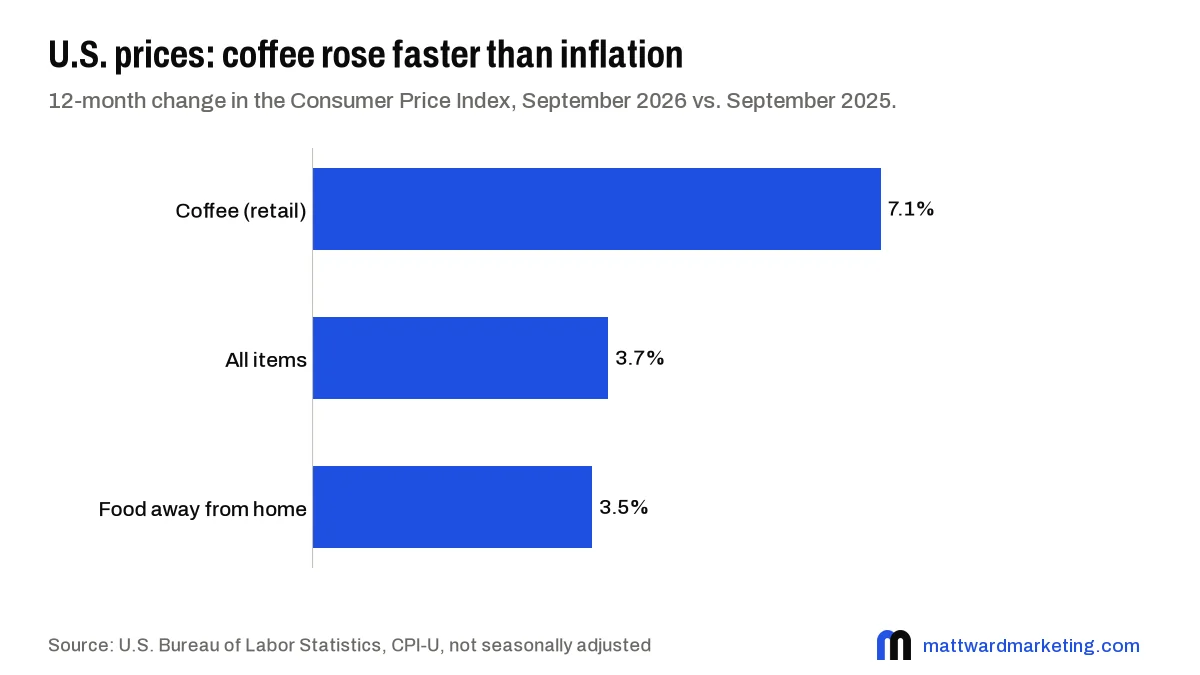
- Economic: U.S. retail coffee prices rose 7.1% in the year to September 2026, almost twice the 3.7% rise in overall consumer prices.
- Social: customers came back in fiscal 2026, with North America comparable transactions up 3.6% under the “Back to Starbucks” plan.
- Technological: the Starbucks app, Rewards Stars, Mobile Order and Pay and delivery shape how many customers order and pay.
- Legal and environmental: union bargaining, California wage rules, privacy law and climate risk to coffee crops are the main long-term pressures.
What is a PESTLE analysis for Starbucks coffee?
A PESTLE analysis for Starbucks coffee is a review of the six external, macro-environment factors that affect the company: political, economic, social, technological, legal and environmental. It shows what Starbucks cannot control but must plan for. For example, arabica prices depend on weather, crop disease and trade policy in producing countries.
PESTLE is the same tool as PESTEL; only the letter order changes. It complements a SWOT analysis, which looks at internal strengths and weaknesses. For the company’s own strengths and weaknesses, see our Starbucks SWOT analysis.
| Starbucks context | Fiscal 2026 (year ended September 27, 2026) |
|---|---|
| Revenue | $37.9B (up 2%) |
| Global comparable coffeehouse sales | Up 6.2% |
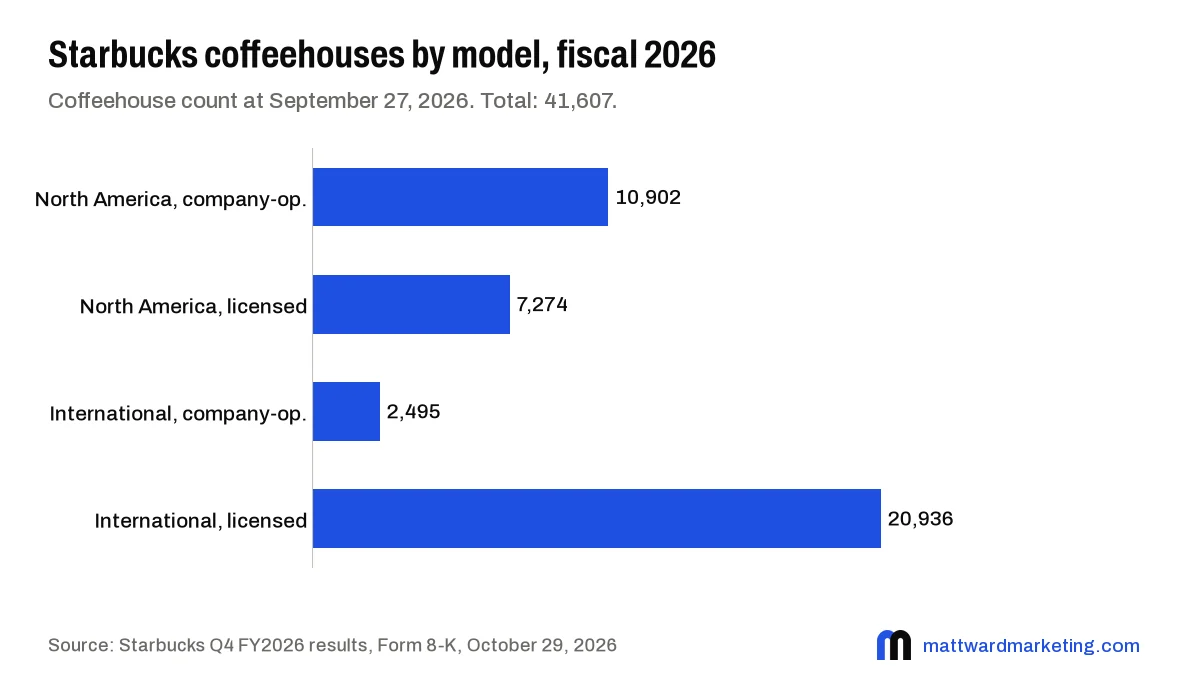
| Coffeehouses | 41,607 (68% licensed) |
| Share of revenue from North America | About 76% ($28.9B) |
| Fiscal 2027 outlook | Revenue down about 1%; about 1,200 net new coffeehouses |
Political factors
The main political factors for Starbucks are trade policy and government action in the markets where it buys coffee and runs stores. In fiscal 2026, tariffs raised its product costs until refunds arrived. Its filings also list sanctions, quotas, customs rules and foreign investment policies as risks.
1. Tariffs on imports
Starbucks imports were subject to reciprocal tariffs under the International Emergency Economic Powers Act (IEEPA). On February 20, 2026, the U.S. Supreme Court ruled those tariffs unlawful. Starbucks then received substantially all the refunds it requested in the third quarter of fiscal 2026, which largely offset the tariffs it had paid that year.
2. Coffee-producing countries
Starbucks buys green coffee beans from many coffee-producing regions around the world. Political and economic conditions in those producing countries affect supply and price. Its 10-K adds that some organizations have tried to influence prices through export quotas.
3. China and foreign investment
In the third quarter of fiscal 2026, funds managed by Boyu Capital bought 60% of Starbucks’s China retail operations. Starbucks kept 40% and still licenses the brand. A local partner changes how Starbucks is exposed to policy in one of its key growth markets.
Economic factors
The key economic factors for Starbucks are coffee commodity prices, consumer spending and inflation. Coffee is its core cost, and U.S. retail coffee prices rose 7.1% in the year to September 2026. Even so, Starbucks grew revenue 2% to $37.9 billion in fiscal 2026 as customers returned.
1. Coffee as a commodity
High-altitude arabica trades at a premium above the “C” coffee commodity price. Both depend on supply and demand, and on trading by hedge funds and index funds. Starbucks uses fixed-price and price-to-be-fixed contracts, plus futures and collars for hedging. At June 28, 2026, it had $383 million in fixed-price and about $440 million in price-to-be-fixed green coffee commitments.
2. Consumer spending
Starbucks sells an affordable treat, but its 10-K warns that cuts in discretionary spending and price increases can reduce demand. In the fourth quarter of fiscal 2026, U.S. comparable sales rose 7.7%, with a 5.2% increase in average ticket.
3. Rising labor and operating costs
Labor investments to support “Back to Starbucks” pushed up store costs in fiscal 2026. Starbucks also names rising real estate costs, interest rates and currency swings as economic risks.
4. Inflation away from home
U.S. prices for food away from home rose 3.5% in the year to September 2026, according to the BLS. That is the price backdrop Starbucks’s menu competes in.
Social factors
The social factors for Starbucks are changing tastes, health concerns and the role of the coffeehouse in daily life. Beverages made up 73% of company-operated store revenue in fiscal 2025, so drink trends matter most. Its 10-K warns that worries about caffeine, sugar or dairy, and use of weight-loss drugs, could reduce demand.
1. Health and diet trends
Starbucks sells dairy and plant-based, non-dairy alternatives such as oat milk and almond milk. Food made up 23% of company-operated store revenue in fiscal 2025, and selling food with drinks is part of its growth plan.
2. The coffeehouse experience
“Back to Starbucks” aims to reestablish the brand as “the community coffeehouse.” It seems to be working: North America comparable transactions rose 3.6% in fiscal 2026.
3. Workforce and culture
Starbucks employed about 381,000 people on September 28, 2025, including about 223,000 in the U.S. Its Green Apron Service Model sets consistent service routines across U.S. company-operated coffeehouses.
Technological factors
Technology shapes how Starbucks takes orders, builds loyalty and runs stores. The Starbucks app powers Mobile Order and Pay, and Starbucks Rewards members earn Stars on purchases. In the fourth quarter of fiscal 2026, higher delivery sales helped lift North America’s average ticket 5.0%.
1. Digital ordering and loyalty
Starbucks Cards and the app let customers pay, order ahead and collect Stars. In fiscal 2026, Starbucks listed a redesigned Starbucks Rewards program among its “Back to Starbucks” priorities.
2. Store technology
The Green Apron Service Model is supported by technology that improves order flow and speed of service. Faster service is part of how Starbucks wins back time-pressed customers.
3. Data, AI and cyber risk
Starbucks says it needs strong marketing and data analytics, including artificial intelligence and machine learning, to grow brand loyalty. It also warns of data theft driven by “increasingly sophisticated threats enabled or accelerated by artificial intelligence.”
Legal factors
The main legal factors for Starbucks are labor law, wage rules, privacy law and product regulation. Unions have won representation at around 6% of its more than 10,000 U.S. company-operated stores, according to its fiscal 2025 10-K. Compliance with changing rules adds cost in every market.
1. Labor and union law
Starbucks partners began seeking union representation through National Labor Relations Board elections in September 2021. Starbucks is negotiating first collective bargaining agreements, and its 10-Q mentions litigation tied to union organizing.
2. Wage and working standards
California’s Assembly Bill 1228 raised the minimum wage and set working standards for some Starbucks partners. Starbucks says changes like this could raise labor costs.
3. Privacy and data protection
Starbucks collects customer data through its app and Rewards program. Its 10-K notes that the Federal Trade Commission and state attorneys general are applying consumer protection laws to online data practices.
4. Taxes on products
Some jurisdictions have taxes or limits on beverages with caloric sweeteners. These rules can raise prices or change what customers buy.
Environmental factors
The environmental factors for Starbucks are climate change, water and packaging rules. Climate change can make weather, water supply and crop disease worse, which hurts coffee yields and availability. New rules on carbon emissions, plastic use and water use may also raise Starbucks’s compliance costs.
1. Climate risk to arabica
Arabica supply depends on weather, water and pests in coffee-growing regions. Starbucks runs ten farmer support centers, including one in China’s Yunnan Province, where agronomists help growers improve their crops.
2. Packaging and plastic rules
Plastic packaging levies and extended producer responsibility laws are gaining traction, Starbucks says. Cups and packaging make this a direct cost for a takeaway coffee brand.
3. Responsible sourcing
Starbucks describes itself as “committed to responsibly sourcing and roasting high-quality arabica coffee” since 1971. Its 10-K also flags emerging rules such as import tariffs tied to alleged human rights violations, which raise the bar for sourcing compliance.
Starbucks PESTLE table
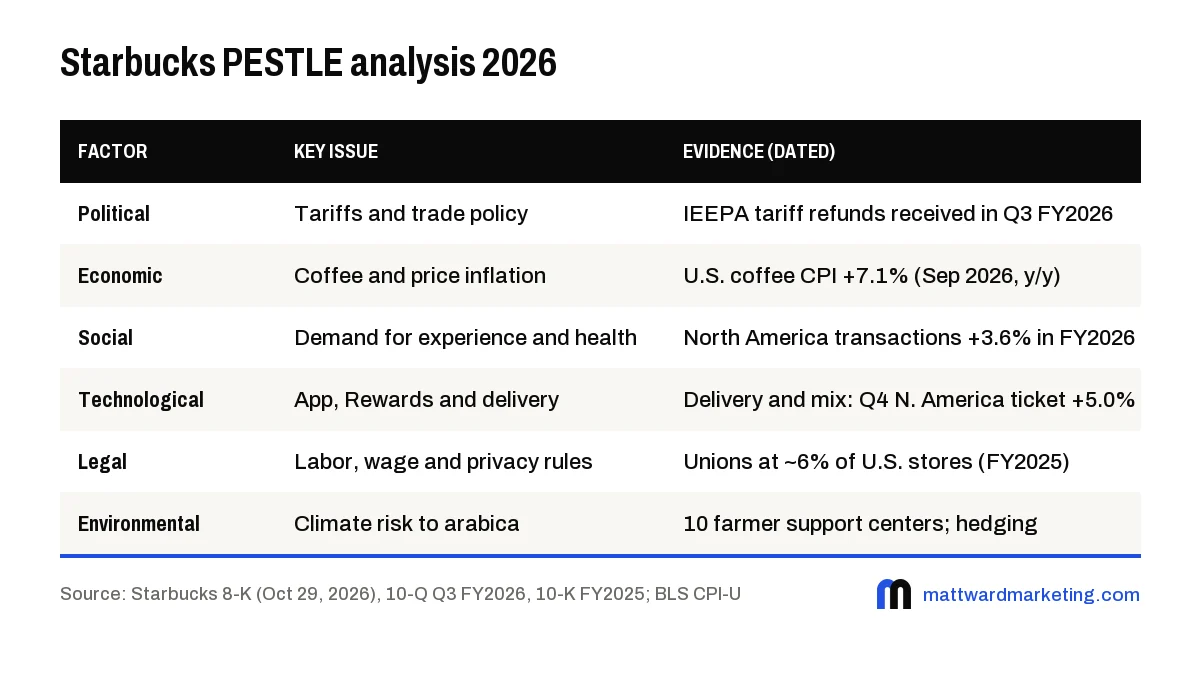
| Factor | Key issue for Starbucks | Dated evidence | Impact |
|---|---|---|---|
| Political | Tariffs, trade and foreign investment policy | IEEPA tariff refunds received in Q3 fiscal 2026; China JV closed in Q3 fiscal 2026 | Mixed |
| Economic | Coffee commodity prices and consumer spending | U.S. coffee CPI up 7.1% (September 2026, year over year) | Negative |
| Social | Demand for the coffeehouse experience; health trends | North America transactions up 3.6% in fiscal 2026 | Positive |
| Technological | App, Rewards, delivery and AI | Delivery helped lift Q4 fiscal 2026 North America ticket 5.0% | Positive |
| Legal | Union bargaining, wage rules, privacy, sugar taxes | Unions at about 6% of U.S. company-operated stores (fiscal 2025) | Negative |
| Environmental | Climate risk to arabica; plastic and carbon rules | Ten farmer support centers; coffee hedging program | Negative |
What does Starbucks’s PESTLE mean for marketers?
Starbucks’s PESTLE shows that the biggest risks to a coffee brand sit far from the counter: in coffee fields, trade courts and labor law. Marketers cannot control those forces, but they can plan around them. For example, Starbucks grew U.S. tickets in fiscal 2026 through food and product mix while coffee costs rose.
- Track your input costs. If a core ingredient rises 7% in a year, plan pricing and bundles before margins suffer.
- Sell the experience, not just the product. Starbucks’s recovery came from more visits, not only higher prices.
- Build compliance into campaigns. Privacy and sugar rules affect loyalty programs and menu promotions.
You can find more frameworks in our PESTEL analysis section, including the Nike PESTLE analysis.
FAQ
What is PESTLE analysis for Starbucks Coffee?
It is a review of the political, economic, social, technological, legal and environmental factors outside Starbucks that affect its business. For 2026, the main ones are tariffs, coffee inflation, demand for the coffeehouse experience, digital ordering, labor law and climate risk to arabica crops.
How do you do a PESTLE analysis for Starbucks Coffee?
Start with Starbucks’s latest 10-K, 10-Q and earnings release on SEC EDGAR, and read the risk factors. Sort each external risk into one of the six PESTLE groups. Then add dated evidence, such as BLS price data, and rate each factor as positive, negative or mixed.
What is an example of PESTLE analysis for Starbucks Coffee?
An economic example: U.S. retail coffee prices rose 7.1% in the year to September 2026, according to the BLS. Starbucks manages that risk with fixed-price contracts, futures and collars. A political example: it recovered substantially all requested IEEPA tariff refunds in the third quarter of fiscal 2026.
Sources
- Starbucks Corporation, Q4 and full fiscal year 2026 results, Exhibit 99.1 to Form 8-K, October 29, 2026 (SEC EDGAR).
- Starbucks Corporation, Form 10-Q for the quarter ended June 28, 2026, filed July 29, 2026 (SEC EDGAR).
- Starbucks Corporation, Form 10-K for the fiscal year ended September 28, 2025, filed November 14, 2025 (SEC EDGAR).
- U.S. Bureau of Labor Statistics, Consumer Price Index for All Urban Consumers, not seasonally adjusted: coffee (CUUR0000SEFP01), food away from home (CUUR0000SEFV) and all items (CUUR0000SA0), September 2025 and September 2026.