Apple SWOT Analysis (2026): Strengths, Weaknesses, Opportunities & Threats
This Apple SWOT analysis for 2026 looks at a company that just posted record revenue of $478.8 billion, up 15%, but still depends on one product and faces regulators on three continents. Every figure below comes from Apple’s fiscal 2026 Form 10-K, filed on November 3, 2026, and its fourth-quarter results.
Key takeaways
- Apple’s biggest strength is its ecosystem: iPhone, Mac, iPad, wearables and services that work together and drove $478.8 billion in net sales in fiscal 2026.
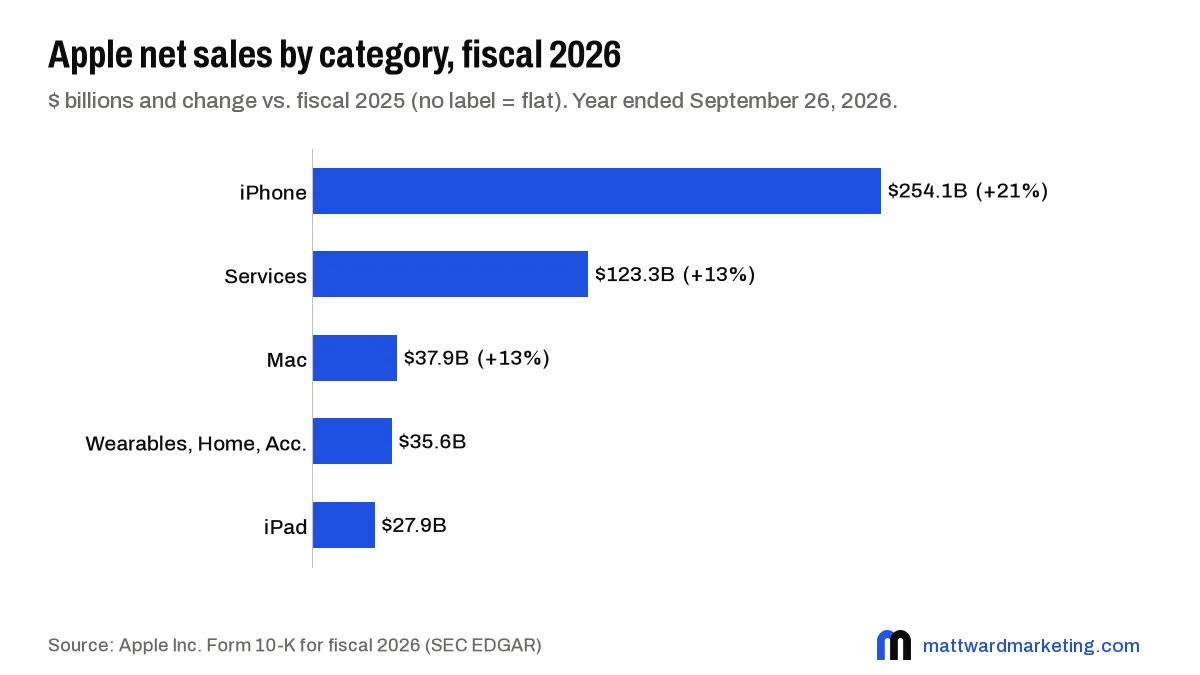
- Its main weakness is concentration: iPhone alone brought in $254.1 billion, or 53% of total net sales.
- The services business is the profit engine, with a 76.2% gross margin against 39.3% for products.
- The clearest opportunities are AI features such as Siri AI, growth in Greater China (up 28%) and new devices like iPhone Duo.
- The biggest threats are antitrust cases, the EU Digital Markets Act, tariffs and rising memory and chip costs.
What is a SWOT analysis of Apple?
An Apple SWOT analysis lists the company’s internal strengths and weaknesses and the external opportunities and threats it faces. For fiscal 2026, that means a record year built on iPhone and services, set against legal pressure on the App Store. For example, net sales grew 15% while R&D spending rose 32%.
Apple Inc. designs, makes and sells smartphones, personal computers, tablets, wearables and accessories, plus a wide range of services. It is based in Cupertino, California, and had about 167,000 full-time equivalent employees on September 26, 2026. John Ternus became CEO on September 1, 2026, and Tim Cook became Executive Chair.
| Apple at a glance | Fiscal 2026 (year ended September 26, 2026) |
|---|---|
| Net sales | $478.8B (up 15%) |
| Net income | $132.2B (up 18%) |
| Gross margin | 48.8% (products 39.3%, services 76.2%) |
| iPhone / Services | $254.1B (up 21%) / $123.3B (up 13%) |
| R&D spending | $45.8B (up 32%) |
| Employees | About 167,000 |
What are Apple’s biggest strengths?
Apple’s biggest strengths are its integrated ecosystem, pricing power and cash. It designs nearly the entire solution for its products, from hardware to operating system to services. That model produced $478.8 billion in net sales and $145.1 billion in operating cash flow in fiscal 2026.
1. An ecosystem that keeps customers
Apple runs its own platforms on every device: iOS on iPhone, macOS on Mac, iPadOS on iPad, watchOS on Apple Watch and visionOS on Apple Vision Pro. iCloud, the App Store, Apple Music and Apple Pay tie them together. CFO Kevan Parekh said in November 2026 that the installed base of active devices “reached a new all-time high across all major product categories and geographic segments.”
2. A services business with high margins
Services net sales rose 13% to $123.3 billion in fiscal 2026, led by advertising and cloud services. Services earned a 76.2% gross margin and produced about 40% of Apple’s total gross profit.
3. A best-selling smartphone line
iPhone net sales grew 21% to $254.1 billion, driven by Pro models. The fourth quarter set a September-quarter record for iPhone revenue.
4. Financial strength
Apple held $136.9 billion in cash, cash equivalents and marketable securities on September 26, 2026. It repurchased $85.8 billion of stock and paid $15.7 billion in dividends during the year.
What is Apple’s main weakness?
Apple’s main weakness is its dependence on iPhone. The phone line produced $254.1 billion, or 53% of net sales, in fiscal 2026. The 10-K itself warns that a decline in demand for that product category could significantly hurt sales and margins. Two other categories, iPad and wearables, did not grow at all.
1. Flat iPad and wearables
iPad net sales were $27.9 billion, flat with fiscal 2025. Wearables, Home and Accessories, which includes Apple Watch and AirPods, was also flat at $35.6 billion, after falling 4% the year before.
2. Minority market share
Apple says it has a minority share of the global smartphone, personal computer, tablet and wearables markets. Rivals running Android and Windows have larger installed bases, which can draw developers away.
3. Concentrated manufacturing
Final assembly of substantially all Apple hardware happens with partners mainly in Asia. Many components come from a single source, which makes any disruption costly.
4. Reliance on carriers and resellers
About 60% of net sales went through indirect channels, such as carriers and resellers, in fiscal 2026. Carriers also held 33% of Apple’s trade receivables at year-end.
What opportunities does Apple have?
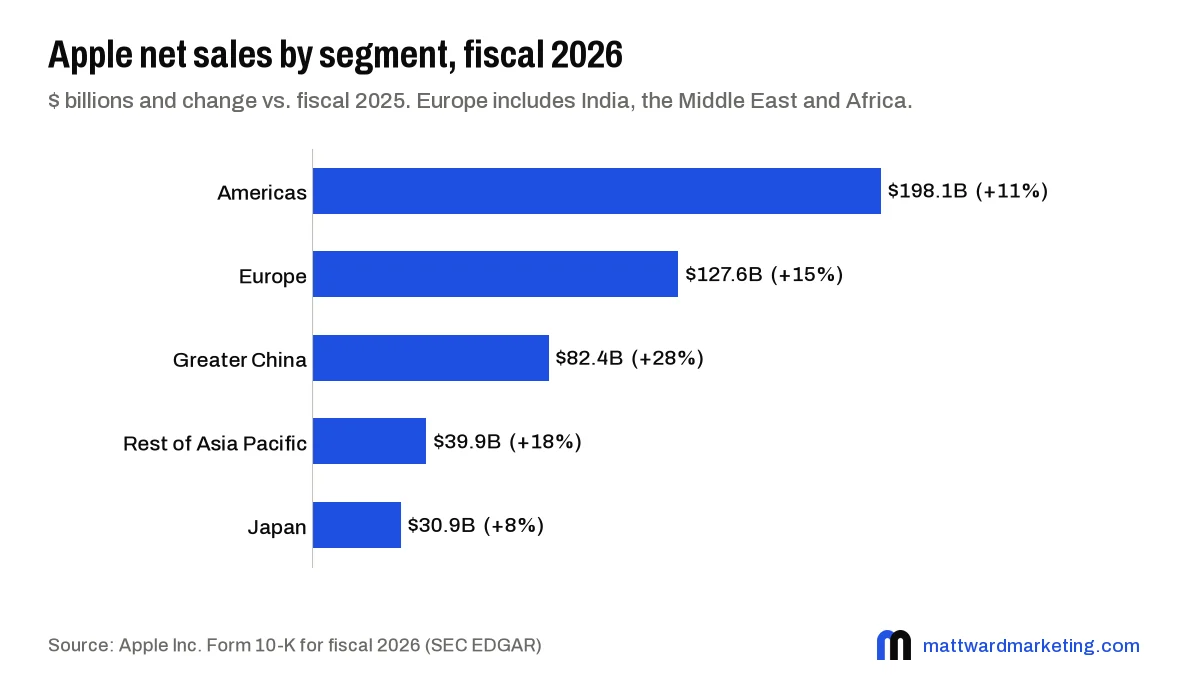
Apple’s opportunities sit in artificial intelligence, new device categories and growth outside the U.S. It announced Siri AI in the third quarter of fiscal 2026 and raised R&D spending 32% to $45.8 billion, driven by infrastructure costs, including AI, and headcount. Greater China net sales also rebounded 28% to $82.4 billion.
- AI features across devices. iCloud will provide expanded access to Apple Intelligence and Siri AI features, which can lift both hardware upgrades and cloud subscriptions.
- New product lines. Apple’s lineup now includes iPhone Duo, MacBook Neo, Apple Watch Series 12 and the Apple HomeView smart home display.
- International growth. Sales outside the U.S. were about 65% of the total. Europe grew 15% and Rest of Asia Pacific grew 18%.
- Health and finance. The 10-K notes that Apple’s products are moving into specialized uses, including health and financial services such as Apple Pay and Apple Card.
- Advertising. Advertising was one of the two main drivers of services growth in fiscal 2026.
What threats does Apple face in 2026?
Apple’s main threats are legal and regulatory action, trade policy and component costs. The U.S. Department of Justice is suing it for alleged smartphone monopolization, the EU fined it €500 million under the Digital Markets Act, and a U.S. court still blocks some App Store commissions. Memory and chip costs are also rising.
1. App Store rules under attack
A U.S. injunction from the Epic Games case limits the commission Apple can charge on purchases made through external links. On June 30, 2026, the Supreme Court agreed to review the legal standard for civil contempt in that case.
2. Antitrust and the Digital Markets Act
The European Commission fined Apple €500 million on April 23, 2025, and could impose fines of up to 10% of worldwide net sales in a second DMA case. Apple says DMA rules may stop it from launching features such as Siri AI in some jurisdictions.
3. Google search revenue at risk
Apple earns licensing revenue from Google for search on its platforms. A U.S. court ordered remedies against Google on September 2, 2025, and both the DOJ and Google have appealed.
4. Tariffs and component costs
New U.S. tariffs since 2025 have hit imports from China mainland, India, Vietnam and other supplier countries. Tariff refunds after the Supreme Court’s February 20, 2026, ruling added about 1 point to fourth-quarter gross margin, but new Section 301 tariffs have since been imposed. Apple also reports rising costs for advanced semiconductors, memory and storage, and expects memory pressure to intensify.
5. Strong, well-funded rivals
Apple names Android, Windows, PlayStation, Nintendo and Xbox as competing platforms. The filing does not name companies, but Android is Google’s platform, used by phone makers such as Samsung. Apple also warns that falling behind rivals in AI could cost it market share.
Apple SWOT matrix
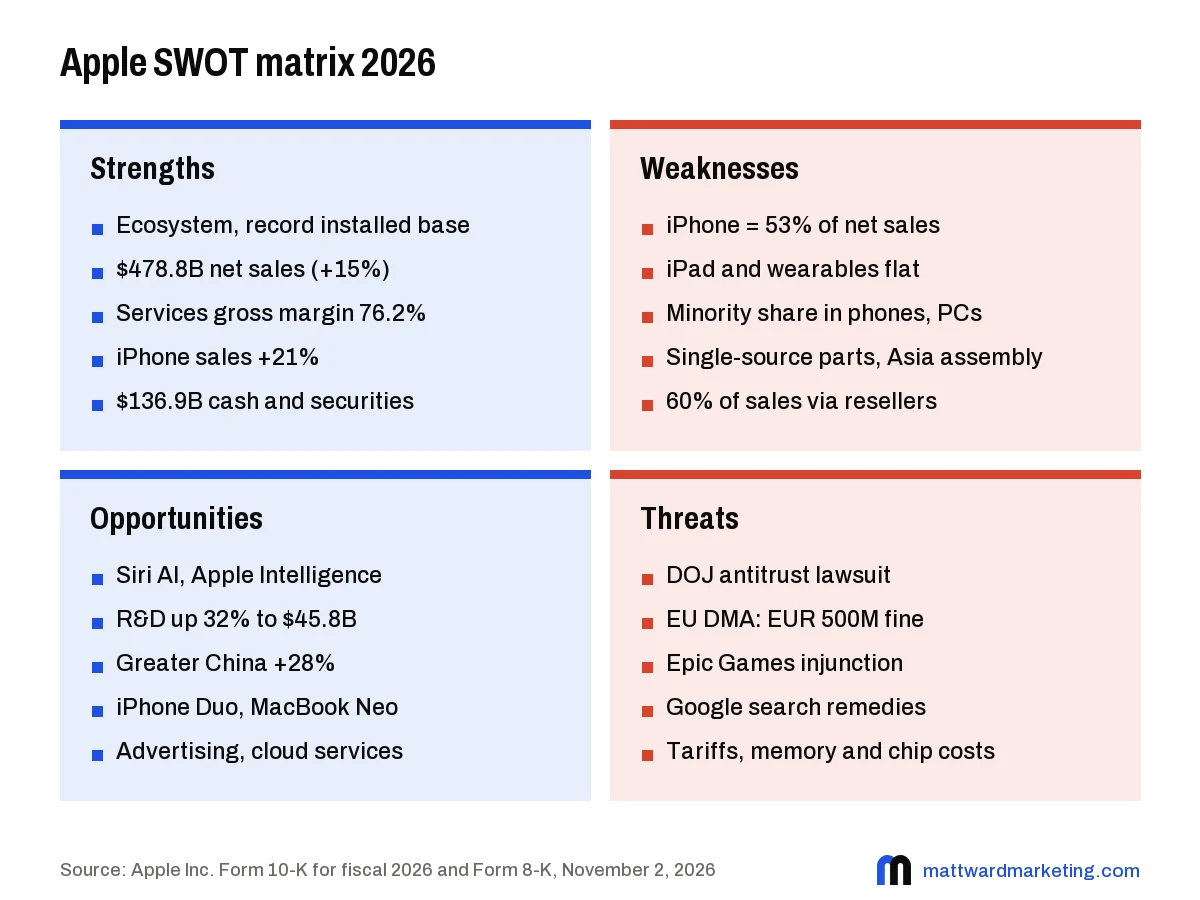
| Strengths | Weaknesses |
|---|---|
| Integrated ecosystem and record installed base; $478.8B net sales; services margin 76.2%; iPhone up 21%; $136.9B cash and marketable securities | iPhone is 53% of net sales; iPad and wearables flat; minority share in smartphones and PCs; single-source parts and assembly in Asia; 60% of sales through resellers |
| Opportunities | Threats |
| Siri AI and Apple Intelligence; R&D up 32%; Greater China up 28%; new devices such as iPhone Duo and MacBook Neo; advertising and cloud services | DOJ antitrust suit; EU DMA fines; Epic Games injunction; Google search remedies; tariffs; rising memory and chip costs |
What does Apple’s SWOT mean for marketers?
Apple’s SWOT shows how an ecosystem turns one sale into many. A customer who buys an iPhone is a likely buyer of AirPods, iCloud storage and Apple Music. That is why services, at 26% of net sales, produced about 40% of gross profit in fiscal 2026.
Three lessons apply to smaller brands:
- Build a reason to stay. Bundles, subscriptions and accounts that connect your products make switching harder.
- Sell the experience, not the spec sheet. Apple lists design, privacy, security and ecosystem among its competitive factors, not only price.
- Watch your biggest channel. Apple’s App Store fees are now set partly by courts. If one platform drives most of your revenue, plan for its rules to change.
You can compare this with our Nike SWOT analysis, a brand that also built its name on design but leans far more on wholesale partners. For more company breakdowns, see all our SWOT analysis guides.
FAQ
What are Apple’s biggest strengths?
Apple’s biggest strengths are its integrated ecosystem, its high-margin services business and its cash. In fiscal 2026 it posted $478.8 billion in net sales, a 76.2% services gross margin and $136.9 billion in cash and marketable securities, with a record installed base of active devices.
What is Apple’s main weakness?
Apple’s main weakness is its dependence on iPhone, which produced $254.1 billion, or 53% of net sales, in fiscal 2026. iPad and Wearables, Home and Accessories were flat, and Apple holds only a minority share of the global smartphone and PC markets.
What threats does Apple face in 2026?
Apple faces a DOJ antitrust lawsuit, EU Digital Markets Act fines and orders, the Epic Games injunction on App Store commissions, remedies against Google that could cut search licensing revenue, U.S. tariffs, and rising costs for memory and advanced chips.