
CRM Manager: Job Description, Skills and Responsibilities
A CRM manager runs a company’s customer relationship management system, using data, segmentation and teamwork to keep customers loyal and support business growth. A CRM (Customer Relationship Management) Manager plays a pivotal role in optimizing customer interactions and driving business growth. Tasked with overseeing CRM systems, they ensure smooth communication between a company and its clients, fostering long-term relationships and enhancing customer satisfaction. This role demands a unique blend of technical expertise, strategic thinking, and interpersonal skills. From analyzing customer data to implementing CRM strategies, a CRM Manager must possess strong analytical abilities, leadership qualities, and a deep understanding of customer behavior. This article explores the key skills required for the role and looks at the common responsibilities that define the day-to-day operations of a CRM lead.
What Is a CRM Manager? Must Have Skills and Common Responsibilities
A CRM lead is a professional responsible for overseeing the Customer Relationship Management (CRM) system within an organization. Their primary role is to ensure that the CRM platform is effectively utilized to improve customer interactions, streamline business processes, and drive sales growth. They act as a bridge between the technical aspects of the CRM system and the business goals of the organization. A CRM lead must possess a combination of technical expertise, analytical skills, and strong communication abilities to succeed in this role.
What are the key responsibilities of a CRM Manager?
The responsibilities of this role revolve around managing and optimizing the CRM system to enhance customer relationships and business outcomes. Key responsibilities include:
– Implementing and maintaining the CRM system: Ensuring the platform is up-to-date and functioning efficiently.
– Data management: Overseeing the collection, storage, and analysis of customer data.
– Training and support: Educating team members on how to use the CRM system effectively.
– Reporting and analytics: Generating insights from CRM data to inform business decisions.
– Integration: Ensuring the CRM system integrates smoothly with other business tools and software.
What are the must-have skills for a CRM lead?
A successful CRM lead must possess a diverse skill set, including:
– Technical proficiency: Familiarity with CRM software like Salesforce, HubSpot, or Microsoft Dynamics.
– Analytical thinking: Ability to interpret data and derive actionable insights.
– Communication skills: Clear and effective communication with both technical and non-technical stakeholders.
– Project management: Ability to manage multiple tasks and projects simultaneously.
– Customer-centric mindset: Focus on improving customer experiences and satisfaction.
How does a CRM lead contribute to business growth?
A CRM Manager plays a critical role in driving business growth by:
– Enhancing customer retention: Using CRM tools to build stronger relationships with existing customers.
– Improving sales processes: Streamlining lead management and sales pipelines.
– Personalizing marketing efforts: Using customer data to create targeted campaigns.
– Increasing operational efficiency: Automating repetitive tasks and improving workflow.
– Providing actionable insights: Using CRM analytics to identify trends and opportunities.
What tools and software do CRM leads use?
CRM leads rely on a variety of tools and software to perform their duties effectively. Some of the most commonly used platforms include:
– Salesforce: A leading CRM platform for sales, marketing, and customer service.
– HubSpot: An all-in-one CRM with marketing, sales, and service tools.
– Microsoft Dynamics 365: A CRM and ERP solution for enterprise-level businesses.
– Zoho CRM: A cost-effective CRM for small to medium-sized businesses.
– Pipedrive: A sales-focused CRM designed for simplicity and efficiency.
What challenges do CRM leads face?
CRM Managers often encounter several challenges in their role, such as:
– Data quality issues: Ensuring the accuracy and consistency of customer data.
– User adoption: Encouraging employees to fully utilize the CRM system.
– Integration complexities: Connecting the CRM with other business systems.
– Keeping up with technology: Staying updated with the latest CRM trends and features.
– Balancing customization and usability: Tailoring the CRM to meet business needs without overcomplicating it.
| Key Responsibility | Description |
|---|---|
| Data Management | Ensuring accurate and organized customer data. |
| System Integration | Connecting CRM with other business tools. |
| Training | Educating staff on CRM usage. |
| Reporting | Generating insights from CRM data. |
| Customer Retention | Building stronger customer relationships. |
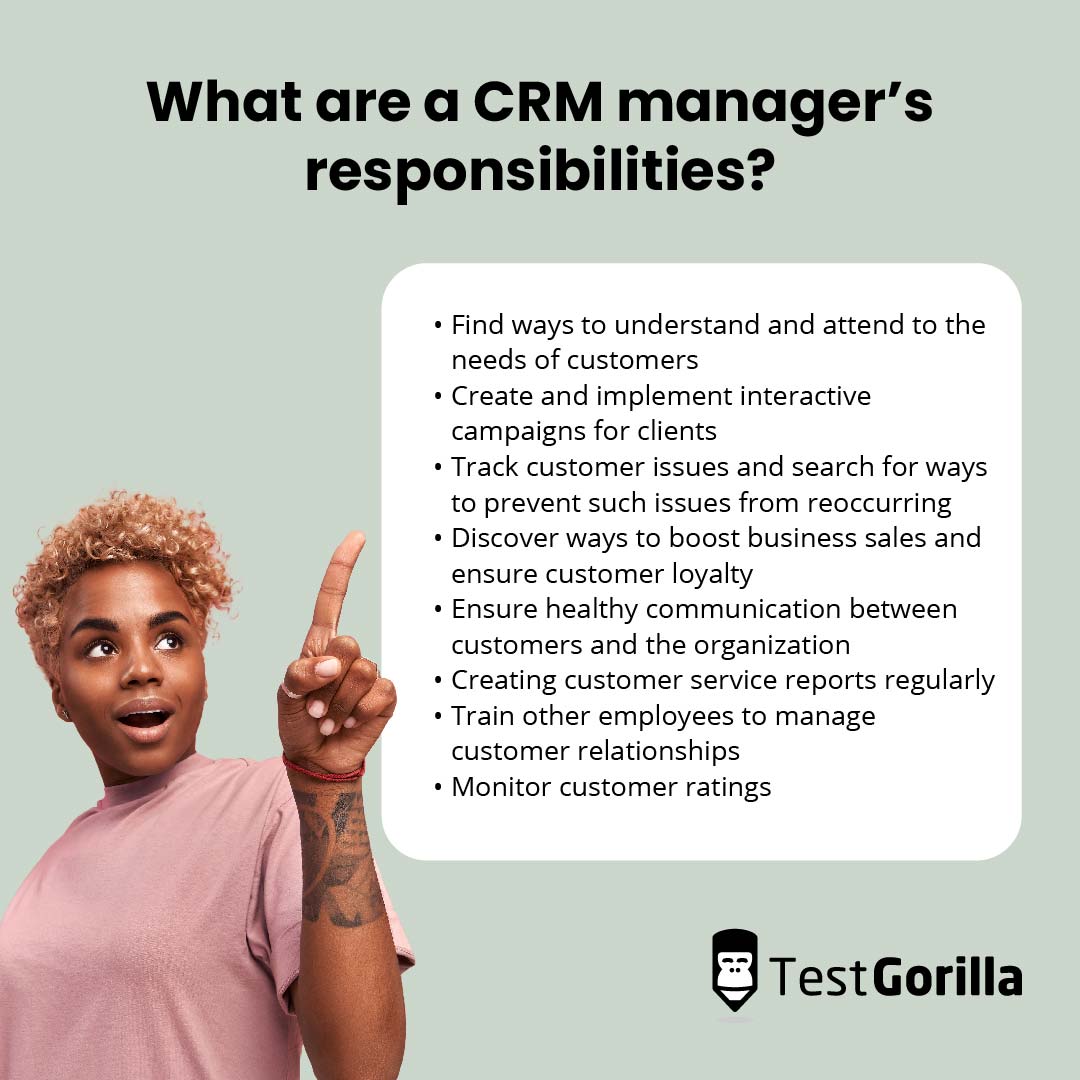
CRM Manager Responsibilities and Job Duties
Customer Relationship Management Strategy Development
A CRM lead is responsible for developing and implementing a complete customer relationship management strategy. This involves:
- Analyzing customer data to identify trends and insights.
- Creating strategies to improve customer engagement and retention.
- Aligning CRM initiatives with overall business goals.
CRM System Management and Optimization
The CRM lead oversees the management and optimization of the CRM system. Key responsibilities include:
- Ensuring the CRM system is up-to-date and functioning efficiently.
- Customizing the system to meet the specific needs of the business.
- Training staff on how to use the CRM system effectively.
Data Analysis and Reporting
A significant part of the role involves data analysis and reporting. This includes:
- Collecting and analyzing customer data to inform decision-making.
- Generating reports on customer behavior, sales trends, and campaign performance.
- Using data to identify opportunities for improving customer satisfaction and loyalty.
Customer Segmentation and Targeting
This role is also responsible for customer segmentation and targeting. This involves:
- Dividing the customer base into distinct segments based on behavior, demographics, or preferences.
- Developing targeted marketing campaigns for each segment.
- Monitoring the effectiveness of segmentation strategies and making adjustments as needed.
Team Collaboration and Leadership
Effective team collaboration and leadership are important for a CRM lead. Responsibilities include:
- Working closely with marketing, sales, and customer service teams to ensure alignment.
- Leading and mentoring a team of CRM specialists.
- Facilitating communication between departments to ensure a unified approach to customer management.
What Professional CRM Skills Are Required?

1. Analytical and Data Interpretation Skills
Professionals working with Customer Relationship Management (CRM) systems must possess strong analytical skills to interpret customer data effectively. This involves:
- Understanding data trends and patterns to make informed decisions.
- Using CRM tools to segment customers and identify opportunities.
- Analyzing customer behavior to improve engagement strategies.
2. Communication and Interpersonal Skills
Effective communication is key for CRM professionals to build and maintain strong customer relationships. Key aspects include:
- Communicating clearly with customers and internal teams to resolve issues.
- Using active listening to understand customer needs and feedback.
- Collaborating with sales, marketing, and support teams to align CRM strategies.
3. Technical Proficiency with CRM Software
CRM professionals must be adept at using CRM platforms and related tools. This includes:
- Mastering popular CRM systems like Salesforce, HubSpot, or Zoho CRM.
- Customizing CRM workflows to meet business requirements.
- Integrating CRM tools with other software systems for easy operations.
4. Problem-Solving and Decision-Making Skills
CRM professionals often face challenges that require quick and effective solutions. Important skills include:
- Identifying and resolving customer issues promptly.
- Making data-driven decisions to enhance customer satisfaction.
- Anticipating potential problems and implementing preventive measures.
5. Customer-Centric Mindset
A strong focus on the customer is vital for CRM success. This involves:
- Prioritizing customer satisfaction and loyalty.
- Understanding the customer journey to deliver personalized experiences.
- Continuously seeking ways to improve customer engagement and retention.
CRM Manager Skills: Key Skills for a Customer Relations Manager

1. Communication Skills
Effective communication is the cornerstone of a successful customer relations manager. This role requires the ability to convey information clearly and listen actively to customer concerns. Key aspects include:
- Verbal communication: Articulating solutions and explaining policies in a way that customers understand.
- Written communication: Crafting clear and professional emails, reports, and messages.
- Active listening: Paying attention to customer feedback and addressing their needs empathetically.
2. Problem-Solving Abilities
A customer relations manager must be adept at problem-solving to resolve customer issues efficiently. This involves:
- Analytical thinking: Identifying the root cause of customer complaints.
- Creativity: Developing innovative solutions to unique problems.
- Decision-making: Making timely and effective decisions to satisfy customers.
3. Emotional Intelligence
Emotional intelligence is vital for managing customer relationships. It includes:
- Empathy: Understanding and sharing the feelings of customers to build trust.
- Self-awareness: Recognizing personal emotions and their impact on interactions.
- Conflict resolution: Managing disagreements calmly and professionally.
4. Organizational Skills
Customer relations managers must be highly organized to handle multiple tasks and prioritize effectively. Key organizational skills include:
- Time management: Meeting deadlines and managing customer inquiries promptly.
- Task prioritization: Focusing on urgent and important issues first.
- Record-keeping: Maintaining accurate records of customer interactions and resolutions.
5. Technical Proficiency
technical proficiency is basic for customer relations managers. This includes:
- CRM software: Using customer relationship management tools to track and manage interactions.
- Data analysis: Interpreting customer data to improve service strategies.
- Digital communication: Using social media, chatbots, and other platforms to engage with customers.
What Are the 5 Keys to Successful CRM Implementation?
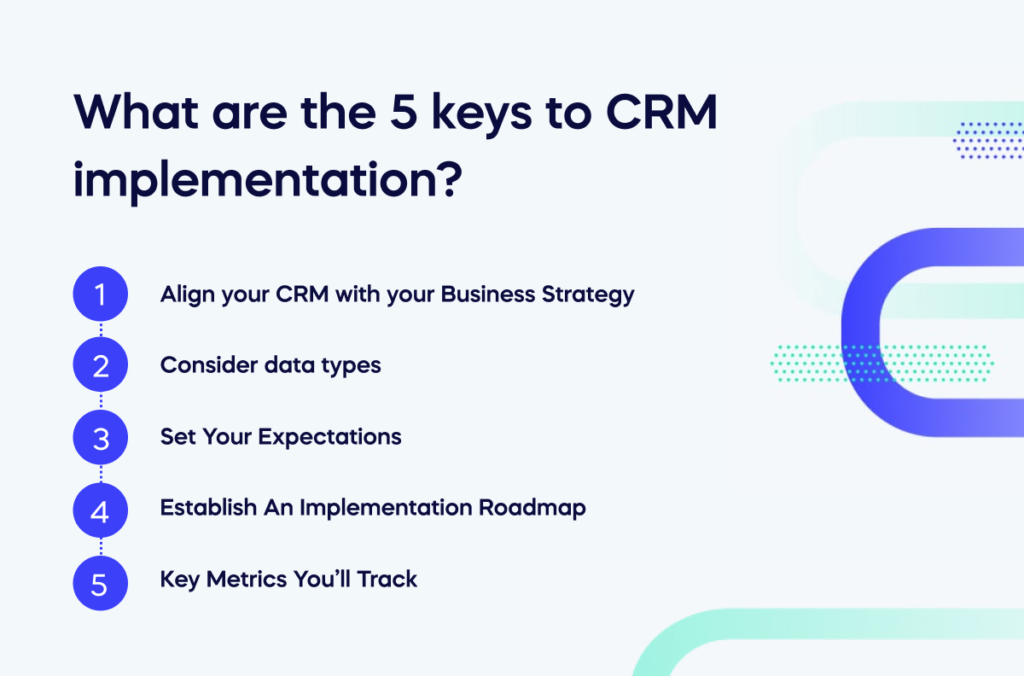
1. Define Clear Objectives and Goals
Before implementing a CRM system, it is important to establish clear objectives and goals. This ensures that the CRM aligns with your business strategy and addresses specific needs. Consider the following steps:
- Identify pain points in your current processes that the CRM should resolve.
- Set measurable goals, such as improving customer retention or increasing sales efficiency.
- Involve key stakeholders to ensure the goals align with overall business objectives.
2. Choose the Right CRM Platform
Selecting the right CRM platform is essential for successful implementation. The platform should match your business size, industry, and specific requirements. Key considerations include:
- Evaluate features such as automation, analytics, and integration capabilities.
- Consider scalability to ensure the CRM can grow with your business.
- Assess user-friendliness to encourage adoption among your team.
3. Ensure Data Quality and Integration
High-quality data and smooth integration are critical for a CRM system to function effectively. Poor data quality can lead to inaccurate insights and hinder decision-making. Focus on:
- Clean existing data by removing duplicates and outdated information.
- Integrate with existing tools such as email, marketing automation, and ERP systems.
- Establish data governance policies to maintain data accuracy and consistency.
4. Train and Engage Your Team
Successful CRM implementation requires team engagement and proper training. Without user adoption, even the best CRM system will fail. Steps to ensure this include:
- Provide thorough training tailored to different user roles.
- Encourage feedback from employees to address concerns and improve usability.
- Highlight benefits of the CRM to motivate users and demonstrate its value.
5. Monitor, Evaluate, and Optimize
After implementation, continuous monitoring and optimization are necessary to maximize the CRM’s effectiveness. This involves:
- Track key performance indicators (KPIs) to measure success against your goals.
- Analyze user feedback to identify areas for improvement.
- Regularly update the system to incorporate new features and address emerging needs.
CRM Manager Job Description: A Short Sample
Use this sample as a starting point for a CRM job description. The person in this role owns the company’s customer relationship management system and the strategy behind it. Daily duties include keeping customer data clean, building segments for campaigns, and reporting on retention and engagement. The role works with sales, marketing and customer service so every team uses the same customer records.
Typical requirements include experience with a CRM platform such as Salesforce or HubSpot, strong data analysis skills and clear communication. Adjust the list to match your tools and team size.
CRM Manager FAQ
What is a CRM Manager?
A CRM lead is a professional responsible for overseeing the Customer Relationship Management system within an organization. Their primary role is to ensure that the CRM platform is effectively utilized to manage customer interactions, improve customer satisfaction, and drive business growth. They act as a bridge between the technical aspects of the CRM software and the strategic goals of the company, ensuring that customer data is used to enhance marketing, sales, and customer service efforts.
What are the must-have skills for a CRM lead?
A successful CRM lead must possess a combination of technical, analytical, and interpersonal skills. Key skills include proficiency in CRM software (such as Salesforce, HubSpot, or Microsoft Dynamics), data analysis to interpret customer insights, and project management to oversee CRM-related initiatives. Additionally, strong communication skills are core for collaborating with cross-functional teams, while strategic thinking helps align CRM efforts with broader business objectives.
What are the common responsibilities of a CRM Manager?
The responsibilities of a CRM lead typically include managing the CRM system, ensuring data accuracy, and optimizing workflows to improve efficiency. They are also responsible for developing customer segmentation strategies, creating targeted marketing campaigns, and analyzing customer behavior to identify trends. Furthermore, they often train employees on CRM best practices, monitor system performance, and work closely with IT teams to implement updates or resolve technical issues.
Why is a CRM lead important for a business?
A CRM lead plays a critical role in helping businesses build and maintain strong customer relationships. By effectively managing the CRM system, they enable organizations to centralize customer data, streamline communication, and deliver personalized experiences. This leads to increased customer loyalty, higher retention rates, and improved sales performance. Ultimately, a CRM lead ensures that the company maximizes the value of its customer relationships, driving long-term growth and success.